


In this article, we use so-called affiliate links. With every purchase through these links, we receive a commission from the merchant. All relevant referral links are marked with . Learn more.
Luggage affects a bicycle’s handling dynamics on several physical levels. The additional mass makes the whole system significantly more sluggish, whilst the altered centre of gravity affects balance and braking behaviour. The moment of inertia about the steering axis determines the steering’s response speed. These effects can be minimised through careful weight distribution. Ideally, you will notice
Centre of gravity and stability when the wheels are loaded
An unladen bicycle has a defined centre of gravity between the front and rear wheels. An additional load shifts this point. Luggage carried at the rear shifts the centre of gravity backwards and upwards. The front wheel is relieved of weight. The bike reacts more sluggishly when cornering. The increased overall mass also results in a longer braking distance.
Front luggage distributes the load more evenly across both axles. The front wheel carries more weight. This has a more direct effect on steering. On classic touring bikes with four panniers, the typical distribution is 40 per cent at the front and 60 per cent at the rear. This distribution stabilises the bike’s straight-line stability.
Frame bags keep the weight centred between the two wheels. The centre of gravity remains low. Tools, water and spare parts belong in this area. A 2 kg frame bag has less of an effect on handling than the same load on a high-mounted luggage rack.

Moment of inertia of the fork-and-luggage unit
The moment of inertia describes a body’s resistance to rotational motion about an axis. In the case of a loaded bicycle, the fork assembly rotates about the steering axis. The moment of inertia increases in proportion to the square of the distance between the mass and the axis of rotation. Doubling the distance therefore quadruples the moment of inertia.
The formula is: I = m × r². Here, I denotes the moment of inertia, m the mass and r the distance from the axis of rotation. A luggage rack weighing 3 kg and positioned 15 cm from the steering axis produces a moment of inertia of 0.0675 kg·m². At a distance of 30 cm, this value rises to 0.27 kg·m².
A higher moment of inertia dampens rapid steering movements. The bike responds more smoothly to bumps. At high speeds, this effect helps maintain a steady straight-line ride. Wobbling and erratic steering movements are reduced. The centrifugal forces generated by the rotating wheels enhance this effect.
Wheelflop and steering geometry at low speeds
A bicycle’s centre of gravity is at its highest when travelling in a straight line. Any turn of the handlebars lowers the frame and, consequently, the centre of gravity. Gravity thereby generates a torque around the steering axis. This effect is known as ‘wheelflop’. It amplifies any initial turn of the handlebars and means that we always have to countersteer slightly to maintain a steady line through a bend.
Luggage positioned above the steering axis increases this torque. At speeds below 20 km/h, the stabilising gyroscopic forces of the wheels are absent. The steering takes on a life of its own. The rider must keep both hands firmly on the handlebars. Slow evasive manoeuvres require significantly more effort.

Caster counteracts this effect. It describes the horizontal distance between the front wheel’s contact patch and the point where the steering axis intersects the ground. Typical values range between 40 and 60 mm. Greater caster stabilises straight-line stability but makes the steering more sluggish.
Lowrider geometry and centre of gravity of the luggage
Lowrider luggage racks mount the load low on the fork. Standard models position panniers in front of the steering axle. The centre of gravity of the load lies above the pivot point. This exacerbates the wheelflop effect when riding slowly.
Moving the pockets forwards in the direction of travel increases the distance from the steering axis. The moment of inertia increases. At high speeds, this improves steering stability. However, at speeds below 20 km/h, the steering becomes heavier. The driver must actively countersteer.
Special lowrider designs position the centre of gravity of the luggage behind the steering axle, so that the bike’s own weight and the weight of the luggage counterbalance one another. The torques cancel each other out. The bike handles stably across the entire speed range. The situation is similar with bikepacking fork bags, which are attached directly to the fork legs on both sides and have relatively little effect on handling.
Load limits and system weight
Every component has a maximum load capacity which must not be exceeded. Most luggage racks can carry between 9 and 13 kilos per side; some Off-road luggage rack Even more than that. It is important to ensure that the bicycle’s maximum permissible weight is not exceeded.
The maximum permissible weight includes the bicycle, rider, luggage, water and accessories. For example: rider 88 kg, bicycle 16 kg, bags 5 kg, equipment 15 kg, water 5 kg, giving a total system weight of 129 kg. A bike with a 120 kg weight limit would be 9 kg over the limit.
The weakest component sets the limit. Wheels, frames, luggage racks and panniers must all be checked individually. Damaged spokes reduce the load-bearing capacity. Before setting off on a cycling trip, you should check the rims, spoke tension and tyres.
Tyre pressure and contact patch under load
Additional weight causes the tyre to deform more. The contact area with the road increases. Rolling resistance increases. Higher tyre pressure partially offsets this effect. The permitted pressure range is indicated on the tyre sidewall.
A 28-inch tyre with a width of 28 mm typically requires around 6 bar. For a width of 40 mm, the range drops to between 2 and 3 bar. Greater weight requires higher pressure. Too high a pressure reduces comfort and traction. Too low a pressure increases the risk of punctures.
Higher pressure works well on tarmac. On gravel or dirt tracks, lower pressure improves shock absorption. The contact patch adapts better to uneven surfaces. The bike feels more stable. The optimum tyre pressure is always a compromise and must be suited to the bike, the tyres and the route.
Test drive with a full load
A test ride with all your luggage on board will highlight any issues before you set off. The route should be at least 10 km long. It should include bends, uphill sections, downhill sections and uneven surfaces. Carry out several controlled braking manoeuvres to check the braking performance.
Rattling bags These are signs of loose fastenings. Saddle bags that are swinging about need to be tightened. Straps that are rubbing must be shortened or tucked away. After 10 km, all screws and hooks should be checked again. Signs of movement are evident in the form of scuff marks.
If the bike has a side stand, it should stand firmly on it when loaded. A flimsy stand will buckle under the weight. When pushing the bike, it must not constantly tip to one side. One hand on the handlebar stem should be enough to push it straight on level ground.
Sources of error in weight distribution
Carrying too much luggage is more common than packing it unevenly. Large bags tempt you to fill them to the brim. The weight creeps up without you realising. A heavy handlebar bag directly affects every steering movement. You should only put the lightest possible items in there.
Heavy items placed on top of the luggage rack or in saddle or top-tube bags can affect the centre of gravity. Tools, water and food should be placed at the bottom. Unsecured bottles in side panniers can slip around. Straps near the spokes are dangerous.
Significant differences in bag sizes make it difficult to load the bike symmetrically. The weight on the left and right should be roughly the same. A difference of several kilograms will cause the bike to pull to one side. You can check the weight of the bags using a bathroom scales.
Different travel systems and their characteristics
Anyone planning a long-distance cycle tour will have quite a bit of luggage to carry. Different bag systems are suitable depending on the type of bike. Classic panniers offer plenty of volume and a low centre of gravity. Four side panniers distribute the load evenly. The weight of the panniers and straps is between 4 and 6 kg. This system works well for carrying camping kit on tarmac.

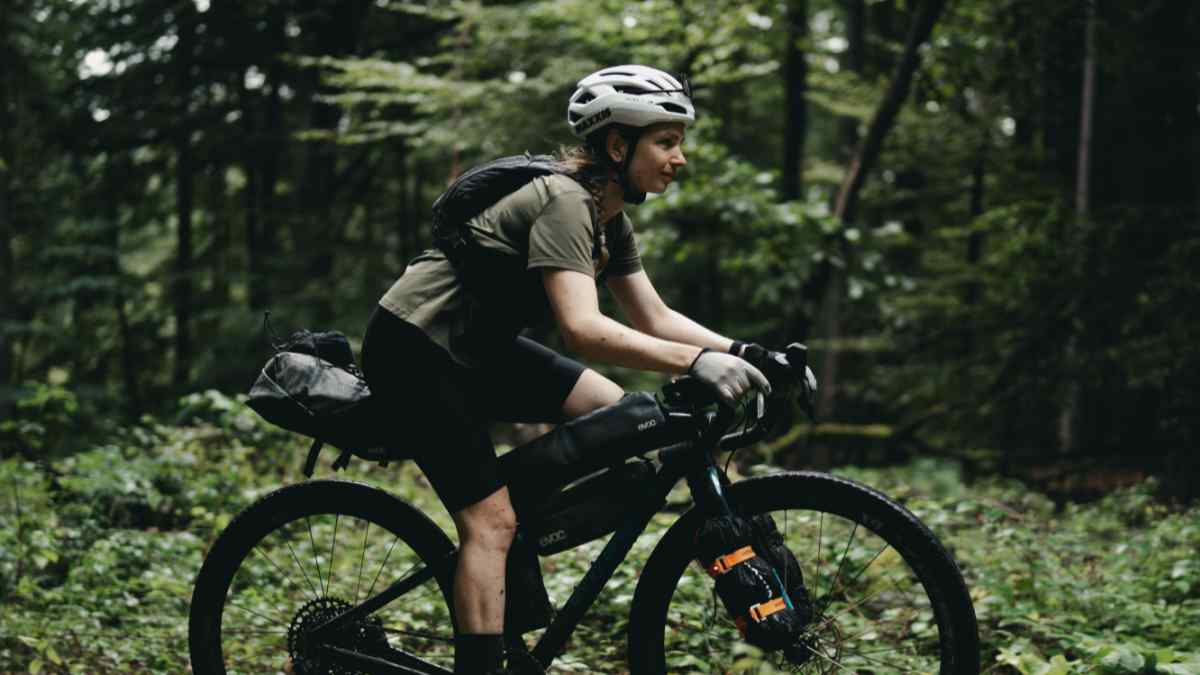
Bikepacking bags Do without a luggage rack. Frame, handlebar and saddle bags keep the weight down and the centre of gravity central. Storage space is limited. Additional bags on the fork legs, top tube or down tube can provide extra storage space. This set-up is ideal for light kit and high speeds on narrow trails, tarmac or gravel. Large saddle bags may swing about if not secured tightly.
Bikepacking racks combine the advantages of both systems. They are attached directly to the rear wheel axle and the seat tube or seat post, providing a stable platform for luggage. They are a clever alternative to the classic saddle bag, particularly for mountain bikes, offering better weight distribution, greater stability and, above all, unrestricted compatibility with telescopic seatposts.
The weight is positioned low and centrally over the rear wheel. Ground clearance is maintained. On technical trails, the secure mounting prevents the load from swinging about. Modern off-road luggage systems such as the sturdy Restrap Switch Rack can carry up to 30 kg. Thanks to its swivel joints, the Tailfin Journey pannier rack pictured below is even designed for full-suspension bikes and can carry up to 32 kg.

These luggage racks can be used with waterproof pack sacks or specialised bags. Compared with the saddle bags that swing about on the saddle, they reduce Bikepacking rack The load oscillates noticeably on rough terrain. The rigid connection to the frame prevents any disruptive movements from affecting handling. The low centre of gravity improves control on descents and in hairpin bends.
For really long rides, trailers are also worth considering. They take the strain off the bike frame and can accommodate particularly bulky kit. The turning radius increases. The braking distance is lengthened due to the additional weight. Trailers are impractical on trails with tight bends.
Centrifugal forces and speed dependence
Rotating wheels generate centrifugal forces. These stabilise the bicycle at higher speeds. The force increases with the speed of rotation, as we know: at 30 km/h, the centrifugal forces are significantly stronger than at 10 km/h. As speed increases, the steering becomes smoother and self-stabilising.
Whilst luggage does not directly affect gyroscopic forces, it does alter the balance between stabilising and destabilising moments. At low speeds, the wheelflop effect predominates. At high speeds, gyroscopic forces and trail predominate.
Conclusion: How luggage affects a bike’s handling
Luggage alters a bicycle’s handling; it makes it less responsive. It is not just the additional weight that matters, but also its position and distance from the steering axis. A load placed high up or far forward makes the steering feel sluggish, particularly at low speeds. By contrast, a low, central and symmetrical weight distribution improves stability and control.
Heavy items should be placed as close to the centre of the bike as possible. Before setting off on longer rides, you should check your load, the total weight, tyre pressure and how everything is secured. A test ride with your luggage will show whether the bike remains safe and controllable, and whether its handling remains predictable. If you carefully adapt your luggage system to your bike and the route, you’ll be able to ride safely and enjoyably from one stop to the next, even on challenging trails. But at a slightly slower pace.
Sebastian Brust
Editor