


In this article, we use so-called affiliate links. With every purchase through these links, we receive a commission from the merchant. All relevant referral links are marked with . Learn more.
Conclusion on the TRP Evo Pro
Top marks for usability, top marks for modulation and at the forefront in terms of power: with the Evo Pro TRP provides the blueprint for a perfect interplay of braking power and modulation - packed into a well thought-out overall package. Test victory! - Max Fuchs, BIKE test editor
Technical data: TRP Evo Pro
| Price (without disc and accessories) | 330 Euro >> available at a reduced price here |
| Weight per piece | 313 grams (incl. 800 mm cable + pads) |
| Slices / thickness | RS01E 180 / 2.20 mm |
| Brake pads | Organic |
| Braking medium | Mineral oil |
| Pressure point adjustment | Yes, tool-free |
| Lever width adjustment | Yes, tool-free |
| Special features | - |
"I want a brake like that!", says tester Dimi firmly and pushes the Canyon e-bike to the pit stop to fit the next brake system. He praises the TRP Evo Pro. It feels like the Tektro subsidiary's gravity flagship is still flying under the radar. Only a few manufacturers fit them ex works, and the key data also attract little attention. A pity really. Because the TRP has what it takes to become the new gold standard.
Textbook lever feel
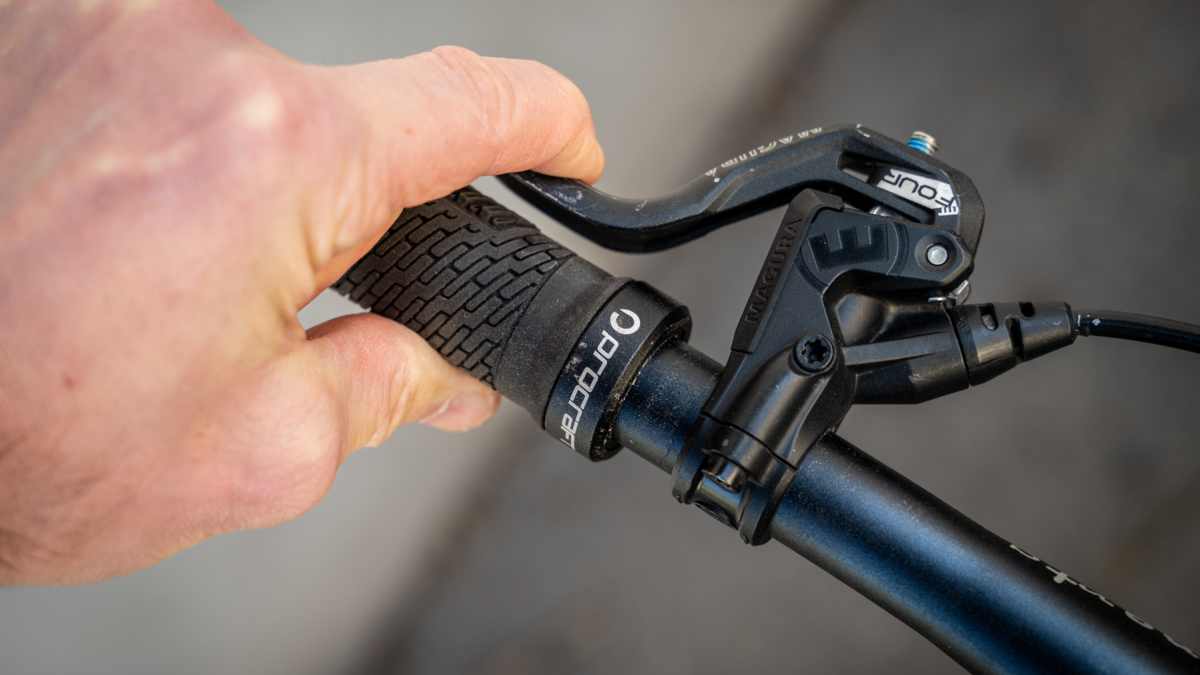
Sensitive, smooth, predictable - that's how the TRP lever feels. You can always feel where you are in the lever travel and when the braking force is applied. Getting used to it? Not a chance. No brake in the comparison responds as easily and intuitively as the Evo Pro. The pressure point remains constant, announces itself gently and provides firm support when braking hard. Not too spongy, not too crisp - simply perfect. This gives the Evo Pro top marks for modulation. The lever width adjustment plays into the hands of riders with small hands in particular. For long-fingered riders, the maximum lever reach should be slightly larger. Thanks to the PAD (Pad Activation Dial), the pressure point can be fine-tuned directly on the lever without any tools. The lever geometry also impressed our test crew: the pronounced hook with its non-slip surface sits firmly in the hand. Coupled with the high material thickness, the TRP fitting is rigid and indestructible even under maximum load.

Frugal in the lab test
In the braking force rating, the Evo Pro comes in just behind Sram in third place. In the lab, she mixes together with Hope, Chassis operator, Sram and Magura right at the front. Although it lacks the best values, it is on a par with its competitors in the practically relevant range at 80 newtons of force. If you pull even harder on the lever in theory, you can squeeze a whopping 963 newtons of braking force out of the TRP - the highest value in the entire test field!
The TRP Evo Pro is practically unbeatable on the trail
Back on the trail: In line with the lab data, the Evo Pro is also one of the most powerful brakes off-road, but doesn't deliver the overwhelming power of a Maven or Fahrwerker at the top end. And this is precisely its trump card. It feels like the TRP holds back its maximum power reserves somewhat in favour of traction. The power input at the lever harmonises perfectly with the brake line. TRP has selected the transmission ratio so that full braking is easy, even with tired hands. Like an extension of the index finger, the Evo Pro fades completely into the background when riding and always has the perfect dose of power at the ready. Dimi is right - you really want a brake like this!
The BIKE rating
| Category | Grade |
| Braking power (50%) | 1,35 |
| Wet braking laboratory (10%) | 2 |
| Dry braking laboratory (40%) | 1 |
| Braking power practice (50%) | 1,5 |
| Modulation (30%) | 1 |
| Usability / Handling (10%) | 1 |
| Weight (10%) | 3 |
| BIKE-NOTE (TEST WINNER) | 1,4 |
How BIKE tests disc brakes
Our impressions of the character, modulation and handling come from practical tests. We determined the maximum braking power and thermal stability in accordance with the DIN standard on the roller test bench of the brake manufacturer Magura.
Braking force test in the laboratory
To ensure that the brakes can deliver their maximum performance on the test bench, the test standard prescribes a defined braking procedure. All models must maintain a constant braking force of 200 newtons over 20 braking intervals in order to come up to temperature and rule out pad fading during the brake force test. Only then does the actual test of strength begin. It consists of three brake applications per force applied to the lever. It starts with 40 newtons of manual force. The test stand increases the force on the lever in 20 Newton increments until the brake reaches its maximum lever travel. Each brake undergoes this procedure twice: once in the dry and once in the wet.
During wet running, the disc is continuously wetted during the entire measurement. For optimum comparison, all models run with 180 mm discs. The pad compounds always correspond to the standard equipment. The manufacturers were allowed to select the discs themselves - if several options are available in their own range - in favour of braking performance. For uniform comparative values, we carry out the braking force test and the heat resistance test with a fresh pair of pads and a new brake disc. For the evaluation of braking performance in the laboratory, we only use the results at 80 N manual force. In this range, all models still deliver practice-relevant values below the 600 N threshold, especially during dry braking. Above this level, there is a risk of rollover under ideal grip conditions.
Heat resistance
As a second hurdle in the laboratory, all brakes have to pass a standardised heat resistance test twice. After all, the candidates should decelerate reliably even under high thermal loads. The programme includes three endurance braking sessions of five minutes each. Shortly after each interval, an abrupt control brake application follows, which shows whether the brakes still decelerate perfectly despite the heat. Finally, the test bench calls up the required minimum braking force three times. All brakes passed this test.
Practical test
No test bench can measure how a brake develops its power off-road, how it reacts to low manual forces, how finely it can be metered and how it feels in the hand. This is where experience counts. And our testers have plenty of it: over 100 complete bikes go through our test procedure every year. Our editors therefore know most of the brakes inside out. In addition, two testers rode all the brakes in this test in direct comparison on standardised bikes with identical setups.

Max Fuchs
Editor