


In this article, we use so-called affiliate links. With every purchase through these links, we receive a commission from the merchant. All relevant referral links are marked with . Learn more.
A spongy pressure point on the brake lever is more than just an annoying detail - it can become a serious danger. While modern hydraulic disc brakes are generally considered to be sophisticated and the early weak points such as hot-running brakes or leaking hydraulic lines have largely been eliminated, one problem persists: Air bubbles in the closed hydraulic system. When microscopic air pockets combine to form visible bubbles, precise deceleration turns into unpredictable braking behaviour.
The treacherous game of physics in the braking system
The way hydraulic brakes work is based on a simple physical principle: fluids are practically incompressible. When the rider actuates the brake lever, the pressure is transmitted through the brake fluid - be it DOT fluid or mineral oil directly onto the pistons in the brake calliper. These press the brake pads against the disc and generate the desired deceleration. Air, however, behaves completely differently: it can be compressed and acts like an invisible buffer in the system.
Even the smallest amounts of air are enough to disrupt this precise mechanism. Instead of the pressure being transferred directly to the brake pads, the trapped air is first compressed. The brake lever moves further towards the handlebars without the full braking force being built up. This situation becomes particularly critical in moments of danger, when every centimetre of braking distance is crucial.
Formation and entry routes of air bubbles
Air bubbles enter the brake system in various ways. The most common cause is shortening the brake line during installation or maintenance. As soon as the closed system is opened, there is a risk of air ingress. Leaky screw connections or improper handling during repairs can also lead to air collecting in the system.

Particularly treacherous: Air bubbles are not only caused by gross errors, but can also form gradually. Temperature fluctuations cause the brake fluid to work, microscopic leaks allow air to gradually penetrate. A critical way in which "air" (actually vapour) enters the system is brake fade. In extreme heat, the brake fluid can reach its boiling point. Even with careful maintenance, a spongy pressure point can develop over a period of months, resulting in a continuous deterioration in braking performance.
Professional venting as a solution
Bleeding disc brakes requires special tools and a systematic approach. Even if the process is basically the same for all manufacturers, there are differences in handling and tools. Shimano systems, for example, use the manufacturer's own bleeding kit, which contains all the necessary components.
This is how the bleeding process works with Shimano disc brakes
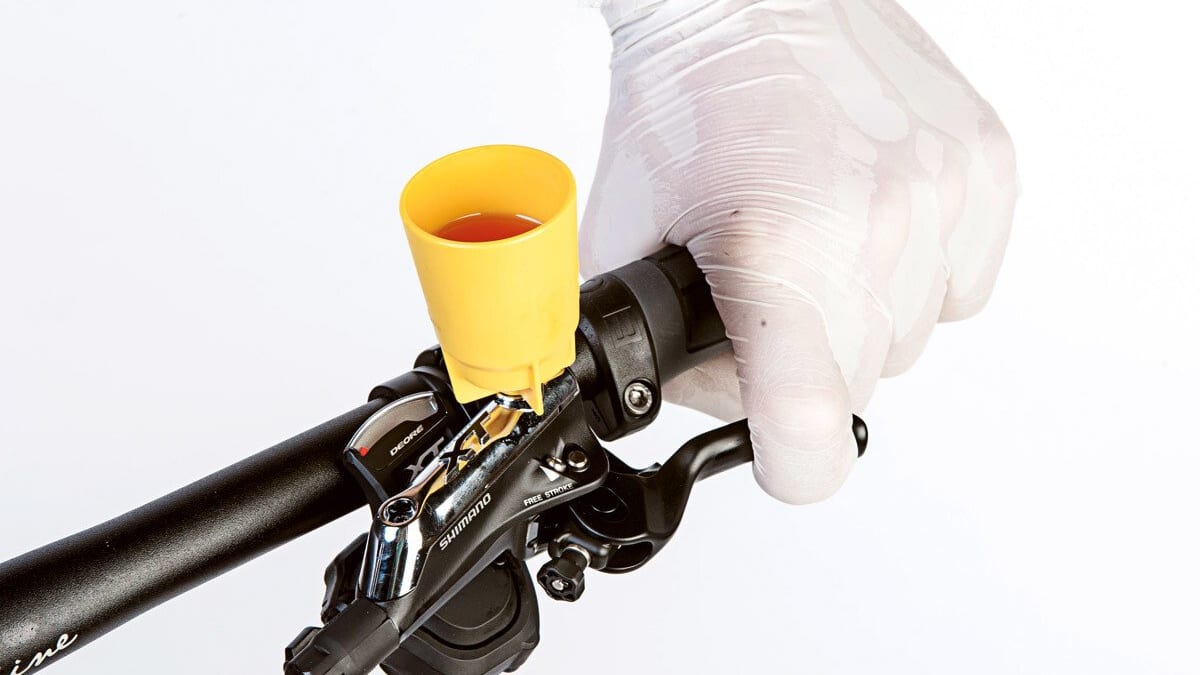
- The process begins with the removal of the wheel and the removal of the brake pads to avoid contamination with mineral oil. A yellow bleeding block replaces the pads during the bleeding process.
- The actual bleeding process is carried out by building up pressure from the bottom to the top. A syringe is used to press fresh Shimano mineral oil into the system through the bleed nipple on the brake calliper. The air bubbles rise upwards and collect in the oil reservoir on the brake lever. It is important to use original mineral oil, as different viscosities and additives can impair the function.
- Particularly stubborn air bubbles can be loosened by tapping the brake line and brake calliper. This mechanical vibration helps to mobilise stuck bubbles and feed them into the mineral oil flow. The process is repeated until no more air bubbles are visible in the escaping oil.
We will show you how to shorten and correctly bleed your disc brakes in a separate article.
Fine tuning for optimum performance
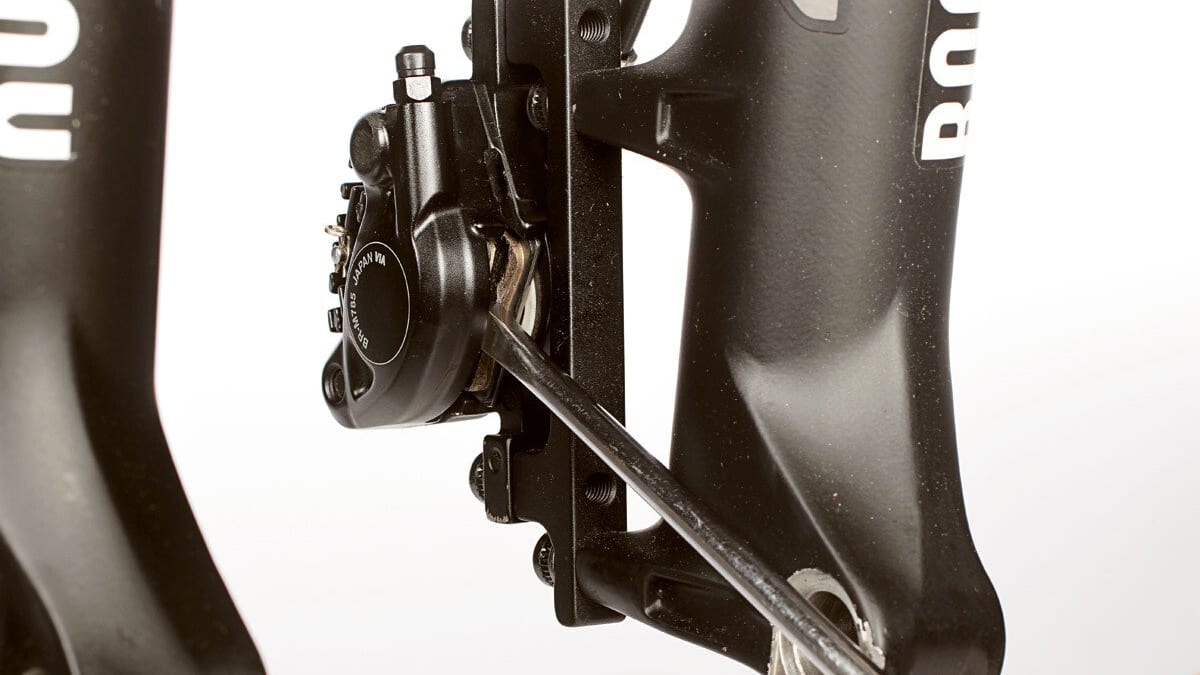
The correct alignment of the brake calliper plays an equally important role for optimum function. Although modern disc brakes are self-adjusting, they require precise basic alignment. To do this, the fixing screws of the brake calliper are loosened, the brake is applied several times and the screws are tightened again with the lever pulled. This procedure ensures that the calliper is positioned centrally over the brake disc. However, a stronger piston often pushes the disc slightly to the side, which can cause the calliper to be fixed at an angle.
An alternative is manual alignment using the light gap between the brake disc and brake pads. Although this is somewhat more time-consuming, it often leads to a more even and more precise alignment of the brake calliper.
Maintenance intervals and preventive measures
Regular checks of the pressure point are part of the basic work of responsible bikers. Even small changes in the feel of the lever can indicate air ingress. Professional workshops recommend complete bleeding every 12 to 18 months for DOT fluids. Mineral oil (Shimano/Magura) is not hygroscopic and hardly ages at all. An annual change is often not necessary as long as the pressure point is stable.
Avoiding grinding noises through correct installation not only contributes to driving comfort, but also protects the entire brake system. Warped brake discs or poorly aligned calipers lead to uneven wear. A regular visual inspection of the brake discs for flatness and checking the caliper alignment should become routine.
Conclusion
Air bubbles in the brake system are more than just a trifle - they can become a serious safety hazard. Professional bleeding with the right tools and original brake fluid restores full braking performance and ensures the precise pressure point that bikers depend on. Regular maintenance and careful monitoring of the brake feel are just as important as the professional bleeding process itself. Only a completely air-free system guarantees the reliability that modern disc brakes promise.


Stefan Frey
Editor
