


In this article, we use so-called affiliate links. With every purchase through these links, we receive a commission from the merchant. All relevant referral links are marked with . Learn more.
The war moves into the wardrobe
When the first Iraq war began, a pattern suddenly conquered the pedestrian zones: Camouflage.
In short: camo.
Camo caps, camo trousers, camo jackets. Pupils, teachers, bankers and pensioners walked around as if they were about to be called up for military service.
By chance? Hardly.
Fashion is a sensitive seismograph of society. It picks up on moods, fears, longings and heroic images. Perhaps camouflage was a sign of solidarity with the "good guys" back then. The world seemed simple: here the Western world, there Saddam Hussein, the dictator with his poison gas crimes, his killer guard and - as was believed at the time - weapons of mass destruction.
Today we know: The story was more complicated.
Formerly the good guys. Today the algorithm
The world has not become any easier. On the contrary.
We live between fake news, half-truths and constant alarms. Every conflict is fought simultaneously on the battlefield and on the internet. The good guys are not always good. The bad guys are not always just bad. Everyone has their truth. And we sit in front of it, scrolling, reading, doubting.
Is the next war coming to Europe? Will the Russians come again? Was your grandmother right after all when she hoarded jars of preserves in the cellar in case it starts again?
I have no idea.
And that is precisely why camouflage clothing suddenly looks different.
The paratrooper on the Stumpjumper
In front of me lies a new Troy-Lee design combination: Skyline Pro Camo. It fits perfectly with my Specialized Stumpjumper Evo. It looks damn good.
Unfortunately.
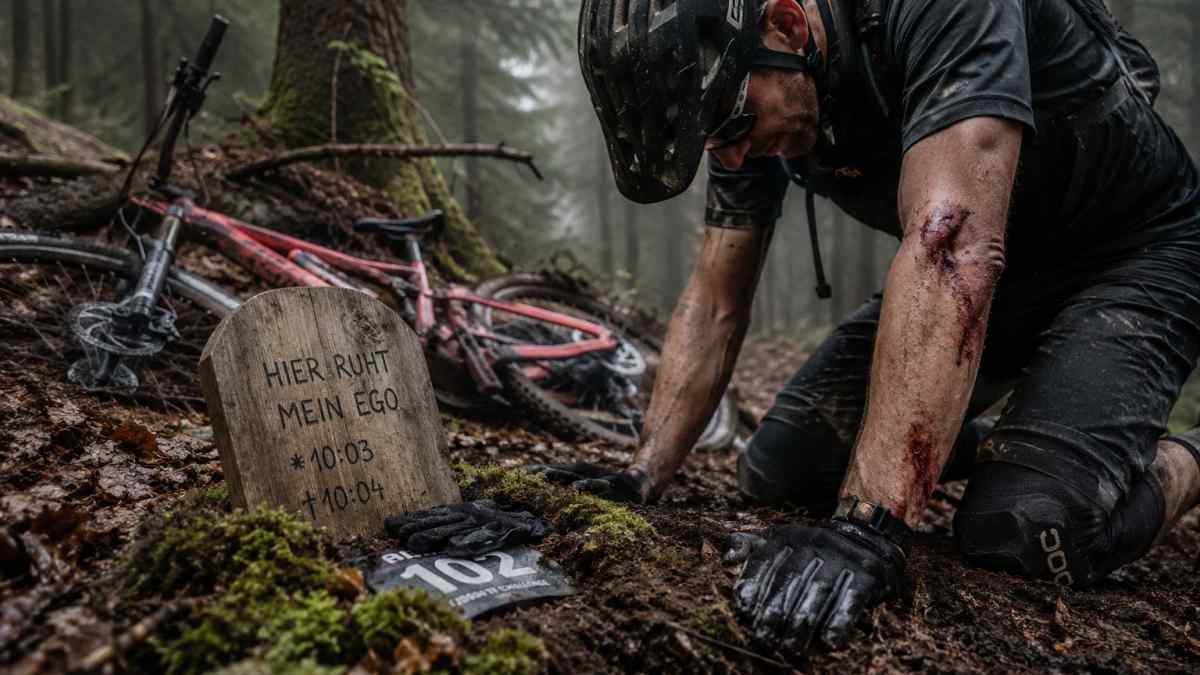
Because that's where the problem begins. The pattern screams adventure, forest, wilderness, action. It fits perfectly with mountain biking. After all, we ride through undergrowth, over roots and rocks. A bit like a commando squad - only with much better suspension and significantly more flow. But as I push up my knee protectors, I think about the real soldiers who are dying in Ukraine right now - on both sides.
Cow spots instead of war paint
So: Is it okay to wear camo? What do you think?
I say: Of course you can. Camouflage trousers don't make you a warrior. Just like a football shirt doesn't make someone a world champion.
But symbols change their meaning. A skull and crossbones means something different in peacetime than it does on the battlefield on the collar patch. And camouflage patterns have a different effect when the war is no longer just a message from a distant country.
Maybe that's why I should just call my Troy-Lee combo something else.
No camouflage spots.
Cow spots. And let's be honest: they look a bit like this.
And if someone asks me about it, I will say with a serious face:
"Of course. This is the new Alpenkuh edition."
Muuuuh.
And off to the trail.
The clothes
Shirt: Troy Lee Designs Skyline Pro LS Jersey Flow Camo Pumice
Price: 85 Euro in long sleeve, 75 Euro in short sleeve
Also available in a darker camo, called Carbon
Trousers: TLD Skyline Pro Pant Flow Camo in 4way Stretch. With laser holes for ventilation, three zip pockets and easy-to-use ratchet fastening. Price: 160 Euro >> available here
Who invented camouflage?
Irregular patches instead of clear contours: the camouflage pattern revolutionised warfare. It was developed from 1935 - by a Munich professor.
Johann Georg Otto Schick was the man's name. Professor, director of the SS "Camouflage" department. His mission: to develop a pattern that would make soldiers disappear in the forest. The principle: coloured spots on a basic tone. The outlines become visually blurred. The enemy sees - nothing.
By December 1936, the first prototype was ready: "Platanen". Engineer Wim Brandt designed the equipment at the same time. From mid-1938, the first Waffen SS units wore the new camouflage clothing. A world first. The pattern proved its worth in the mixed forest of Central Europe. And caught on: Today, armies around the world use spot camouflage - in countless variations, adapted to deserts, jungles and mountains. A German invention with dark origins. And a global career.
Incidentally, the word camouflage comes from the French and means "camouflage" or "concealment". Camouflage, or camo for short, is now the common word for spot camouflage and refers to the use of patterns and colours to deceive visual perception and blend in with the surroundings.

Dimitri Lehner
Editor
