


Lightweight bike racks put to the test: 4 towbar-mounted racks, from Atera to Yakima
Stefan Frey
· 11.07.2026


In this article, we use so-called affiliate links. With every purchase through these links, we receive a commission from the merchant. All relevant referral links are marked with . Learn more.
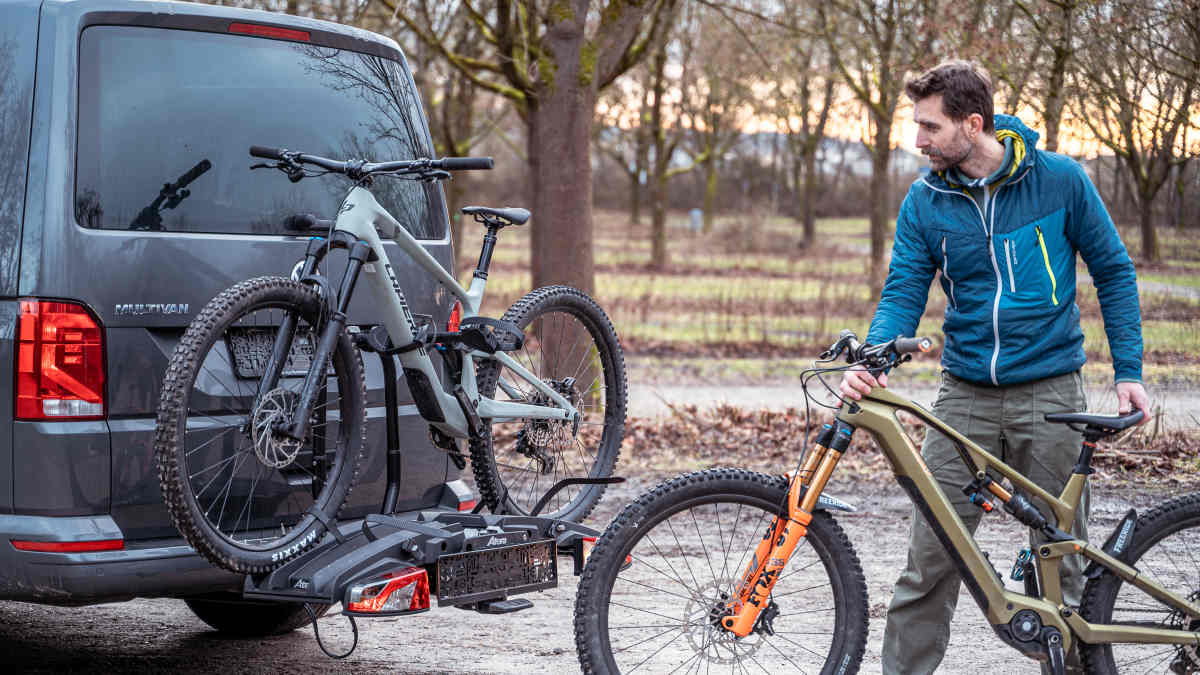
Cycling is booming just like inline skating did in the 90s. Back then, you could have been forgiven for thinking people had wheels instead of toes on their feet. It’s much the same with cycling today: everyone is gravelling, biking and pedalling their way through the countryside on all manner of two-wheelers – even on holiday. But the bike has to get there first, which is why another item is also enjoying a boom: the bike rack. If you take a look at the convoys of cars heading south in the summer, one thing stands out: the way bikes are transported has changed. Instead of being carried on the roof or attached to the boot, bikes are now transported on the tow bar.
Four lightweight bike racks put to the test
- Atera Strada Sport 2 >> e.g. available here
- Thule OutPace >> e.g. available here
- Uebler i21 Z60 >> e.g. available here
- Yakima FoldClick 2 Evo >> e.g. available here
Transporting bikes on the tow bar has many advantages: the most important one, in this age of e-bikes, is probably the low loading height. Instead of laboriously hoisting the bikes onto the roof – which, purely in terms of weight, is out of the question with most motorised bikes anyway – even the bulkier e-bikes can often be rolled onto the carrier quite easily via loading ramps – and, if necessary, even with the assistance of push mode. Positioning the bikes and securing them to the rack is also much easier at eye level than when working overhead.

Lightweight and compact rather than bulky and heavy
However, whilst they are easy to use, bike racks do have their drawbacks. Most models are heavy and bulky. Weights of 18 kilos and more are not uncommon. And in cramped cellars, these bulky racks take up much-needed space. Not to mention the free strength training that comes with this new ‘discipline’: lugging the bike rack from the cellar to the car.
The solution: lightweight bike racks that fold away compactly, making them much easier to transport and store. There aren’t that many models of this sort on the market yet, but we’ve tracked down four that meet our requirements.
Folding systems to save space
The German manufacturer Uebler is a pioneer in lightweight towbars. The i21 has been on the market for several years now; weighing in at 13.9 kilos, it is arguably the lightest of its kind and features a particularly practical mounting system for the tow bar. What’s more, it can be folded up like origami and disappears even into the smallest of cellar nooks.
Thule – usually known for its high-quality but rather bulky bike carriers – has also recently added a foldable carrier to its range, aimed at urban customers. The new Epos weighs 15 kilos; it can also be stowed away compactly and, above all, stands out thanks to its innovative bike mounts. Instead of a single bar at the rear of the carrier, each bike rail has its own gripping arm, which allows for a wide range of mounting positions and enables bikes to be unloaded independently. In addition, the Thule features a function that allows the carrier to be angled by 90 degrees in urban traffic – making it easier to park and manoeuvre.
Not all racks are suitable for e-MTBs
A classic in the lightweight category is the Strada Sport 2, which Atera has brought onto the market. It also weighs just under 15 kilos, but does not yet feature a sophisticated folding mechanism. In terms of features and handling, too, the Strada is no longer quite up to date. A narrow rail spacing and tight wheel wells make it difficult to transport bulkier e-bikes. Whilst the Atera works brilliantly for gravel and road bikes, e-bike riders would be better off opting for the models in the range specifically designed for this purpose.
Yakima is still relatively unknown on the German market, but has already impressed in previous tests with its solid performance. Weighing in at 16.3 kilos, the new FoldClick 2 Evo is certainly no featherweight, yet it impresses with its compact storage dimensions, innovative towbar mounting and a practical carrying handle. However, the Yakima reaches its limits due to its classic claw-type clamps. Square tubes or bulky frames are harder to secure with these than with the ratchet systems used by the other three manufacturers.
Minor shortcomings in the details
There are also subtle differences when it comes to wheel attachments: with Atera, Uebler and Yakima, all the ratchets face towards the centre of the carrier. To attach the second wheel, you have to contort yourself quite a bit. Thule does it better, positioning all the ratchets outwards for greater user-friendliness.
Whilst all the bike racks tested are fully suitable for transporting gravel or road bikes, there are some minor restrictions, at least when it comes to e-bikes: Thule limits the load capacity of the OutPace to 50 kilos. With full-power bikes, this limit is quickly reached, especially when accessories such as luggage racks or mudguards are added. With the Atera, the narrow rail spacing of just 18 centimetres is one of the sticking points; another is the wheel mounts, which are not ideally suited to wide tyres and long wheelbases in particular.
These are the key points in practice
- Lightweight: Weighing around 14 to 16 kilos, the bike racks can still be easily carried from the boot to the car
- Fold and carry: the more compactly the trolley can be folded, the easier it is to manoeuvre round corners in narrow cellar corridors. What’s more, foldable models take up less space in the cellar and in the boot. An integrated handle is the icing on the cake for easy transport.
- Bicycle rack: Clamping arms with ratchet straps secure even heavy-duty frames reliably and are also gentler on the material than traditional clamps, which often reach their limits, particularly when dealing with the solid tubes of e-MTBs.
- Rail spacing: The distance between the rails is particularly important for e-bikes with wide rear triangles and chunky suspension forks. If the bikes are positioned too close together, the frame may be damaged.
- Clamping mechanism: Systems that sit vertically on top of the coupling and can then be clamped in place are particularly practical. A wing nut, such as the one on the Thule OutPace, is less practical
Atera Strada Sport 2 at a glance
- Price: 589 euros >> available here
- Variants: Available for 2 or 3 bikes; can be extended by one rail
- Assembly: Traditional clamping mechanism using a wide lever
- Folding function: Convenient activation of the tilt function via a foot pedal, dual locking mechanism
- Weight: 14.9 kg
- Payload: max. 60 g / 30 kg per rail
- Dimensional tolerance: 100 x 20 x 59 cm
- Rail length / width / spacing: 99 / 7 / 18 cm
- Max. wheelbase / tyre width: 134 cm / 2.4 inches
- Max. pipe diameter: 25–80 mm
- Rack / Lockable bikes: yes / yes
- Accessories: Extension to accommodate a third bicycle; ramp; wheel holders for tyres up to 4 inches

Conclusion & Review: Atera Strada Sport 2
| Grade | |
| Assembly (30%) | 2.3 |
| Handling (40%) | 3.3 |
| Features / Workmanship (10%) | 1.9 |
| Weight / Transport (20 per cent) | 2.7 |
| BIKE-NOTE | 2.7 |
The Strada Sport 2 is a solid classic that appeals particularly to beginners and road cyclists. Its build quality, stability and simple basic design are impressive, and its expandability is also a plus. In detail, however, the design feels a bit dated: awkward loading, fiddly straps and, above all, the narrow rail spacing set clear limitations. The Strada Sport 2 is only of limited suitability for modern mountain bikes or e-bikes – in these cases, it’s better to opt for more up-to-date or specifically designed models such as the Atera Strada E-Bike.
Advantages and disadvantages of the Atera Strada Sport 2
Advantages
- lightweight
- Secure, gentle tyre levers and wheel rims for gravel and road bikes
- good value for money
Disadvantages
- less compact when folded
- narrow track width makes it less suitable for e-MTBs
- cumbersome handling of gripper arms and clamping straps
The Thule OutPace at a glance
- Price: 629.95 euros >> available here
- Variants: Available for 2 or 3 bicycles
- Space-saving: Fully foldable design for easy storage
- Universal genius: Movable gripping arms for frame diameters from 20 to 90 mm
- Parking mode: Innovative tilt function reduces the size of the carrier when parking
- Safety: Integrated rear lights and adjustable strap systems to prevent cable tangles
- Lightweight: Optimised for vertical, one-person fitting to the coupling
- Weight: 15 kg
- Dimensional tolerance: 76 x 24 x 72 cm
- Rail length / width / spacing: 121 / 6.5 / 22.5 cm
- Max. wheelbase: 144 cm
- Max. pipe diameter: 90 mm
- Rack / Bikes can be locked: yes / yes
- Accessories: Frame protectors; wheel strap fasteners; bicycle frame adaptors

Conclusion & Review – Thule OutPace
| Grade | |
| Assembly (30%) | 2.2 |
| Handling (40%) | 1.9 |
| Features / Workmanship (10%) | 2.2 |
| Weight / Transport (20%) | 1.7 |
| BIKE-NOTE | 2.0 |
Lightweight, compact when stowed and featuring a handy carrying handle – when it comes to manoeuvrability, the Thule scores highly. The separately positioned loading arms are in a class of their own: they make loading and unloading much easier and fit even around complex frame shapes. Thanks to its folding mechanism, the OutPace is much less of a hindrance when manoeuvring in town and can even remain attached to the vehicle whilst parked.
The fact that the bike rack is fitted using a wing nut is clearly down to its low price – by Thule’s standards – but it does make the whole process a bit more fiddly. We would have liked at least some indication of when the carrier is securely fastened to the towbar. The folding mechanism, which doesn’t require a foot pedal, is also a bit awkward, as you have to reach between the bikes and, if you’re not careful, end up getting chain grease on your sleeves. The maximum load capacity of 50 kilos and 25 kilos per bike is slightly below the usual figures – something to bear in mind, particularly with heavy e-bikes.
Advantages and disadvantages of the Thule OutPace
Advantages
- Flexible gripper arms with excellent handling capabilities
- High-quality workmanship
- Folding function for parking and city driving
- Compact when folded and a handy carrying handle
Disadvantages
- Low maximum payload
- Installation on the coupling is a bit fiddly
The Uebler i21 Z60 at a glance
- Price: 909 euros or 1,139 euros >> available here
- Variants: Available for 2 or 3 bikes
- Assembly: Easy clamping thanks to the patented clamping mechanism
- Traffic jam wonder: Can be stored to save a great deal of space thanks to its foldable rails
- Folding function: Convenient activation of the tilt function via a foot pedal
- Lightweight: Vertical mounting on the coupling with a handle on the bracket
- Weight: 13.5 kg
- Payload: max. 60 g / 30 kg per rail
- Dimensional tolerance: 61 x 20.5 x 69 cm
- Rail length / width / spacing: 119 / 7.5 / 24 cm
- Max. wheelbase / tyre width: 130 cm / 3 inches
- Max. pipe diameter: 115 mm
- Rack / Bikes can be locked: yes / yes

Conclusion & Review: Uebler i21 Z60
| Grade | |
| Assembly (30 per cent) | 1.3 |
| Handling (40 per cent) | 2.1 |
| Features / Workmanship (10%) | 2.2 |
| Weight / Transport (20 per cent) | 1.2 |
| BIKE-NOTE | 1.7 |
With the i21 Z60 Uebler delivers a genuine high-end package for discerning cyclists: ultra-light, extremely sturdy and with a well-thought-out design down to the last detail. The clever click mechanism and flexible clamping arms set new standards in terms of ease of use and frame protection. Minor shortcomings with the ratchet straps do little to detract from the overall first-class impression. Anyone looking for one of the lightest yet safest bike racks on the market will find exactly what they’re after here – though they’ll have to dig deep into their pockets to get it.
Advantages and disadvantages of the Uebler i21 Z60
Advantages
- Extremely compact when folded and lightweight
- Effortless assembly with an intuitive folding system
- Grippers that can be positioned flexibly, also suitable for large-diameter pipes
- Wide track width (e-MTBs), multiple positions on the handlebar
Disadvantages
- Very high price
- The cable routing isn’t quite as neat as it could be
- Operating the ratchets and grippers can be a bit fiddly at times
The Yakima FoldClick Evo 2 at a glance
- Price: 700 euros >> available here
- Variants: Available for 2 or 3 bikes
- Assembly: Easy clamping thanks to the patented clamping mechanism
- Traffic jam wonder: Can be stored away to save space thanks to foldable rails and light strips
- Folding function: Convenient activation of the tilt function via a foot pedal
- Lightweight: Vertical mounting on the coupling with a handy carrying handle
- Weight: 16.3 kg
- Payload: max. 60 g / 30 kg per rail
- Dimensional tolerance: 67 x 74 x 28 cm
- Rail length / width / spacing: 128 / 6.8 / 22 cm
- Max. wheelbase / tyre width: 128.5 cm / 4 inches
- Max. pipe diameter: 22–80 mm
- Rack / Lockable bikes: yes / yes
- Accessories: longer brake pads; guide rail; rim protectors

Conclusion & Review: Yakima FoldClick Evo 2
| Grade | |
| Assembly (30%) | 1.4 |
| Handling (40%) | 2.2 |
| Features / Workmanship (10%) | 2.4 |
| Weight / Transport (20%) | 2.0 |
| BIKE-NOTE | 1.9 |
With the FoldClick Evo 2 is supplied by Yakima A well-designed, conveniently compact bike rack for everyday use. Its simple assembly, space-saving folded dimensions and reliable performance whilst cycling are particularly impressive. In practice, it scores highly for its intuitive handling and good suitability for e-bikes. There are some drawbacks in terms of the quality of the materials, the finish of the details and the somewhat limited adjustability of the clamping arms. All in all, it’s a solid all-rounder for anyone who values compactness and straightforward handling – with a few minor shortcomings in the details.
Advantages and disadvantages of the Yakima FoldClick Evo 2
Advantages
- Compact storage dimensions and a handy carrying handle
- Ingenious clamping system for the coupling
- Plenty of space for wide frames
- Gripper arms that are very easy to position
Disadvantages
- Low-quality plastics
- Claw grippers are not ideal for bulky, angular pipes

Stefan Frey
Editor