


With the EVO Rail Ultra, the developers at Sixpack have completely reimagined the saddle design. At its heart is a one-piece construction made from fibre-reinforced polyamide, in which the saddle shell and rail system are fused together. This so-called ‘one-piece’ design is intended to save weight whilst distributing forces more evenly throughout the material.
Compared to conventional saddles, where the rails and shell are constructed separately, this results in a distinctly different flex profile: precisely tuned without compromising stability. At the same time, the dimensions remain compatible with standard seatposts – the integrated rail system (7 × 10 mm) fits into standard seatpost clamps.
E-TPU instead of traditional foam
Sixpack also takes a unique approach to padding. Instead of PU foam, it uses expanded TPU (E-TPU). The material is designed to distribute pressure peaks more effectively whilst being less sensitive to temperature. The surface is deliberately textured. The aim is to provide additional grip in the saddle – particularly on technical sections or when changing riding positions. The design is complemented by a central relief channel, which is intended to improve pressure distribution for different riding positions.

A new approach to assembly
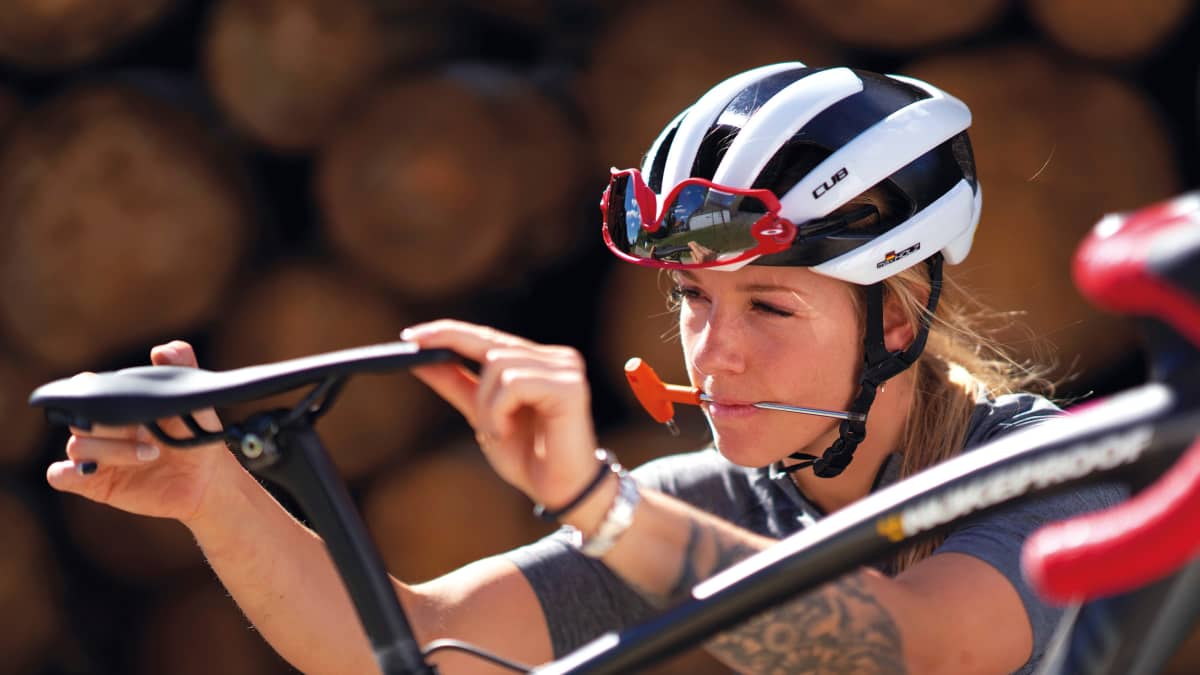
The mounting system is particularly striking: the EVO Rail Ultra is slid into the seatpost from the rear. There’s no need to completely dismantle the clamp. Adjust the position, secure it, and you’re done.
In everyday use, this is likely to be particularly useful for those who frequently change their setup – for example, when testing different positions or using several bikes.
Mounting points for accessories
Sixpack has integrated an M5 mounting point beneath the shell. This allows accessories such as saddle bag holders to be attached directly to the saddle. It is a minimalist solution designed to replace traditional Velcro or rail systems.
Wide range of uses, from gravel to downhill
The range of applications is particularly noteworthy. Sixpack positions the EVO Rail Ultra not only in the trail and enduro segments, but also for gravity and gravel riding.
Whilst weight and suspension are the main priorities on long rides, the compact shape and grippy surface are designed to provide control, particularly during gravity riding. The saddle has been deliberately kept short so as not to get in the way, even on steep descents.
Sixpack EVO Rail Ultra – Information & Price
- Scope of application: Trail, Enduro, Downhill, All-Mountain, E-MTB, Gravel
- Design: One-piece shell with integrated rail system
- Saddle clamp: 7 × 10 mm (compatible with standard top clamps)
- Upholstery: E-TPU
- Widths: 140 mm / 160 mm
- Length: 246 mm
- Weight: approx. 148 g (140 mm) / 150 g (160 mm)
- Special features: integrated M5 mounting point
- Price: 129.95 euros
Editor’s conclusion
The Sixpack EVO Rail Ultra breaks the mould. Rather than focusing on fine-tuning details, Sixpack has adopted a fundamentally new design principle. The integrated rail system and the streamlined design are particularly striking features. The simplified assembly could be a key advantage over conventional saddle frames.
What’s exciting is the combination of very low weight and comparatively generous padding – a trade-off that many saddles have so far failed to resolve. Whether the design lives up to its promise in practice will become clear in the trail test.
Our colleague Sandra Schuberth has raised some concerns, but this only applies to bikepacking trips using traditional panniers or ‘arse rockets’. Anyone planning to do exactly that won’t get on well with this saddle and will have to opt for one with traditional seat stays instead.


Stefan Frey
Editor