


Assessment Ochain MY27 - Max Fuchs, BIKE Editor
We have already had the opportunity to extensively test the most expensive of the four new Ochain spiders. Our verdict: the system is not a new concept - but it is a mature one. It works as usual: it calms the drivetrain in rough terrain, reduces shocks and vibrations to the feet and ensures a safer, smoother ride.
Traction, especially under braking, also improves with increasing degrees of freedom. And the background noise is also dampened. But the previous model also impressed us in this respect.
The fact that there are now two variants for Bosch e-bikes is my highlight of the new generation. Whether the revised seals and improved impact resistance really improve durability remains to be seen.
What does everyone mean by pedal kickback?
On most full-suspension bikes, the distance between the bottom bracket and the rear wheel axle increases during compression. As the chainring and cassette are connected via the chain, there is an interaction that pulls the crank backwards during compression - the so-called pedal kickback.

But why is pedal kickback problematic and why do so many systems want to eliminate it? If the cranks are constantly hitting your feet downhill, you lose your secure footing on the pedals, resulting in a harsh, rough ride. In addition, the rear end hardens - not exactly conducive to downhill riding.
Not pedal kickback, pedal feedback!
To coincide with the launch of the new Ochain family, the label has done a lot of research and has come up with new findings on pedal kickback. The classic pedal kickback - as just described - should hardly occur on the trail because the forward rotation of the bike compensates for it.
In practice, however, the problem remains the same. The manufacturer therefore no longer refers to the cause of vibrations or impacts against the sole of the foot as pedal kickback, but as pedal feedback. Two sources of interference are primarily responsible for this.
1. cassette backwards slap
If the chain hits rough trails, the cassette rotates forwards briefly and then moves back again. This movement causes the chain to pull the cranks backwards - noticeable as vibrations or jerking on the sole of your foot.
2. rear wheel lockup
When braking, the weight shifts forwards. As a result, the rider presses harder against the pedals. If the rear wheel lifts off and locks, the cassette also comes to a sudden stop for a moment - the impulse is transferred to the crank via the chain. The result: a slight knock against the sole of the foot.
The Ochain spider is designed to eliminate both disruptive factors to a certain extent and create a smoother and quieter driving experience.
Ochain MY27: What's new?
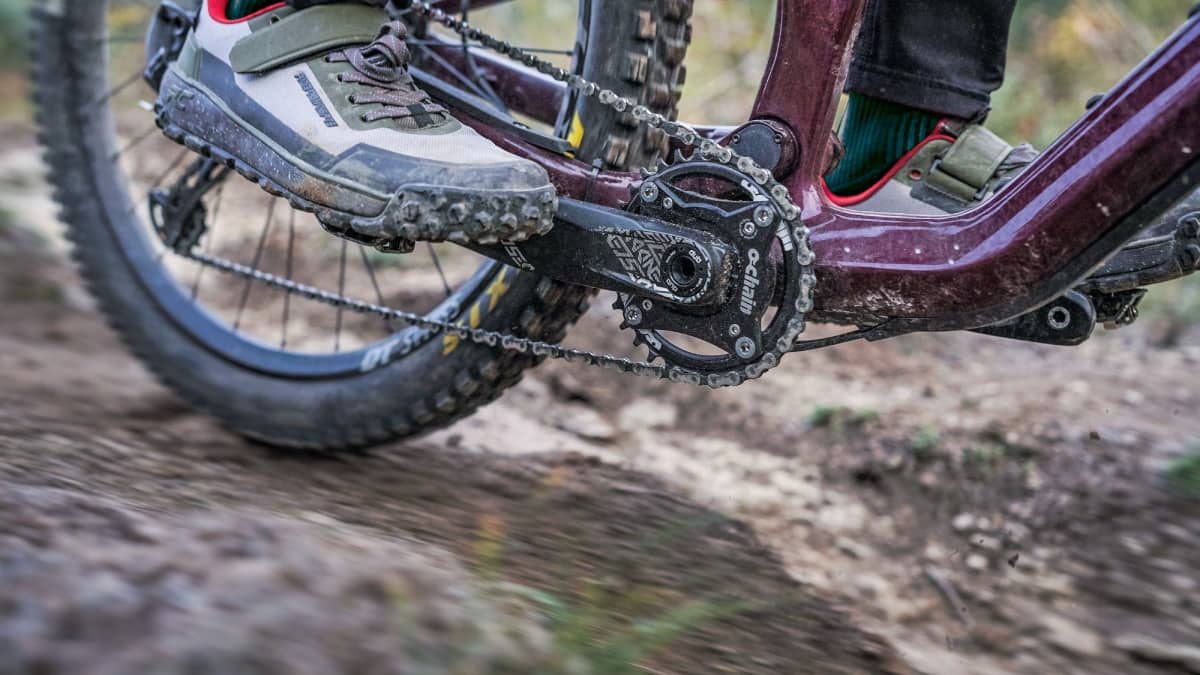
The basic principle remains the same: the Ochain-Spider is screwed between the crank and chainring. Thanks to springs and elastomers inside, the chainring can rotate independently of the crank. With the high-end R and S spiders, the chainring can rotate by 3, 6, 9 or 12 degrees depending on the setup.
The degrees of freedom are intended to minimise or even eliminate pedal feedback. The degrees of freedom - i.e. how much the chainring turns back - can be set in four stages directly on the spider. Depending on the model variant, this can even be done manually.
| ► Better sealing: New silicone sealing lips (double) and revised sealing materials keep dirt and water out. Longer maintenance-free. ► More impact resistance: Newly designed housing - certified to ISO and SRAM fatigue standards. In other words: DH-compatible without being too heavy for trail bikers. ► Four models instead of two: Ochain R and N for MTB, Ochain S and E for E-MTBs with Bosch CX Gen 5, plus an upgrade kit that turns N into R and E into S. |
Ochain R and N
The Ochain-R-Spider is the flagship version. There is a knurled screw on the outside - five positions, five different degrees of freedom: closed, 3°, 6°, 9° and 12° travel. Simply turn and you're done. On the trail, without tools. Price: 380 euros and therefore even slightly cheaper than the previous R-Spider.
The Ochain N costs just 310 euros and uses interchangeable chips inside to adjust the degrees of freedom. This model variant comes from the factory with 9° travel. Optionally retrofittable to 6° or 12°. Tools are required.
Ochain S and E for e-mountainbikes
The E is new in the line-up: Ochain for E-MTBs. Mounting on the motor - specifically on the Bosch BDU38, better known as Performance CX Gen 5. Other drives? Not yet compatible.
Ochain S = external rotary wheel for setting the degrees of freedom, Ochain E = degrees of freedom can only be set with travel chips and with the aid of tools. Same logic as the MTB counterpart. Due to their geometry and additional weight, E-MTBs tend to produce more chain turbulence - this is exactly where the Spider damper comes in.
Ochain prices the e-bike version in the same way as the normal Ochain Spiders: 380 euros for the S model, 310 euros for the simpler E version.
Service: every 100 and 200 hours
All MY27 models share the same maintenance intervals: elastomer replacement every 100 operating hours, full overhaul every 200 hours. According to the manufacturer, this is feasible for home mechanics. The new seals should noticeably extend the intervals compared to the previous models.

Max Fuchs
Editor