


Canyon Stingr Smart Helmet: Cycling helmet with heads-up display and AI warning system
Florentin Vesenbeckh
· 18.06.2026


With the Stingr Smart, Canyon presents a cycling helmet that blurs the lines between traditional protective gear and digital assistance technology. This concept offers a glimpse into the future of cycling from the perspective of the Koblenz-based mail-order company. At the heart of the prototype is a heads-up display (HUD) integrated into a flip-up visor, which projects real-time information on the traffic situation.
Connecting to the Canyon Predict System
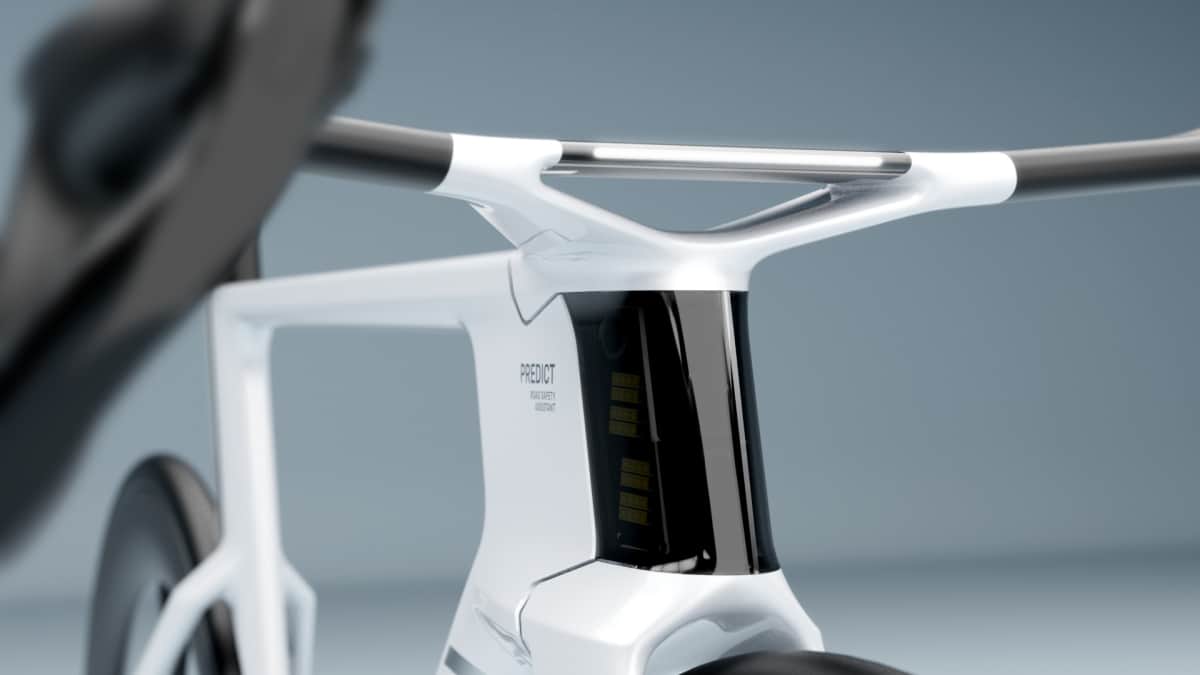
The Smart Helmet was developed to complement the Canyon Predict System, an AI-powered safety technology integrated directly into the bike. Through this interface, the helmet receives data on road hazards, the behaviour of other road users and the position of fellow riders in a group. What makes it special is that the system also warns of hazards that are still outside the rider’s field of vision – such as braking manoeuvres by vehicles ahead or approaching road users.
Canyon employs a multi-stage warning system: information is primarily displayed in the rider’s peripheral field of vision to minimise distraction. In the event of imminent danger, the warning is intensified by central display indicators, haptic signals and audible alerts via an integrated near-ear audio system.
Hands-free operation via voice control
The Stingr Smart can be controlled entirely hands-free via voice commands. This is said to be a key safety advantage over conventional cycle computers or smartphone mounts. The flip-up visor extends and retracts automatically on voice command, whilst an integrated wiper cleans the outside. Alternatively, touch controls are available on the helmet shell.
As well as its safety features, the helmet can also display standard performance data such as speed, power, cadence and heart rate. The helmet measures the heart rate itself; additional sensor data can be integrated via Bluetooth or ANT+. Even without the Canyon Predict System, the helmet can be paired with smartphones to display navigation data, messages or calls.
Based on: The tried-and-tested Canyon Stingr CFR road cycling helmet
The technological basis for the smart helmet is the Canyon Stingr CFR road bike helmet, which is already available. Canyon promises that the prototype will offer the same features in terms of protection, aerodynamics and comfort as the production model. The company has not yet provided details on how the safety standards will be implemented in a helmet with integrated electronics.
Presentation at Eurobike 2026
Canyon will be presenting the Stingr smart helmet alongside the Canyon Predict bike at Eurobike in Frankfurt from 24 to 27 June 2026 (Hall 11.0, Stand B50). The manufacturer has not yet provided any details regarding the price, market launch or production readiness of the prototype. However, the concept demonstrates the direction in which connected safety technology in cycling could develop.
The question remains as to whether such complex systems will prove their worth in everyday life – and whether cyclists are prepared to pay a significantly higher price than for conventional helmets in exchange for the added safety.



Florentin Vesenbeckh
Editor CvD
