


120 mm full-suspension bikes weighing under 10 kg: What lightweight construction really brings to cross-country bikes
Jan Timmermann
· 17.10.2026

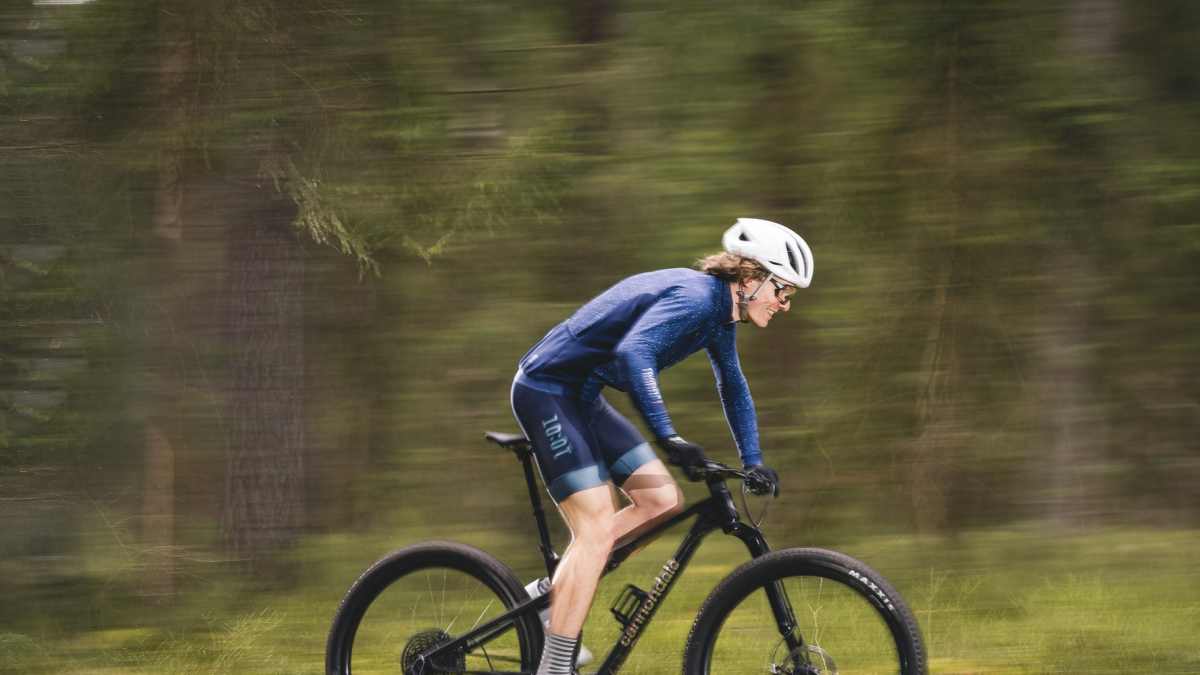
In size XL, the Specialized S-Works Epic 9 weighs just 9.9 kilos. We investigate whether this really gives it a competitive edge. | Photo: Max Fuchs
Cross-country is probably the MTB discipline in which weight has the greatest direct impact on performance. Really light hardtails come in under the eight-kilo mark, whilst many modern XC full-suspension bikes remain well under ten kilos despite having 120 millimetres of suspension travel. Does it make a difference? We put the facts to the test.
Lightweight construction is key. This guiding principle applied to cross-country bikes for decades. Nowadays, however, race bikes have become significantly more capable, featuring larger wheels, wider tyres, dropper posts and more suspension travel. For a while, keeping full-suspension bike weights below ten kilos was only possible with DIY solutions and extreme modifications.
Slowly but surely, the trend towards lightweight construction is making a comeback on production bikes. The current Specialized Epic 9 S-Works, for example, weighs in at just 8.3 kilos – despite all its modern features. The new Scott Spark RC, the Giant Anthem Advanced SL and the Orbea Oiz also effortlessly tip the scales at under ten kilos. Manufacturers have described recent model years as ‘over-engineered’ and aim to return to lightweight cross-country racing bikes with the new generation of models. But is a lightweight bike really a competitive advantage? We reveal whether weight optimisation on cross-country bikes really makes a difference.

Conclusion
I reckon cross-country full-suspension bikes weighing under ten kilos are absolutely brilliant! It’s great to see lightweight construction enjoying a bit of a revival. But races aren’t won by the scales alone. The rider with the lightest bike doesn’t automatically end up at the top of the podium – we’ve known that for ages. Tyres and wheels also offer amateur racers the greatest potential for improving performance. - Jan Timmermann, BIKE editor
Why weight is important when cycling uphill
When cycling uphill, the cyclist must take into account the entire system comprising the cyclist, the bicycle and the equipment move upwards against gravity. The energy required for this can be calculated using the following formula:
- Energy = total mass × acceleration due to gravity × change in height
So the heavier the system, the more energy is required to gain the same height. Assuming constant power, a further formula can be derived from this as an approximation:
- Power = total mass × acceleration due to gravity × velocity × sine of the angle of inclination
The greater the mass, the lower the speed at the same power output. This is one of the reasons why the power-to-weight ratio (measured in watts per kilo) is so important when climbing. The lighter the rider, the more significant the bike’s weight becomes in relation to the total mass. For a rider weighing just 60 kilos, a bike weighing ten kilos already accounts for 14.3 per cent of the total weight. Light riders – often women or young athletes – therefore benefit relatively more from reducing the bike’s weight.
Studies in sports science show that this is not merely a matter of physical theory. Studies involving cyclists show an almost proportional relationship between oxygen uptake and the combined mass of the rider and the bicycle when riding uphill. Furthermore, scientific research identifies maximum aerobic power in relation to total mass as an important predictor of uphill performance.
For a rider weighing 75 kilos, a one-kilo difference in weight on a cross-country bike accounts for just under 1.2 per cent of the total mass. Under idealised conditions, a one-kilo reduction in the bike’s weight therefore gives the rider an improvement of approximately 1.2 per cent in climbing speed. That may not sound like much, and indeed the effect on a single short climb is minimal. It’s the scale that matters. Cross-country courses often feature six or more significant climbs per lap. With a total of ten minutes of climbing, a 1.2 per cent speed advantage already translates to a lead of around seven seconds. At professional level, that could make a huge difference.
Firing up the turbo: The secret to acceleration
During the race, the bike is constantly accelerating and decelerating. According to this formula, the mass of a bicycle affects not only its potential energy but also its kinetic energy:
- Kinetic energy = 0.5 × mass × speed squared
A lightweight bike is therefore particularly useful for high-intensity, varied cross-country routes. If a rider needs to accelerate sharply out of a bend, a lighter bike will reach speed more quickly. The weight of a bike can also be a decisive factor on routes with many short but steep climbs, or a few long ones. On flatter, faster or highly technical courses, this factor becomes less important. Perhaps the most important insight is this: not every gram is physically worth the same. Different components serve different purposes.
With wheels and tyres, there is an additional rotational effect. In other words: when accelerating, not only must the entire body be accelerated in a translational sense, but the wheels must also rotate. The energy required for this depends on their moment of inertia. That is why, in all our tests, we measure the wheel inertia ourselves in the BIKE test laboratory and include the data in the final assessment. A cross-country bike with lightweight tyres, lightweight wheels, a lightweight cassette and lightweight brake discs often feels significantly more responsive than a bike with the same total weight but heavier wheels.
The crucial question: choosing tyres
But it gets even more complicated: even a heavier tyre can be more energy-efficient. Namely, if it rolls significantly faster. Rolling resistance does not depend solely on weight, but primarily on the tyre carcass, tread pattern, air pressure and road surface. If a 75-kilo rider reduces the weight of their bike from ten to 9.5 kilos, this represents just under 0.6 per cent of the total mass. If, on the other hand, they stick with their 10-kilo bike but save several watts in rolling resistance through their choice of tyres, the effect can be greater on flatter stretches and in fast sections.
Countless measurements have shown that, given an otherwise identical set-up and tyre pressure, wide tyres on a mountain bike roll more efficiently than narrow ones, although they do weigh more. Due to the different shape of the contact patch, the braking lever arm in the direction of travel is shorter on wide tyres. Rolling resistance is a particularly important factor on hard, dry surfaces. For cross-country racers, however, this always presents a dilemma: is it better to save 100 grams or gain five watts?
A good tyre must not only roll quickly, but also transfer the forces generated by braking and acceleration to the ground. With a high-traction tyre, racers can brake later, accelerate sooner, navigate corners more safely and lose less grip on technical surfaces. Lightweight tyres, in particular, do not excel in terms of traction on all surfaces. The ideal tyre setup lies somewhere between low rolling resistance, sufficient grip or traction, puncture protection and low weight.
Lightweight construction isn’t everything
Cross-country races consist of repeated climbs, short bursts of acceleration, technical sections and descents. The perfect bike for this type of riding must therefore not only be lightweight, but also accelerate efficiently, climb well, provide good traction and offer sufficient control on technical descents. Especially on descents, speed off-road does not depend solely on weight. It is no coincidence that even the very best riders now consistently opt for dropper posts and suspension travel of around 120 millimetres.
High-end hardtails are generally lighter than any full-suspension bike. Nevertheless, even an 11-kilo full-suspension bike can be faster on an XC course than a 9-kilo hardtail. A good full-suspension bike can offer more traction and control, and delay rider fatigue by better absorbing vibrations and impacts. If this means the rider gains a few seconds on every descent compared to a hardtail, the extra two kilos are more than made up for on the climb. That is why almost all Cross-Country World Cup riders now rely on full-suspension bikes.
In reality, therefore, a bike that is one kilo lighter is not automatically 1.2 per cent faster. Other factors also come into play, such as rolling resistance and aerodynamic drag, drivetrain losses, traction, riding technique and physical factors. So we can see that a bike’s weight is just one part of the overall package. Reducing a bike’s weight from 12 to 11 kilos can be relatively inexpensive and efficient. However, bringing a bike down from nine to eight kilos may require compromises that could prove disadvantageous in competition.

Jan Timmermann
Editor