


Since its premiere in 2019, the Ranger has stood for efficient pedalling and playful handling with moderate suspension travel. The second generation was correspondingly popular - and this is exactly where Revel comes in. Instead of fine-tuning the concept, the US brand has redeveloped it and shifted the focus more towards down-country: in other words, bikes that perform like an XC fully on the climbs but are significantly more potent on the descents.
Revel Ranger: From trail bike to down-country tool
With 120 millimetres of travel at the rear (plus 130 mm at the front), the travel on the Ranger has only increased slightly in nominal terms - but according to the manufacturer, the real progress has been made in the design, kinematics and geometry.
What has changed?
In short: everything. According to Revel, every tube shape, every bearing and every detail has been rethought. Despite more suspension travel, the frame is around 200 grams lighter than its predecessor, but is also said to be stiffer.
Visually, the bike has been significantly tidied up: Some of the routing has been moved to the frame triangle, the tube cross-sections are larger and the lines more modern. There are also numerous functional improvements to the details - such as protected cable guides or additional mounting points in the frame.

New geometry: longer, flatter, more efficient
With the Ranger V3, Revel has consistently modernised the geometry:
- The Steeper seat angle brings the rider more centrally over the bottom bracket, which should offer a noticeable advantage on steep climbs.
- A longer reach provides more freedom of movement and better weight distribution in the cockpit.
- The flatter steering angle increases smoothness and safety on fast or technical descents.
- The Lower bottom bracket conveys an integrated riding experience - the biker is supposed to stand much better on the bike, for safe and agile handling at the same time.

Interesting: The Chainstays grow with the frame size. In this way, Revel wants to ensure that handling feels consistent across all sizes - an approach that is becoming increasingly established.
New rear triangle: CBF in the short-travel set-up
The centrepiece of the Ranger remains the familiar CBF system (Canfield Balance Formula). For the new generation, however, the kinematics have been specifically adapted to the shorter suspension travel. Revel describes the setup itself as having a three-stage ride feel:
- Sensitive at the beginning of the spring travel
- Stable and supportive in the mid-range
- Progressive with plenty of reserve at the end
In practice, this means that small impacts are effectively absorbed, while the bike remains firm and efficient when pedalling. The increased anti-squat is intended to provide propulsion without sacrificing traction. When braking, the rear end remains active and low in its travel - an advantage for control in rough sections.
Why the new Ranger is particularly quiet
An often underestimated topic: noise development. Revel pays a lot of attention to this point with the Ranger V3 and has taken several measures to counteract the driving noise:
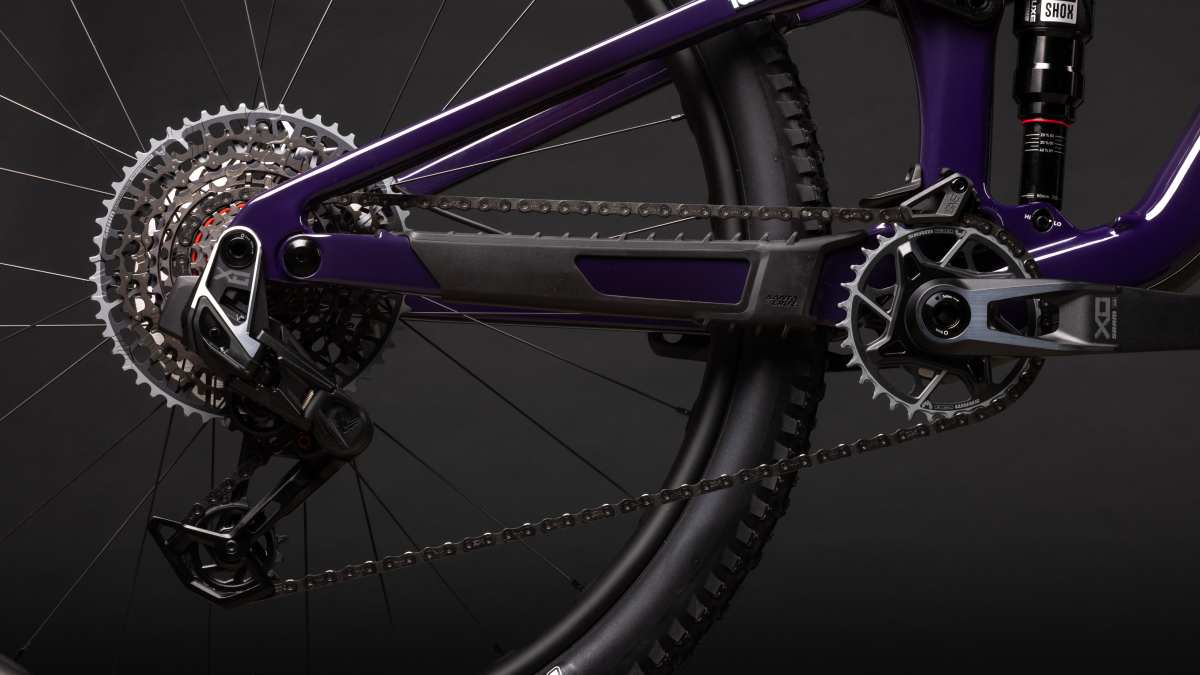
- Soft rubberised chainstays effectively dampen chain slaps
- A Robust down tube protection Buffers stone chips
- A Integrated fender Keeps dirt out of critical areas
- Co-moulded cable guides in the frame Prevent rattling
- High-quality bearings at all pivot points reduce play and noise
All of these points are designed to make the Ranger a bike that fades into the background acoustically - and thus completely focusses on riding.
Revel Ranger - Info & Prices
- Spring travel120 mm rear / 130 mm front
- Framearound 200 g lighter than its predecessor
- Rear endNewly tuned CBF suspension for short-travel performance
- GeometryModern geometry (longer, flatter, steeper seat angle)
- Chain stays: Size-dependent chainstay lengths
- Special features: tyre clearance up to 29 x 2.6 inches; large dropper compatibility; two bottle cages in the main frame + additional mount under the down tube; fully integrated, protected cable routing; co-moulded cable guides to prevent rattling; additional utility mount on the top tube
- Colour options: Red Zeppelin, Steezy
Prices:
- Frame kit: 3,699 Euro
- SRAM Eagle 90: 5,599 Euro
- SRAM XO Eagle Transmission: 6,599 Euro
- SRAM XX Eagle Transmission: 10,199 Euro
Conclusion of the editorial team
With the Ranger V3, Revel deliberately takes one big step instead of many small ones. More travel alone does not make a new bike - the decisive factor is the interplay of geometry, kinematics and attention to detail. This is exactly where the new Ranger delivers. The down-country orientation is clearly recognisable: efficient uphill, surprisingly potent downhill. What is particularly striking is how much attention has been paid to seemingly minor issues such as noise reduction and frame integration. All in all, the Ranger V3 looks like a consistently well-developed overall package for riders looking for a light, versatile trail bike - with a clear tendency towards a sporty pace.



Stefan Frey
Editor