


Red Bull Cerro Abajo Genoa and Stuttgart 2026: “If you take it easy, you’ll be out in a flash”
Dimitri Lehner
· 13.06.2026


Genoa, Stuttgart, Valparaíso: For Johannes Fischbach, urban downhill races aren’t just weekend fun, but high-speed events with very real consequences. In an interview with BIKE, the silver medallist from Genoa explains why stairs don’t make him nervous, why he doesn’t study videos of the courses – and why the most dangerous part of a race often takes place in the mind.
Pressure? Always.
BIKE: Genoa and Stuttgart are the big highlights of the season. Where is the pressure greater?
Johannes Fischbach: They’re both equally important. I want to perform well in both races. Of course, I’m delighted that Stuttgart is taking place in front of a German crowd. But I’m not putting any extra pressure on myself because of that.
BIKE: You’ve been doing this for years. Do you ever get more relaxed?
Fischbach: Not at all. If you want to be up there with the leaders at events like this, you’re always pushing yourself to the limit. A crash or a small mistake can have much more serious consequences there than in a normal race. If you take it too easy, thinking ‘it’ll be fine’, things often go wrong. That approach doesn’t work at Red Bull Cerro Abajo.
Why Valparaíso is different
BIKE: The race in Valparaíso, Chile is considered the most dangerous urban downhill race in the world. Is that true?

Fischbach: It certainly is for me. The track is extremely narrow, full of obstacles, steps, walls and corners. If you crash there, you often know as soon as you go down: this isn’t going to end well. Genoa is faster, but wider. The landing areas are more predictable.
BIKE: And Stuttgart?
Fischbach: I know next to nothing about Stuttgart. I’ve got no idea what the course layout looks like. What you see beforehand is basically a waste of time – that’s something I’ve learnt over the last 15 years. You just end up driving yourself crazy for no reason. It’s only once you’ve done the track walk that it counts. I know what I need to perform well in a city downhill race. And that’s how I prepare.
“It’s only when I’m there that what I see counts. The track walk is what matters.”
Is climbing stairs good exercise? Only to a certain extent.
BIKE: Your mate Tomáš Slavík is heading to Prague for stair training. Do you do that sort of thing too?
Fischbach: No. I sometimes work on projects – specific sets of stairs or jumps that I want to try out. But I don’t regularly travel to cities just to practise on stairs.
BIKE: Why not?
Fischbach: Because many urban downhill courses aren’t actually made up mainly of steps. In Genoa, for example, you mainly have to ride like a very good downhill rider: lose as little speed as possible, accelerate smoothly, and hold your line precisely. The step jumps are only a small part of the course.
Silver was good. But not perfect.
BIKE: You came second in Genoa. What else can you improve on?
Fischbach: Quite a lot. I’m just getting back into a really good training rhythm. My knee and back held me back for a long time, and then I injured my collarbone in the winter as well. Now I can train harder again and I can feel myself getting stronger.
BIKE: And how does it handle?
Fischbach: I lost time at the bottom in Genoa because I eased off the throttle. I knew I was on a good run and wanted to see it through to the finish. If you want to win, you have to push right to the finish line – and hope everything goes smoothly.
Who will win in Stuttgart?
BIKE: Tell us your favourites.
Fischbach: Tomáš Slavík is always in the mix, especially on twisty tracks. For me, Juanfer Vélez is the man to beat when things get really fast and crazy. Roger Vieira is performing strongly in the World Cup, finishing second in Chile and making the podium at the Red Bull Hardline in Tasmania. The Brazilian is on a roll at the moment. And Adrien Loron shouldn’t be underestimated either.
BIKE: Why Loron?
Fischbach: Because he prepares in a very specific way. In winter, he trains almost exclusively on stairs and urban skills. He starts doing things that hardly anyone else has done before – such as manual landings on staircases. That’s a complete skill set for this sport.
Prize money? It won’t make anyone rich
BIKE: Which bike will you be riding in the race?
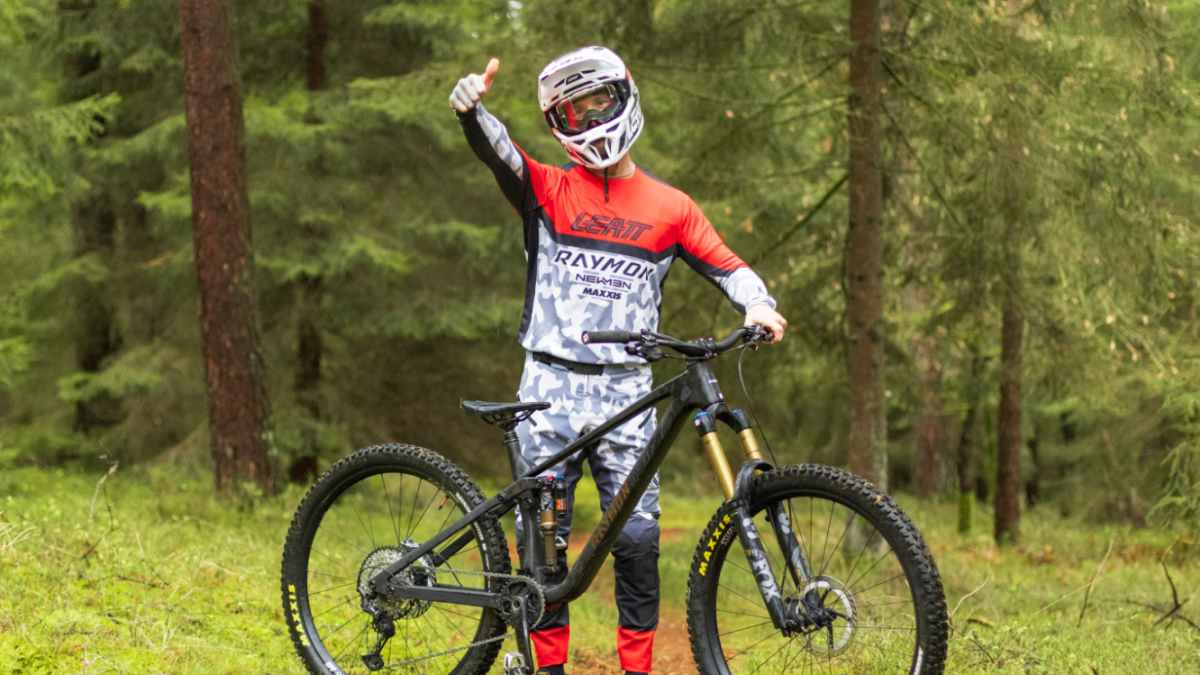
Fischbach: On my Raymon Rokua. A slightly modified carbon enduro bike with 170 millimetres of suspension travel. It’s actually a full-size 29er, but because of my short legs, I’ve fitted a smaller rear wheel.
BIKE: And the suspension will be pumped up rock-hard again?
Fischbach: It depends on the track. I usually go for slightly stiffer set-ups than many others. But it depends on the circuit.
BIKE: Can you get rich from urban downhill?
Fischbach: (laughs) It depends where you live. In some village in Asia, perhaps.
BIKE: What are the prize money figures?
Fischbach: The winner gets around 6,000 to 6,500 euros. After that, the prize money drops off quite sharply. That’s fine for mountain biking. But nobody’s going to get rich from it.
BIKE: Not even in South America?
Fischbach: No. The prize money there is also roughly in that range. Races with five-figure prize money have become extremely rare in gravity sports. I can’t think of any off the top of my head.
“If you want to be up there with the leaders, you’re always pushing yourself to the limit.”
Johannes Fischbach will continue to ride his modified Raymon Enduro, which features 170 millimetres of suspension travel and a small rear wheel. And perhaps, he reveals with a grin, there’ll be a new tyre trick in store for Stuttgart. He doesn’t want to give anything else away before the race.

Dimitri Lehner
Editor