


Amflow PR Carbon put to the test: Is this affordable e-MTB really unbeatable?
Florentin Vesenbeckh
· 29.08.2026


Verdict on the Amflow PR Carbon test
Although there are a few details that could be criticised, the Amflow PR Carbon offers an almost unbeatable package for 4,500 euros and therefore deserves our ‘Best Value for Money’ recommendation. A top-class motor, low weight and a fun ride – it ticks all the right boxes. The bike really shines on tours and moderate trail rides, but it also holds its own for a long time on tougher terrain. All in all, a strong all-rounder. – Florentin Vesenbeckh, test editor
Data and facts about the Amflow PR Carbon
| Price | 4.499,00 € |
| Suspension travel | 160 mm |
| Wheel size | 29"/ 27,5" |
| Weight | 23.47 kg |
| Motor | Avinox M2 |
| Battery | Avinox 800Wh |
| Fork | Fox Float AWL HD Sport |
| Rear shock | Fox Float Rhytm |
| Drivetrain | SRAM S1000 Eagle Transmission |
| Front brake | Tektro TKD 173 |
The term ‘Chinaware’ often carries negative connotations in this country. It is usually associated with low-cost products or even cheap copies of dubious quality. The Avinox motors have impressively demonstrated that this stereotype does not apply to the new cycling products from tech giant DJI. Rather than simply offering existing technology at a lower price, DJI’s subsidiary Avinox has noticeably raised the bar in terms of performance and usability – whilst keeping prices surprisingly low. This link provides an overview of affordable Avinox bikes.
The bikes from Amflow, DJI’s second spin-off, are also serious pieces of sports equipment and not merely stylish showpieces. However, the first generation of these ready-to-ride bikes did not quite match the appeal of the Avinox motors.
The new PR Carbon It is explicitly aimed at the mass market of e-mountain bikers and seeks to win over customers with a fair price rather than technical features. What’s more, it’s the first Amflow with a removable battery. This offers greater flexibility and appeals to a wider customer base. However, this means that neither a record-breaking weight nor a super-slim design can be achieved.

Good value – yet still lightweight
In return, the PR Carbon is breaking into new price brackets. For €4,499, you get a full-carbon frame, a Fox suspension system and an electronic wireless groupset from SRAM. When you compare the spec with that of similarly priced e-full-suspension bikes from recent years, that alone is absolutely remarkable!
At 23.5 kilos, the PR doesn’t quite match the record-breaking figures for the lightest Avinox bikes. However, compared to other e-full-suspension bikes with a removable 800-mAh battery, that’s an excellent figure. Even some e-MTBs in the 10,000-euro price range are heavier. What’s more, Amflow achieves this without cutting corners: solid Maxxis tyres with a DD carcass at the rear, a robust wireless gear-shift system, thick brake discs – they haven’t skimped in the wrong places here. But does the bike also deliver in practice?
A look at the features
Of course, even the Amflow isn’t entirely free of compromises. The most striking detail is the Tektro brakes, which unfortunately also stand out for the wrong reasons in practice. Whilst the bite point is well-defined and pleasant, the braking performance is only moderate. This means you have to pull the lever unnecessarily hard to bring the bike to a halt. Incidentally, the Avinox fast charger is only included as standard on the more expensive model. The PR Carbon comes with the slower 4A charger.
When it comes to the engine, too, the budget-friendly PR model is only available with the less powerful version. However, the The Avinox M2 already has more than enough power and leaves the competition far behind. You only notice the difference compared to the M2S when driving side by side on steep inclines. That’s when the top-of-the-range engine pulls noticeably ahead.
Cost-cutting measures have also been applied to the suspension. Whilst the promising Fox logo adorns the stanchions, the bike actually features the basic AWL fork, which is more commonly found on SUV bikes. Nevertheless, the suspension as a whole is of a higher quality than budget Suntour suspension components or a basic RockShox Psylo Silver, which are commonly found in this price range. But all the brand hype is of little use if the performance on long rides and off-road isn’t up to scratch.
Field test: The Amflow PR on an uphill stretch
Amflow has deliberately designed the geometry of the PR Carbon to be slightly more conservative than that of the sportier PX Carbon. This is immediately apparent, as the riding position is very classic and, with a flat seat angle, rather stretched out. Advantage: The weight is distributed evenly across the sit bones and wrists – ideal for long rides on moderate terrain.
However, as soon as the climb gets steeper, this becomes a disadvantage. You tend to pedal from the back and lose pressure on the front wheel. This is particularly true when you make use of the Avinox motor’s massive turbo boost. On technical climbs, the bike is therefore not so easy to keep under control, and it’s difficult to fully exploit the potential of the extremely powerful motor. The long chainstay adjustment helps somewhat here, but the flat seat angle remains a drawback in such scenarios.
On the trail
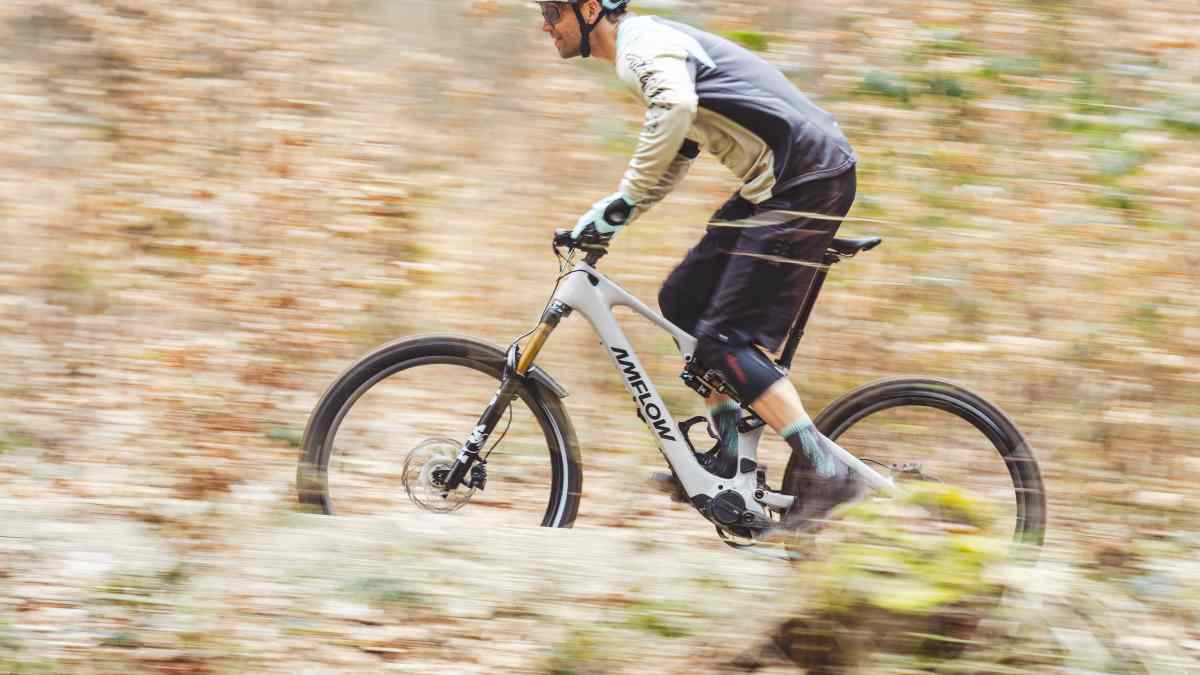
The PR Carbon’s handlebars have plenty of rise, and the bike also comes with a generous number of spacers beneath the stem. This means the cockpit sits high up, and you feel comfortably integrated behind the front wheel. You immediately feel at ease on trail descents. The suspension is comfortable and instils a sense of confidence. Thanks to its low weight and moderate geometry, the handling remains delightfully playful. Manuals, jumps and quick changes of direction come easily. This is a rarity, particularly in the affordable entry-level e-MTB segment.
The PR Carbon holds its own even on tricky trails and rougher descents. The top-class tyre combination lays the foundation, but the suspension and geometry also inspire confidence. On sections punctuated by roots or rocky ground, the suspension fork is the first to dampen the thrill of speed: it struggles to cope with rapid successive impacts, and it compresses too deeply on hard hits. The brakes are also a weak point. But in this price range, that’s just nit-picking.
It’s a shame about the distracting background noise. As well as the rattling of cables and cables, a distinct clattering noise was noticeable during hard impacts, which we were unable to get under control throughout the test. This is likely more of an issue with our test bike than a design flaw.
Strengths and weaknesses
Strengths
- easy
- fun to drive
- Powerful motor with a long range, replaceable battery
Weaknesses
- not exactly a whizz at uphill cycling
- sluggish brakes
- Play in the seat post
- Rattling noises

Florentin Vesenbeckh
Editor CvD