


Bosch Performance Line CX Gen5: The most important error codes and their causes
Josh Welz
· 07.08.2026

The Bosch Performance Line CX is the most commonly fitted drive system in sporty e-mountain bikes. Despite being in its fifth generation, faults can still occur. We explain what the error codes mean and what to do if the drive system malfunctions.
Our conclusion: Many problems can be solved quickly
The fifth-generation Bosch Performance Line CX is a technically mature drive system, but faults and defects can still occur. Simple causes such as a speed sensor that has slipped out of place, a jammed switch, a loose cable or a contact problem can often be identified quickly. Often, simply restarting the system is enough to resolve the issue. If the message persists or reappears, for some error codes you can rectify the causes yourself by following the instructions. If not: a professional specialist workshop has the right tools for a thorough diagnosis and can provide reliable information about the actual causes.
The Bosch Performance Line CX is one of the defining drive systems for modern e-mountain bikes. It is fitted to numerous sporty e-mountain bikes and is aimed at riders who need plenty of assistance on steep climbs, long rides and technical trails. It delivers a powerful and direct ride, whilst the motor assistance responds sensitively to pedal pressure and adapts to the current riding situation.
Development of the Performance Line CX began at Bosch back in 2015. Since then, the drive system has been revised several times. The fifth generation is lighter and quieter than its predecessors and can be customised even further via the eBike Flow app. On top of that, it recently received a power update – the CX now delivers 120 Nm of torque and a maximum power output of 750 watts.

Despite being a fifth-generation model, the CX can still experience electronic faults or motor defects. If the e-mountain bike displays an error code, the cause is not necessarily the motor itself. The battery, the display, the control unit, the speed sensor or a connector may also be responsible for the error message.
Important: Switch off the system before carrying out any work on the e-mountain bike. Never disconnect plug connections whilst the system is live. Do not open the motor or the battery yourself.
This is what you should check first if you get an error code
Before you try to identify the error code more precisely, here are a few basic steps to help:
- Switch off the e-mountain bike completely.
- Wait a few seconds and restart the system.
- Do not apply any load to the cranks when switching on.
- Check that the battery, display and control unit are correctly fitted.
- Check the connectors for moisture, dirt or loose cables.
- Check the speed sensor and the spoke magnet.
- Check the eBike Flow app for a software update.
- If the fault code reappears, make a note of it and do not simply delete it permanently.
Restarting the device may resolve a temporary software or connection fault. If the message reappears, there is usually a specific cause behind it. Some faults can only be reliably diagnosed using the specialist retailer’s diagnostic system. Others, however, can be resolved by the user themselves.
Error codes on the Bosch Performance Line CX Gen5
The following overview covers typical error codes for the Bosch Smart System, as used in the Performance Line CX Gen5.
| Error code | Probable cause | Things you can try yourself |
| 410, 418 | Button on the display or control unit is stuck | Check the buttons for dirt, damage or jamming |
| 414, 422, 423, 424 | Communication problem between system components | Check the connectors and cables, then restart the system |
| 431 | Software version error | Restart the system and check for an update |
| 440, 450 | Software or internal drive error | Contact a dealer |
| 460 | Fault with the USB port | Remove the USB cable and any connected devices |
| 500 | Internal fault in the drive unit | Restart the system; if the problem persists, contact your dealer |
| 502 | Faults with the lighting | Check the lighting cables and connections |
| 503 | Fault with the speed sensor | Check the sensor, magnet and cable |
| 504 | An implausible or tampered-with speed signal | Check the spoke magnet and sensor position |
| 530 | Battery fault | Remove and reinsert the battery; check the contacts |
| 540 | Temperature error | Allowing the battery and e-mountain bike to cool down or warm up |
| 550 | Unauthorised consumer detected | Remove external devices and USB connections |
| 580 | Software version errors | Update the software or visit a retailer |
| 591 | Battery authentication error | Reinsert the battery and restart the system |
| 602, 603 | Internal battery fault | Restart the system; if the problem persists, contact your dealer |
Errors 410 and 418: A key is not responding correctly
Regarding error codes 410 and 418 the Bosch Smart System detects a stuck button. This may affect buttons on the display or on the control unit.
Possible causes
- Dirt or dust under a key
- moisture ingress
- a damaged keypad
- a key held down continuously
- a faulty switch
Solution
Switch off the e-mountain bike and check that all the buttons move freely. Carefully remove any visible dirt with a dry cloth. Do not use a high-pressure washer and do not spray any cleaning product directly onto the control unit.
If the fault persists, the control unit should be checked at a specialist workshop and replaced if necessary.
Errors 414, 422, 423 and 424: Communication errors
These error codes usually indicate a problem with communication between the battery, motor, display or control unit.
Possible causes
- loose plug connection
- damaged cable
- Moisture on a contact point
- Corrosion
- a display that has not been fitted correctly
- a software problem
Solution
Switch off the system and check the cables and connectors that are accessible from the outside. Look out for kinked cables, damaged insulation and visible moisture.
Not every connection should be disconnected by the rider themselves. If the connections are located in the frame or directly on the motor, you should contact your specialist dealer. This is particularly important if the fault occurs following a fall or after thorough cleaning.
Errors 431 and 580: Software or version errors
Error codes 431 and 580 indicate that the software version is incorrect or faulty. This can occur following a failed update, after a component has been replaced, or when there are different software versions within the system.
Solution
First, restart the e-mountain bike. Then check the eBike Flow app to see if a software update is available. During an update, your smartphone, e-mountain bike and battery must be sufficiently charged.
If an update has not been completed successfully or if the fault reoccurs afterwards, the system should be checked at a specialist workshop using a diagnostic tool. It is not possible to reset the software yourself.
Errors 440, 450 and 500: Internal error in the drive unit
Error codes 440, 450 and 500 These are the types of faults where you shouldn’t carry out any work on the engine yourself.
Possible causes
- internal electronic fault
- Problem with the engine control unit
- Fault in the power supply
- damaged sensor
- mechanical or electrical fault in the drive
Solution
Switch off the e-mountain bike and restart it. If the message does not disappear or reappears after a short while, the drive unit must be diagnosed by a specialist workshop.
Opening up the engine yourself is not a sensible repair measure. As well as the risk of causing further damage, this may also invalidate any warranty or guarantee claims.
Errors 460 and 550: USB port or additional power-consuming device
The error 460 indicates a problem with the USB port. Error 550 This may also occur if the system detects an unauthorised load.
Common triggers
- Smartphone or other device connected to the USB port
- damaged USB cable
- Moisture in the connection
- unsuitable accessories
- an electrical fault with a connected appliance
Solution
Remove all external devices and cables from the e-mountain bike. Switch the system off and then on again. Check the USB port for moisture and allow it to dry completely.
If the fault reoccurs when no device is connected, the connection or the display should be checked by a specialist workshop.
Error 502: The lighting is not working
The error code 502 points out a fault with the bicycle lights. This affects e-mountain bikes fitted with front or rear lights.
Possible causes
- loose plug connection
- damaged fibre-optic cable
- broken bulb
- Moisture in the connection
- retrofitted, incompatible lighting
Solution
Check whether a cable has come loose or is visibly damaged. If the cable is routed inside the frame, the repair should be carried out by a specialist retailer.
Important: The lighting must not simply be replaced with just any lamp. Bosch systems require compatible components.
Error 503: The speed sensor is providing incorrect readings
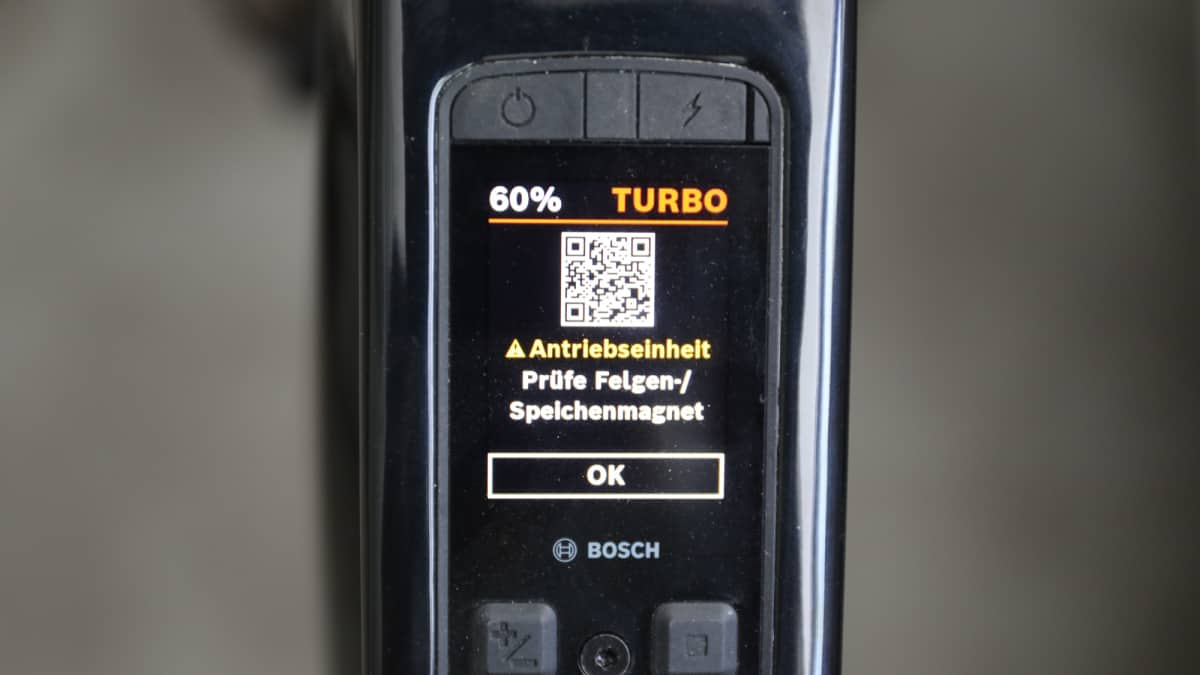
At Error 503 the system detects a problem with the speed sensor. Without accurate speed data, the motor may reduce or switch off the assistance for safety reasons. On modern e-mountain bikes, the magnet is usually fitted to the brake disc or the valve, whilst the sensor is located in the chainstay; furthermore, the cables typically run through the frame to the sensor in the chainstay. It is unusual for any of these components to slip or come loose. In older systems with spoke magnets and possibly external cables, however, such problems occur frequently.
Possible causes
- a twisted or misaligned spoke magnet
- The distance between the magnet and the sensor is too great
- dirty sensor
- damaged sensor cable
- loose sensor mount
Solution
Check the sensor and the magnet. When the wheel is turning, the magnet must pass the sensor reliably. A gap of around 8 to 14 millimetres is usually appropriate.
If the magnet is correctly positioned and the fault persists, the sensor or the wiring should be checked.
Error 504: The speed signal is implausible
The error 504 is displayed if the Bosch system detects a tampered or implausible speed signal.
Possible causes
- misaligned spoke magnet
- incorrect distance between the magnet and the sensor
- damaged speed sensor
- Assembly errors following an impeller replacement
- Tuning or a detected tampering
Solution
First, check the magnet and the speed sensor. A magnet that has slipped out of position can trigger the fault even if there was no intention to tamper with the system.
Do not use any tuning products! As well as potentially damaging the drive system, they may lead to error messages, the loss of type approval and problems with warranty or insurance claims. If the error message persists despite the magnet being correctly positioned, the dealer must check the cause using the diagnostic system.
Error 530: Problem with the battery
The error code 530 indicates a battery fault. The problem may lie with the battery itself, the contacts or the connection to the rest of the system.
Possible causes
- Battery not inserted correctly
- dirty contacts
- Moisture on the battery or the connector
- damaged battery casing
- internal battery fault
Solution
Switch off the system and remove the battery, if your e-mountain bike is designed to allow this. Check the contacts for dirt and moisture. Then reinsert the battery correctly and restart the system.
Do not use metal objects to clean the contacts. If the contacts are damaged or there is visible damage to the casing, the battery must not be used any further.
Error 540: The battery or motor is too hot or too cold
The error code 540 indicates that the temperature is outside the permissible range.
Possible causes
- The e-mountain bike was parked in direct sunlight
- A long, steep climb with high assistance
- The battery was charged in very cold weather
- The bicycle was taken from a cold car into a warm room
- The battery or motor has overheated
Solution
Store the e-mountain bike in a dry place at a moderate temperature. Wait until the battery and motor have returned to a normal temperature. Do not charge a battery that is very cold or very hot straight away.
Avoid actively heating or cooling the battery using heaters, hot water or strong cold air.
Error 591: The battery cannot be authenticated
At Error 591 The system does not recognise the battery correctly.
Possible causes
- The battery is not fully seated in the frame
- Contact issue
- incompatible or replaced battery
- Software problem
- Fault in the battery electronics
Solution
Remove the battery and reinsert it correctly. Then restart the e-mountain bike. If you have fitted a new battery, you should also check that it is compatible with the Bosch Smart System installed on the bike.
If the message persists, the dealer must scan both the battery and the system together.
Errors 602 and 603: Internal battery fault
Error codes 602 and 603 indicate an internal fault with the battery.
Restarting the device may help in the short term. However, if the message does not disappear, you must not under any circumstances open the battery or attempt to repair it yourself. Lithium-ion batteries can be dangerous if handled incorrectly.
Your Bosch authorised dealer can check the battery and determine whether it needs to be repaired, replaced or further diagnosed.
If the motor suddenly stops providing assistance
Not every fault is immediately displayed as a fault code. If the Bosch Performance Line CX Gen5 stops providing assistance whilst riding, the following are some of the possible causes:
- Speed sensor or magnet is not working properly
- The battery isn't fitted properly
- The system temperature is too high
- A plug connection has come loose
- Software error
- Internal fault in the drive unit
- The battery is flat or is not being recognised correctly
First, proceed as follows:
- Pull over and switch off the system
- Check the speed sensor and the magnet.
- Check the battery seat and any visible connectors.
- Restart the e-mountain bike.
- Make a note of the error code in the app or on the display.
- If the fault persists, contact your dealer.
If the fault only occurs under heavy load or when the motor is warm, the e-mountain bike should be inspected particularly thoroughly. A recurring fault is not normal operating behaviour.
When should I take my e-mountain bike to the dealer?
A specialist retailer is the right place to go if:
- the error code persists after a restart
- the engine keeps cutting out
- an internal drive or battery fault is displayed
- Cables within the frame may be damaged
- the battery becomes very hot, is misshapen or is damaged
- the system no longer works properly after an update
- the cause cannot be clearly identified
Before visiting the garage, make a note of the full fault code, when the fault occurred and the driving conditions at the time. It is also helpful to provide details of the temperature, battery charge level, driving mode and any previous repairs.

Josh Welz
Editor-in-Chief