


Steering Assistant: (Unintended) steering assistance: Why K.I.S. has not caught on
Laurin Lehner
· 10.08.2026

True innovations are few and far between some 200 years after the invention of the bicycle. Carbon as a lightweight material, full suspension, the Vario seatpost, single-speed drivetrains, modern geometries and, indeed, the large 29-inch wheels were all regarded as genuine game-changers. “And K.I.S. is part of that too,” says Robert Kühnen, a graduate engineer.
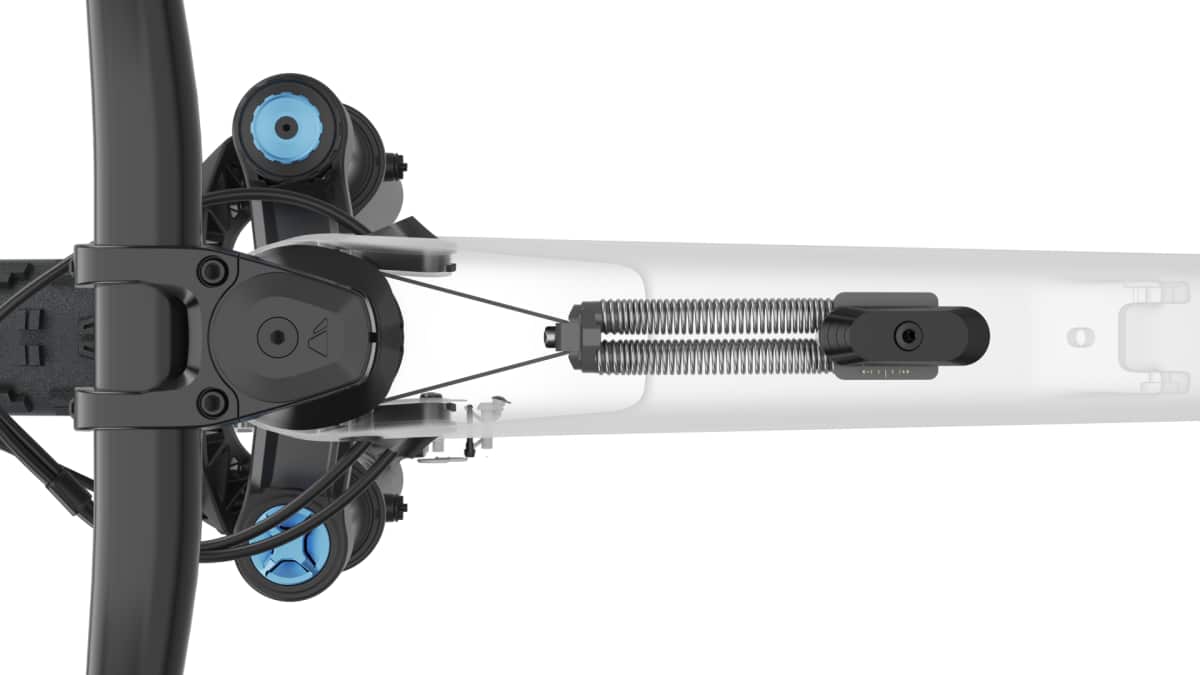
The K.I.S. advocate cannot understand why the system has not caught on. The idea is that the steering system ensures a smoother ride at high speeds, thereby making cycling on challenging trails easier.
A look back
In 2022, inventor and Syntace founder Jo Klieber unveiled the system to the cycling world. His aim was also to eliminate the drawbacks associated with shallower steering angles. The specialist press’s reactions ranged from cautious to enthusiastic. Peter Nilges, then head of testing at BIKE magazine, also saw clear advantages in the system. Everyone noticed the positive effects – some more, some less. But of course there were also critical voices along the lines of: ‘I can steer just fine as it is – and please, no more bits on the bike.’


The big K.I.S. boom never materialised. The mail-order giant Canyon secured the rights for a year, fitted the system to high-travel bikes – and continues to do so on many models to this day. Other manufacturers did not follow suit. “Perhaps that’s also one reason why K.I.S. didn’t catch on – besides, innovations that don’t establish themselves in racing tend to struggle,” says designer and bike visionary Peter Denk. His conclusion after a brief test ride with K.I.S.: It’s nice to have, but not essential.

XCO ace and Canyon rider Luca Schwarzbauer is said to have requested K.I.S. for his Race-Fully Lux following test rides. When asked by Canyon what role K.I.S. will play in future, the company stated: “With our latest models, we’re focusing even more consistently on the rider. That’s why, going forward, we’re fully committed to uncomplicated simplicity, maximum performance and pure riding enjoyment.” Perhaps this is a hint that Canyon is planning to move away from K.I.S. soon. At least, that’s how it can be interpreted.
Does K.I.S. make sense for road bikes as well?
“The system has so many advantages and would even make sense on road bikes and city bikes,” claims Kühnen. He has tried it out on a road bike with aero handlebars. Without K.I.S., it’s particularly difficult to ride in a straight line without weaving – but with K.I.S., it worked. Even critic Denk can envisage a positive effect here. Kühnen sees another area of application in city bikes. “The steering geometries of these bikes are often too twitchy anyway – and many riders are relatively inexperienced. With K.I.S., the handling would become much smoother,” says Kühnen.
According to our information, manufacturers are said to have experimented in this area as well – but it seems rather unlikely that anyone would dare to relaunch a product using K.I.S. again.
Interview: Sebastian Maag, MTB Marketing Lead, Canyon

For a while, K.I.S. was available exclusively from Canyon, and afterwards from all manufacturers. But no one else has followed suit. Why not?
Good question. I know K.I.S. very well and appreciate its benefits. The media response has been largely positive and the concept is gaining momentum – I don’t know whether other manufacturers will buy the Syntace licence. Ultimately, though, you have to try it out for yourself to appreciate the benefits – especially when it comes to new technologies.
Which bikes do you fit K.I.S. into, and are there any models without it?
We have fitted K.I.S. into models such as the Spectral:ONfly, Spectral, Strive:ON and Sender. If you do not wish to use the system, we provide simple instructions on how to remove it. With our latest models, we’re focusing even more consistently on the rider. That’s why, going forward, we’ll be fully committed to uncomplicated simplicity, maximum performance and pure riding enjoyment.
Crazy, isn't it?
Yes, because there’s definitely an advantage to it. Our Cross-Country World Cup rider, Luca Schwarzbauer, gave it a go and would have liked to have ridden it on his XC race bike as well. We received similar feedback from our road cyclists too.
What do you personally think of K.I.S.?
I can really feel the benefits. The front wheel keeps returning to its neutral position. This helps me maintain the ideal line more effectively – whether at high speed, going uphill or in so-called off-camber situations. When I go back to riding a bike without K.I.S., it feels very unfamiliar and unstable at first. That just goes to show how effectively the system works.
Further comments on K.I.S.
“I’ve never tried K.I.S. before, but I’ve never had any trouble steering. So why K.I.S.?” Janik Rohe, BIKE reader (by email)
“I gave K.I.S. a quick go right at the start – I wasn’t entirely convinced. It probably didn’t catch on because it might not have been fully thought through. I’d be happy to give it another go with suspension. Besides, it’s yet another part on the bike that could break.” Peter Denk, cycling visionary
“K.I.S. is a nice feature, but in my view it’s not a game-changer. I noticed differences (in Canyon) – some of them positive – but on mountain tours with lots of hairpin bends, I found K.I.S. rather tiring.” Laurin Lehner, BIKE tester
“K.I.S. offers significant advantages, particularly on wet or slippery descents. But yes, it does take some getting used to. Of the few test bikes we had fitted with K.I.S., I much preferred the Liteville system to Canyon’s. It feels smoother, not quite so ‘digital’, even with a lot of spring preload.” Adrian Kaether, BIKE tester

Laurin Lehner
Editor