


For almost an entire season, I struggled down the descents on my long-term test bike – a Pivot Trailcat SL. The brakes had hardly any bite. Sore fingers after long downhills. Countless missed braking points. The culprit: a rather feeble brake – which, in the interests of fairness, I won’t name here. But also: the wrong size of brake disc. A 180-millimetre disc on a trail bike for an 80-kilo rider? Combined with a weak brake, that’s like trying to smash in window panes with marshmallows.
Conclusion from the editor’s perspective
For me, switching to larger brake discs was a real game-changer. Whilst the 200-millimetre disc on the front wheel doesn’t turn the mid-range entry-level brake into a heavy-duty anchor, it does noticeably improve its performance.
In practice, I’ve benefited immediately from significantly better braking performance and more precise control. Above all, on long descents, my hands and arms no longer feel as though I’ve just lost an arm-wrestling match against Devon Larratt.
I’m happy to put up with those few extra grams of weight in exchange for these additional safety margins. The larger discs also have hardly any effect on handling, because the extra weight is situated particularly close to the axle. Under-sized brake discs on a mountain bike? For me, that’s an absolute no-go. Stefan Frey, BIKE editor
But what are the real benefits of switching to larger lenses? And is bigger always better? Or can a lens that’s too large also have its drawbacks? I’m no Isaac Newton, but I’ve more or less got the basics of physics sorted.
The physics behind lens size, or: why size does matter after all
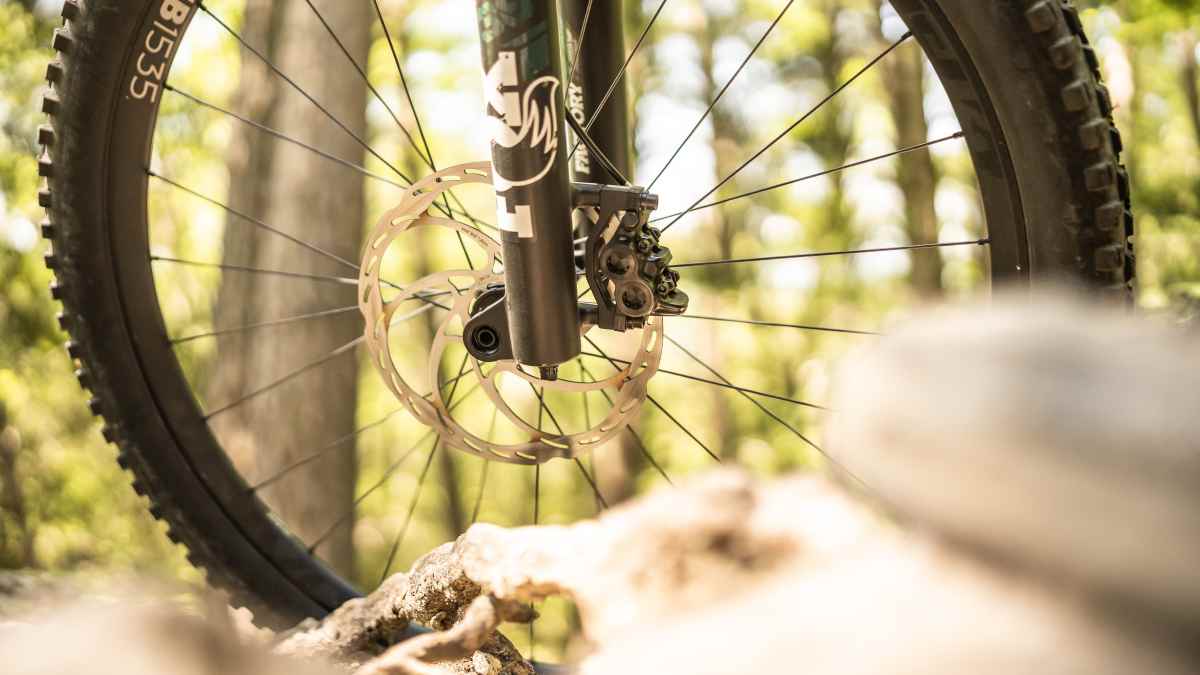
A larger brake disc primarily increases the Braking torque (torque at the wheel). The actual braking force exerted by the brake caliper (where the pads press against the disc) remains the same, but the longer lever arm results in greater braking effect on the wheel. There is a simple physical formula behind this:
M = F × r
- M = braking torque
- F = Friction force between the brake pad and the disc
- r = effective radius of the brake disc
If the brake caliper, pads and applied force remain the same, the braking torque is almost proportional to the radius of the disc.

A larger brake disc = more power
If we compare the standard disc sizes of 180 mm, 200 mm and 220 mm, the results are quite remarkable. Taking the 180 mm disc as a reference (= 100 %), the figures break down as follows:
| Disc diameter | Relative lever arm | Relative braking torque |
| 180 mm | 1.00 | 100 per cent |
| 200 mm | 1.11 | 111 per cent |
| 220 mm | 1.22 | 122 per cent |
This means:
- 200 mm compared with 180 mm: approx. 11 per cent more braking torque
- 220 mm compared with 180 mm: approx. 22% more braking torque
- 220 mm compared with 200 mm: approx. 10 per cent more braking torque
The actual figures may vary slightly, as the lining does not extend quite to the very edge of the disc, but the order of magnitude is very accurate.
Magura’s laboratory results
To lend a little more weight to the theoretical figures, we also contacted the braking specialist Magura. The Bad Urach-based company compared the braking force figures for 180 mm and 203 mm brake discs across two disc brake models in its test department.
Test 1: With the same brake and the same brake pads, the larger disc delivers a difference of approximately 15% across the entire braking force curve. The red line at 600 N of braking force indicates the range that ordinary cyclists can just about control without the risk of a rollover.

Test 2: The second braking model also shows a difference of approximately 11% across the entire braking force curve. These figures are fairly consistent with the theoretical assumption that discs 20 millimetres larger provide around 10% more braking force.

What does that mean on the trail?
For many riders, switching from 180 mm to 200 mm brake discs can feel like a significant step up and offer noticeable benefits on descents:
- noticeably easier to brake
- less manual effort required
- easier to measure out
- slightly greater fade reserves
When switching from 200-mm to 220-mm brake discs, the difference is often less noticeable in normal trail riding than the step from 180 to 200 millimetres.
- a further increase of around 10 per cent in braking torque
- particularly interesting on long, steep descents
- significantly better heat absorption
- is popular with experienced riders and in the bike park
Thermal advantage of larger brake discs
The often even greater advantage of a large disc is not always the additional braking power, but the temperature. A 220 mm disc has a larger circumference and therefore greater mass, as well as a larger surface area. As a result, it heats up more slowly, cools down more quickly and is less prone to fade. That is why many enduro and downhill riders use a 220 mm disc at the front, even though they do not constantly need the extra braking power.
Practical example of driver weight
Typical recommendations:
| Rider's weight | Trail | Enduro | Bike Park/DH |
| < 70 kg | 180/180 | 200/180 | 200/200 |
| 70–90 kg | 200/180 | 200/200 | 220/200 |
| > 90 kg | 200/200 | 220/200 | 220/220 |
An interesting side effect: hand strength decreases
If one speaks of 180 by 220 mm changes, receives approximately 22% more braking torque. Put another way, you need significantly less hand force to achieve the same deceleration. For me, this was one of the key factors in deciding to switch to larger brake discs. As the clamping force is generated by hydraulic pressure, which in turn depends on hand force, the required hand force ideally decreases proportionally. Here, too, a simple equation helps: 180 divided by 220 is approximately 0.82.

So you only need to apply about 82 per cent of the force previously required to the brake lever Manual labour – 18 per cent less – generate the same braking force.
Here are the points to bear in mind when replacing brake discs
1. Maximum disc size for the fork and frame
The most important point is the maximum size specified by the manufacturer.
- Lightweight XC forks are often approved for rotors up to 180 mm or 203 mm in diameter
- Trail and enduro forks: usually compatible with 203 mm or 220 mm
- Downhill forks: often rated for up to 220 mm
There are also restrictions regarding the rear end:
- Some frames only allow 180 mm brake discs at the rear
- Many modern enduro and e-MTB frames allow for 203 mm or 220 mm
- A rotor that is too large may come into contact with the chainstay or seatstay
Important: It is not the size of the adapter that matters, but solely the manufacturer’s approval of the frame and fork.
2. Suitable brake caliper adapter
A different adapter is usually required for a larger disc. Example: The brake caliper is currently designed for 180 mm. To upgrade to 200 mm, a +20 mm adapter is required. When changing to 220 mm, a +40 mm adapter must be fitted accordingly.
The adapter must be compatible with the brake caliper mount (Post Mount / Flat Mount), the current mounting size and the target disc size.
3. Load on the wheel and spokes
Larger discs generate higher braking torques. This means:
- higher loads on the hub
- greater loads on the spokes
- greater stress on the fork and frame dropouts
This is usually taken into account in modern enduro, DH and e-MTB components. That is why some manufacturers limit the disc size on lighter XC components.
4. Greater braking power can also have its drawbacks
A larger disc makes it easier to lock the front wheel. This means you need to be a little more delicate with the brake lever. For experienced riders, this is usually not a problem, as less hand strength is required and the brake becomes easier to modulate.
For beginners, a very large disc may seem rather intimidating at first. That’s why it’s better to increase the size in 20-millimetre increments rather than upgrading straight away to a ‘pizza tray’. At the rear, a change isn’t always necessary, as the front wheel provides around 70 to 80 per cent of the total braking power anyway.
Who stands to benefit most from larger windows?
Heavy riders
This is where the benefit is greatest. A rider weighing 65 kg plus a 15 kg bike has significantly less kinetic energy to dissipate than someone weighing 100 kg plus a 25 kg e-MTB. The heat that needs to be dissipated increases almost in proportion to the total mass. For riders weighing over approximately 90 kg, 200- or 220-mm front rotors are often advisable.
E-MTB riders
On an e-MTB, you benefit particularly from larger brake discs. Why? A modern e-bike often weighs between 23 and 27 kg, compared with 14 to 17 kg for a mountain bike. In addition, riders often travel at higher average speeds. The consequences: this results in more kinetic energy, longer braking distances and higher thermal stress. That’s why many high-performance e-MTBs today come fitted as standard with 220 mm at the front and 200 or 220 mm at the rear.
Enduro riders, downhill and bike park riders
Here, too, a larger wheel is usually worth it. Anyone who regularly rides long descents in the Alps will often notice the difference more clearly than on short local trails. Typical advantages:
- less hand fatigue
- less fading
- constant pressure point
Riders with hand problems
Another aspect that is often underestimated is ergonomics: larger discs mean less lever force is required and, as a result, less strain on the fingers and forearms. This is particularly relevant for riders with:
- little hands
- Osteoarthritis
- Tendon problems
- forearms that tire quickly
Conclusion from the editor’s perspective
For me, switching to larger brake discs was a real game-changer. Whilst the 200-millimetre disc on the front wheel doesn’t turn the mid-range entry-level brake into a throwing anchor, it does noticeably improve its performance.
In practice, I’ve benefited straight away from significantly better braking performance and more precise control. Above all, on long descents, my hands and arms no longer feel as though I’ve just lost an arm-wrestling match against Devon Larratt.
I’m happy to put up with those few extra grams of weight in exchange for these additional safety margins. The larger discs also have hardly any effect on handling, because the extra weight is situated particularly close to the axle. Under-sized brake discs on a mountain bike? For me, that’s an absolute no-go. Stefan Frey, BIKE editor

Stefan Frey
Editor