


Sitting correctly on your bike: Your riding position determines whether you experience pain or enjoyment
Tim Farin
· 28.07.2026


2. Author: Sebastian Klaus, Komsport Cologne
Sebastian Klaus holds a degree in sports science (DSHS Cologne) and is the managing director of the Cologne Centre of Excellence for Sport. Here, he offers some tips on how to find the correct riding position on your bike.
Cycling is considered to be gentle on the joints – and that’s true. But the movement is extremely repetitive: at 80 revolutions per minute and a two-hour ride, you’ll complete just under 10,000 pedal revolutions. Every single one puts strain on your knees, hips, back and shoulder girdle, which in turn can lead to injury. If your posture isn’t correct, minor misalignments can add up to noticeable problems.
Studies suggest that bike fitting can improve comfort and reduce pain for many people – however, the data is often based on self-reports and is not equally conclusive for all types of discomfort. An international survey of more than 800 cyclists revealed a clear link between bike fitting and reduced pain levels. This effect persists even after several months.
Listening to your body – but doing it properly
“The first thing that really matters is listening to your own body,” says sports scientist Sebastian Klaus, founder of Komsport in Cologne, who has specialised in biomechanical seating position analyses for many years. “If you start to feel discomfort after ten minutes on the bike, you really should make a change. But if you can ride for half a day without any pain: never change a system that’s working.”

Either way, not everyone needs a professional fitting straight away. Many problems can be solved with a bit of understanding and targeted adjustments – a few tools can’t do any harm.
The Neck Paradox: Why ‘higher’ doesn’t mean ‘more comfortable’
One of the most common misconceptions is that anyone with neck pain thinks their handlebars need to be higher. “That’s the common belief. But it’s often not true,” says Klaus. For short distances, high handlebars aren’t a problem. But from around ten kilometres onwards, your overall riding position becomes crucial.
Most neck problems are caused by handlebars that are too high and too far away: the shoulders rotate forwards, and the muscles have to work constantly to maintain posture. The solution is sometimes counter-intuitive: a slightly lower but shorter stem – a more compact setup – relieves strain on the neck because the shoulders return to a more natural position.
By the way: Numb fingers are often not a problem with the hand at all, but a sign of strain on the neck and upper back muscles. This tension can easily irritate the nerves.
Three millimetres on the saddle: it’s not the model that’s the problem
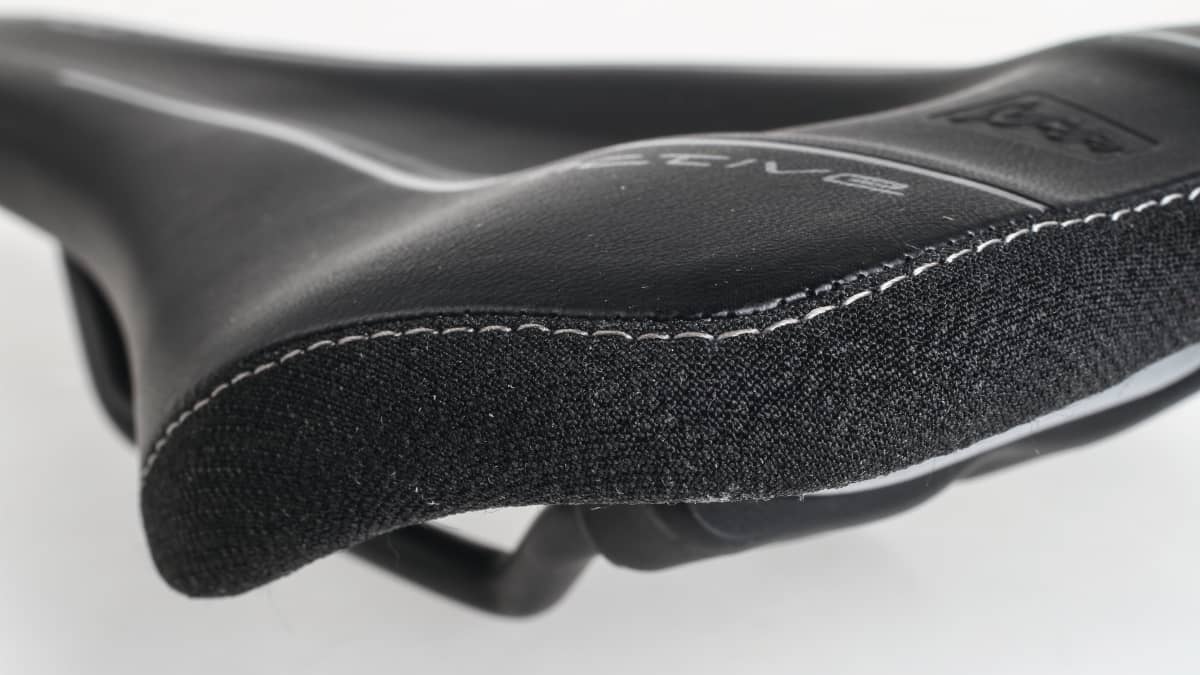
When it comes to riding comfort, many people immediately think of the saddle and buy a new one. However, it is usually not the saddle that is the problem, but the position in which it is fitted.
“A difference of three millimetres in seat height can make all the difference,” says Klaus. This is an approximation intended to illustrate just how small a difference we’re talking about. The body can compensate for around two millimetres, although the figures vary from person to person due to anatomical factors. Any deviation from this can lead to pelvic rotation – and the back extensor muscles effectively have to work overtime.
Important: If you move the saddle backwards, the effective seat height changes too – you’ll be sitting higher. The saddle must then be lowered accordingly.
Sebastian’s Pain Compass: Symptoms and Possible Causes
- Pain below the kneecap – saddle too high, compensation due to a high-arched foot
- Pain behind the kneecap – saddle too far forward
- Burning thighs – saddle too low
- Pressure in the perineal area – the saddle is often just 3 mm too high
- Back pain – pelvic rotation caused by an incorrect saddle height
Important: There are many other possible causes of knee and perineal pain.
Warning signs when cycling is painful
Medical attention is required if one (or more) of the following symptoms occurs whilst cycling:
- sudden, severe pain
- Swelling
- persistent numbness in parts of the body
- Loss of strength
- Numbness in the perineal area / sensory disturbances in the genital area
- Pain that does not subside within 30 minutes of dismounting
- Symptoms on one side only, which may indicate an asymmetrical misalignment or an orthopaedic problem
- Tingling or a burning sensation that radiates into the arms or legs (indicating nerve irritation or compression)
- Visual disturbances, dizziness or headaches caused by hyperextension of the cervical spine
- Erectile dysfunction or changes in sensation after cycling (seek urological advice)
- Blood in the urine after long journeys
- Recurrent inflammation at tendon insertions (Achilles tendon, patellar tendon, iliotibial band or IT band)
- Joints that click or seize up during the pedalling motion
“The key factor isn’t the frame size, but the frame length,” emphasises Klaus. A bike that’s too long forces the body into an overstretched position: arms fully extended, shoulders rotated forwards. The tricky thing is that a bike that’s too big can feel more comfortable during a test ride than a smaller one that fits properly – because the higher front end feels more comfortable over short distances. But in the long run, your body will pay the price.
The rule of thumb is therefore: compact is better. “Frame length is the biggest problem we generally face in cycling.”
Stress: The invisible factor
Even with a perfectly adjusted bike, pain can still occur – if the overall stress is too high. “We often see a great deal of tension in the system,” Klaus explains. In short: the nervous system is geared towards activity; stress affects the body; our brain reacts by releasing stress hormones. This can become a vicious circle.
This particularly affects amateur cyclists who go all out two or three times a week and simply take the sport a bit too seriously. It feels good at first. But the stress builds up on top of work and family pressures. Biomechanics alone won’t solve the problem. However, if you sit in a more relaxed position, you’ll tense up less – and recover better.
What you can do yourself
"You don’t have to use a sledgehammer to crack a nut," says Klaus.
Three adjustments you can make at home:
- Adjust the saddle height – in 2-mm increments, ride for a week, then assess
- Adjusting the stem angle – often adjustable continuously on trekking bikes
- Adjusting the handlebar rotation – loosen the screw, turn it slightly
Always change just one variable at a time – otherwise you won’t know what made the difference. If that isn’t enough, it’s worth having a professional riding position analysis carried out: the whole system comprising your body and the bike, in motion, under realistic conditions.
Because: Biomechanics isn’t just about performance. It’s about prevention.

Tim Farin
Editor