


Heinz Stücke was not an adventurer in the traditional sense. At any rate, he did not want to be seen as one. “I just ride my bike,” is one of his most down-to-earth self-descriptions. Yet that is precisely what makes his story so special: Stücke did not treat his bike as a piece of sports equipment for breaking records, but as a tool for freedom, encounters and lifelong learning.
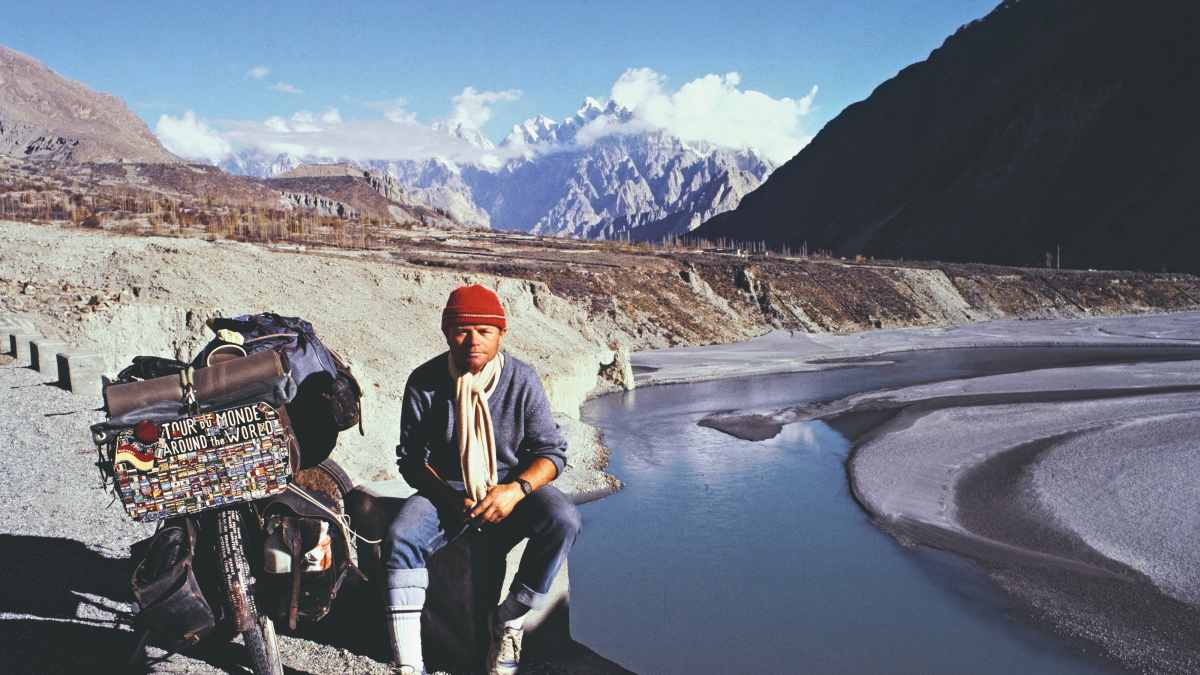
Carina Wolfram’s book Just a quick trip to see the world traces the journey of the round-the-world cyclist through memories, photographs and interviews. From the chapters on the route, the people, the dangers, nutrition, health and the bicycle, ten pieces of advice can be drawn which also provide guidance for today’s cycle tourists.
1. Get started before your plan is perfect
Heinz Stücke planned his travels, but he never allowed himself to be completely bound by a fixed itinerary. His trip to Tokyo was originally intended to last two years. In the end, he spent 51 years on the road. His route took him through Africa, South America, North America, Asia, Australia and numerous island nations.
His most important lesson is therefore this: an itinerary is a starting point, not a prison. Anyone who waits for the perfect kit, the ideal time or a fully mapped-out route may never set off. Stücke made his preparations, packed his bike and adapted the rest of his journey to the circumstances.
For today’s cycle tourists, this means that the most important visas, a realistic financial plan, suitable kit and information on high-risk regions must all be sorted out before setting off. After that, however, there should still be room for detours, spontaneous invitations and new destinations.

2. Travel slowly enough to understand a country
On his early journeys, Heinz Stücke used to cover long distances. Over time, his pace changed. In the chapter ‘Pace’, he explains that he often spent between two and six months in a country, depending on its size. A typical day on good roads might cover around 120 kilometres, whilst on poor tracks it was sometimes only 30 to 60 kilometres.
The reason was not solely the physical strain. Stücke did not want to judge a country on the basis of a single experience. Anyone who spends just a few days travelling through a region inevitably sees only snippets of it. Travelling slowly, on the other hand, allows time for conversations, everyday life, landscapes and contradictions.
A word of advice for today’s cycle tourists: not every stage needs to be as long as possible. A rest day, a longer stay or an unplanned detour can be what really makes a trip worthwhile.
3. Treat people with respect and goodwill
For Heinz Stücke, people were the most important part of travelling. The bicycle made it easier for him to connect with them, as it aroused curiosity and made him seem approachable. Many invitations, friendships and overnight stays came about as a result of these spontaneous encounters.
In doing so, Stücke took care not to interfere in political or religious matters. He wanted to remain a visitor and not to judge other ways of life too hastily. He summarises his attitude as follows: ‘Anyone who travels to a country with a positive attitude is also entitled to expect openness from the people there.’
That does not mean naively romanticising every situation. Stücke also experienced rejection, theft and dangerous encounters. Nevertheless, his fundamental attitude remained one of respect. This is particularly relevant for cycle tourists today: friendliness, patience and cultural sensitivity often open more doors than perfect language skills.
4. Learn the local language
Heinz Stücke devised a simple but effective method: every day, he learnt 20 words in the local language. He wrote these down on cards, which he attached to his handlebars. After two weeks, he had built up a basic vocabulary suitable for everyday use.
He didn’t want to sound like a dictionary. His aim was to be able to speak to people. To this end, he listened to the radio, repeated phrases and used every encounter as a learning opportunity. In this way, he learnt, amongst other things, English, Spanish, French, Japanese, Russian and Chinese.
For today’s cycle tourists, this advice is easy to put into practice. A few dozen words for greetings, food, accommodation, directions and emergencies can make a big difference. Translation apps are helpful, but they are no substitute for the personal gesture of making an effort to learn the language of the host country.
5. Plan with change, not against it
His routes were constantly changing. A ship, a visa, an invitation or a political border could throw his entire plan into disarray. When he was refused permission to cycle through the Soviet Union, he accepted the train journey and then continued his journey.
Even the trip to Tokyo, which had seemed set in stone, lost its significance along the way. Africa, South America and the encounters he had there were more important than his original destination. The book makes it clear that Stücke did not view the world as a collection of places to tick off a list.
This is a useful alternative to today’s obsession with ticking off tourist attractions and countries on a list. A destination can be a source of motivation, but it should not prevent travellers from engaging with reality as they go.
6. Only take what you really need
Heinz Stücke travelled lightly, but not unprepared. His bicycle was robustly built, and his luggage was evenly distributed. His tent, sleeping bag, clothes, cooking equipment, camera kit and food all had to be arranged sensibly. His first heavily laden bicycle weighed up to 75 kilograms with all his luggage.
At the same time, Stücke was prepared to adapt his kit. He raised his handlebars because of back problems, repaired parts along the way and found a practical solution in Australia for tyres that didn’t fit. Later, he switched to lighter bikes and a folding bike as his travel destinations and means of transport changed.
The lesson is not to set off with as much luggage as possible. Rather, it is that your kit must be suited to your particular journey. A lightweight item may be indispensable, whilst an expensive specialist item may, by contrast, be superfluous. What matters most are reliability, reparability and a sensible approach to weight.
7. Never underestimate the importance of water, sleep and health
Many of the dangers encountered on long cycling trips do not stem from spectacular incidents, but from everyday mistakes. *Stücke* recounts cases of food poisoning, amoebic dysentery, typhoid, pneumonia and dangerous dehydration.
His journey through the Australian outback is particularly striking. He took large quantities of water and provisions with him for the remote stretches of the route. Nevertheless, he describes the loneliness and uncertainty as mentally taxing. In other regions, mosquito nets, a first-aid kit and the proximity to settlements helped him.
For today’s touring cyclists, the following applies: water supplies must be appropriate for the route, the climate and the actual opportunities to top up. Equally important are sleep, sun protection, insect repellent and a realistic assessment of one’s own stamina. Anyone who is unwell should not carry on cycling out of a false sense of pride.
8. Choose where to sleep wisely
He spent well over 18,000 nights in tents, budget accommodation, private homes and makeshift shelters. He slept in churches, police stations, barns, caves, garages and under bridges.
However, his experiences also show just how carefully a campsite must be chosen. Hollows can fill with water, branches or coconuts can fall, and ants and scorpions can find their way into the tent. In unsafe areas, Stücke would move camp immediately if people stumbled over his tent at night.
The advice is clear: a good place to sleep is not only pleasant, but safe. Watercourses, the risk of flooding, traffic, animals, insects and human activity are all factors to consider when choosing a spot. A spectacular sunrise is only a bonus if the night before has passed without any unnecessary risk.
9. Learn from your own mistakes
Heinz Stücke was persistent, but by no means flawless. In the chapter ‘Mistakes’, he lists numerous situations which he advises other travellers to avoid: not carrying enough water in the desert, cooking in a tent, inadequate sun protection, overlooking insects, or the rash purchase of a weapon.
Particularly dramatic is the story from Zambia, where, after several beers and in the sweltering heat, a shot was accidentally fired from his pistol. His tent also burnt down in Vienna because he fell asleep by candlelight. His account is valuable because it not only recounts heroic tales but also reveals the mistakes he made.
Cyclists should use such experiences to draw up a personal list of risks. Which mistakes would be particularly dangerous on their own route? Where are they lacking in experience, equipment or information? Good preparation does not mean ruling out every risk. It means avoiding repeating typical mistakes as far as possible.
10. Keep your curiosity alive
Perhaps the most important lesson to be learnt from Stück’s life is his unflagging thirst for knowledge. He was interested in geography, languages, people, history, nature and political issues. He used the time spent waiting at borders or in government offices to study. His radio and his magazines were not luxuries to him, but intellectual companions.
This approach meant that his travels were more than just a long journey. Stücke didn’t just want to see countries; he wanted to understand the bigger picture. He photographed people and scenes from everyday life, documented his experiences and preserved them over the decades.
For today’s cycle tourists, this means: stay open to what isn’t in the guidebook. Ask questions, listen, and don’t just document the sights. The most vivid travel memories often arise where a plan ends and genuine interest begins.
An overview of the 10 most important lessons
- Setting off: A journey doesn’t have to be fully planned before you set off.
- Travelling slowly: It is only by taking enough time that you can really get to know countries and people.
- Showing respect: Openness and goodwill make it easier to get along with others.
- Learning languages: Even just a few words can foster a sense of closeness and practical independence.
- Staying flexible: A route may change as a result of events and new opportunities.
- Reducing your luggage: It is essential to have robust, repairable and suitable equipment.
- Protecting health: Water, sleep, sun protection and hygiene are not trivial matters.
- Sleep safely: Choosing the right storage location prevents many problems before they arise.
- Analysing errors: Mishaps are also part of the journey, provided you learn from them.
- Stay curious: Cycling holidays are not just a means of getting from A to B, but a form of learning.
Conclusion
Heinz Stückes’s journey through life cannot simply be replicated. His circumstances were different, the risks he faced were often greater, and his determination was extraordinary. What can be applied, however, is his attitude: cycle tourists do not need the most expensive bike to start with, but rather the courage to set off, the ability to adapt, respect and curiosity. Those who travel slowly enough to listen, and are prepared enough to take dangers seriously, will find more than just a new path around the next bend.
Barbara Merz-Weigandt
Editor-in-Chief