


In the past, you had to be careful where you stepped in the forest. Today, you have to be happy if anything crawls at all.
It's shameful how little wilderness you still see in Germany. When I gravelled 1000 kilometres across Germany with my brother, we came across three slow worms. Nothing else.
No stag beetle, no adder, no common toad, no fire salamander, no grass snake elegantly crossing the path. Nada. The forest looked as tidy as a DIY store car park.
I remember summers 40 years ago when it was alive everywhere. It molted, chirped, wriggled, hummed and hopped. Some mysterious creature crouched under every second stone. Today, there is an eerie silence on many trails. Perhaps because we are cutting up forests, poisoning streams and mowing meadows like golf turf. Or maybe it's because we thunder over everything smaller than a cereal bar at 30 km/h with studded tyres. That's the only evidence that toads and fire salamanders really exist - damp patches of flesh in the gravel.
Mountain bikers like to talk about "experiencing nature". Sounds good. Nature may see it differently.
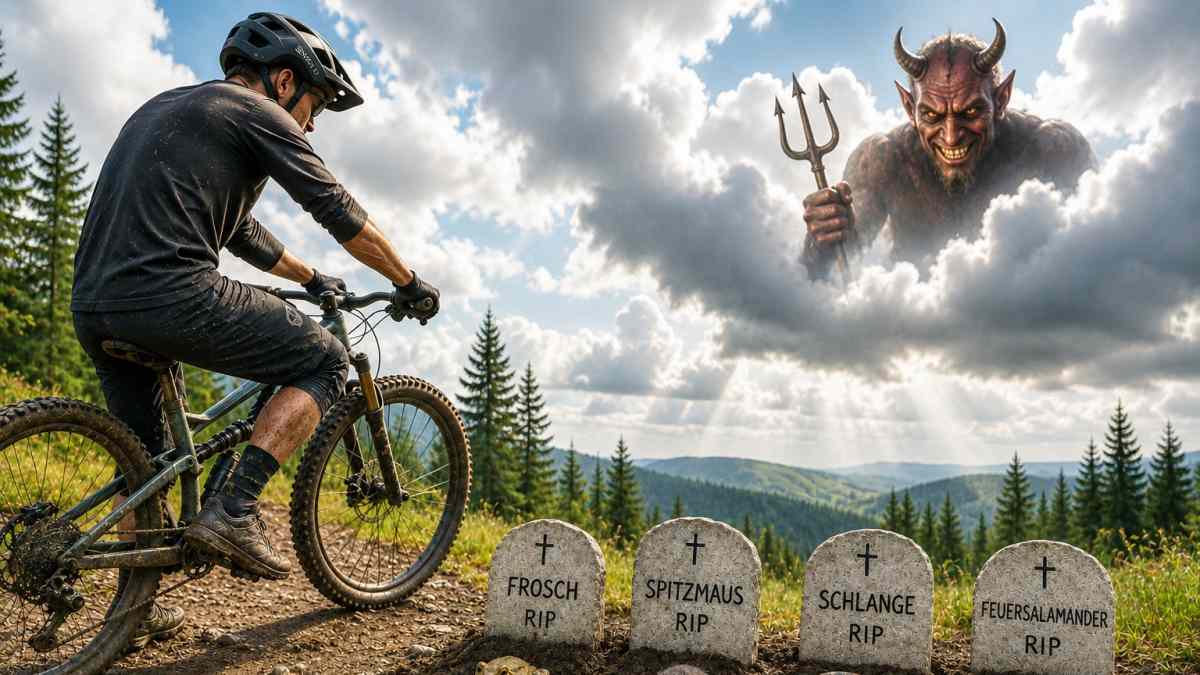
Here come the little victims of the big fun. The run over. The overlooked. The last of their kind on the single trail.
1 | Cricket
Pain in the arse with wings
How can such a small creature make such a hell of a noise?
A cricket lives outside my bedroom. More precisely: a male that is obviously difficult to communicate with. As soon as the window is open, the concert begins. Crickets used to chirp in Tuscany or somewhere behind Barcelona. Today, thanks to climate change, they chirp in our neighbourhood too. Mediterranean flair, I guess you'd call it. I call it sleep deprivation.

The sound is produced by the male rubbing its front wings together. Tiny dental ridges function like a violin and bow. The warmer the night, the louder the love song. And apparently also the more desperate. Because females live polyamorously. So the gentleman outside my window broadcasts non-stop. A permanent single on air and full of hope.
Yet the cricket is actually an amazing animal. They live in burrows they dig themselves - as thick as a finger and up to 30 centimetres deep. There it hides from rain, heat and enemies. There are plenty of them: spiders, blackbirds, lizards, shrews. And, of course, bicycle tyres. Gravel bikes in particular flatten the animals on dirt tracks without the rider realising it. A quick crack - that's it.
In Japan, crickets are considered lucky charms and are kept as pets. There are even cricket competitions. However, only among males, which can become surprisingly aggressive. At the same time, crickets now end up on our plates as a source of protein in fitness bars or as insect noodles. In Switzerland, they are already officially authorised as food - frozen or dried.
The real tragedy: the cricket lives two years as a larva in hiding and only a few months as a finished animal. Half its life is spent underground - and once it has reached the surface, the next tyre is often already waiting.
2 | Alpine salamander
The invisible man of the mountains
It looks as if it has been painted black by a tuner: the Alpine salamander - deep black, shiny, almost unreal. No yellow pattern like the more famous fire salamander, no show talent, no Lurchi charisma. Instead, it has the aura of an animal that, since the Ice Age, has simply decided to be as unimpressed by mankind as possible.
The Alpine salamander lives in medium and high mountain areas, hidden between moss, roots and scree. It was named "Amphibian of the Year 2026" - presumably because hardly anyone even knows it exists. The salamander is extremely loyal to its habitat. Some animals spend their entire lives in just a few square metres. For a mountain biker, that's the blink of an eye. For the salamander: the whole world.
It hates dryness like a racing cyclist hates mud. Its skin needs to stay moist, which is why it usually comes out of its hiding place at night, after rain or in the early hours of the morning. Then it hunts worms, spiders and larvae. Cosily. Without haste. The Alpine salamander trusts that the mountains are slow.
Unfortunately, bikes are faster.
Because it is black, it almost melts into the ground on damp trails. You can hardly see it. And if you roll over it, you probably won't even feel it. That doesn't make things any better.
Yet the little mountain dweller is anything but defenceless. It secretes a poisonous skin secretion via glands to deter predators. This is why it only has a few natural enemies: particularly courageous magpies, alpine choughs or adders. However, the secretion is about as effective against studded tyres as sun cream is against avalanches.
The Alpine salamander also tends to belong to the "just don't stress" faction when it comes to reproduction. It is considered to be extremely slow to reproduce. The females only give birth to a few fully developed young - no tadpole stage, no bustle in the pond. Evolution on the back burner. This is precisely why the populations are small and fragile.
The Alpine salamander is strictly protected. Not because it is spectacular. But because it is the opposite: quiet, slow, hidden. An animal like a silent forest secret.
And perhaps that is precisely his problem. Those who are loud are seen. Those who live invisibly can easily end up as collateral damage on two wheels.
3 | Aesculapian snake
The climbing artist
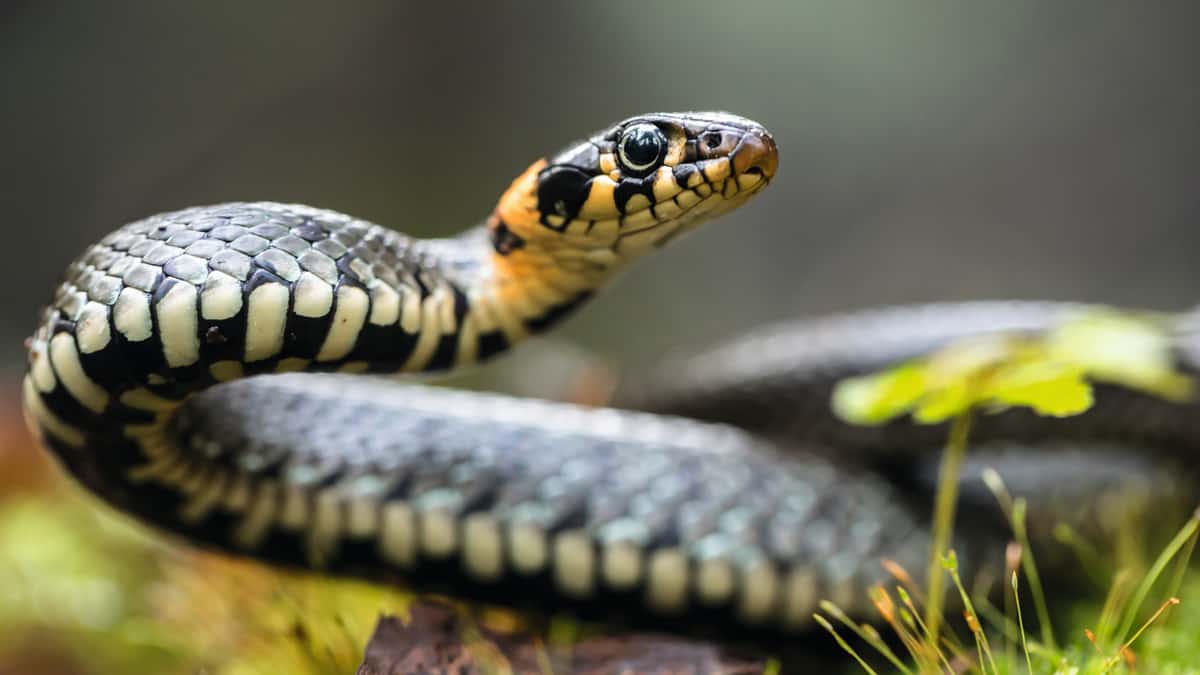
Anyone who encounters this snake in the forest is in for a fright. The Aesculapian snake can grow up to two metres long - making it the largest snake in Europe. The sight of it makes many a hiker or biker instinctively take a step back. Quite wrongly.
This is because the Aesculapian snake is non-poisonous, peaceful and shyer than most people. A simple glance into its eyes reveals this: instead of the vertical "cat pupil" of a viper, it has round pupils - a typical characteristic of vipers. In case of danger, it prefers to flee rather than confront. It only defends itself with a harmless bite if it is held or harassed.
The colouring ranges from yellowish-brown to olive to almost black. Perfect camouflage for sunny forest edges, dry slopes and sparse mixed forests. There, the diurnal snake hunts mice, lizards, young squirrels and even bats. Larger prey are enveloped and strangled.
However, its real superpower is climbing. Thanks to special belly scales, it can even climb smooth tree trunks. Observers have reported animals climbing several metres vertically up trees. For a snake, this almost seems like magic.
In winter, the Aesculapian snake goes into torpor and withdraws into crevices, root caves or old walls. In summer, on the other hand, it loves warmth and sunshine - often the sunlit trail. Paths, forest roads and trails therefore repeatedly become death traps.
The Aesculapian snake can live to an astonishing age. In the wild, they often reach 20 to 30 years, in human care even significantly longer. Provided that no tyre ends its career prematurely.
The snake was named after Asclepius, the Greek god of healing. His staff, with a snake coiled around it, is still the best-known symbol of medicine today. Ironically, the Aesculapian snake itself is in urgent need of help: In Germany, Austria and Switzerland, it is now only found in a few isolated populations and is considered highly endangered in many places.
So if you're lucky enough to come across an Aesculapian snake on the trail, you're not just seeing a snake. But a piece of European natural history - older than any mountain bike brand.
4 | Wolf spider
The huntress without a net
When you think of spiders, you think of webs. The wolf spider thinks little of it. It prefers to hunt on foot - and doesn't "spin" around.
Wolf spiders are the wolves among spiders: fast, active predators that chase their prey instead of waiting for it. There are around 90 species in Central Europe. Some live on dry heathland, others in bogs and swamps - the so-called pirate spiders. What they all have in common is their lifestyle: nomads instead of web owners. They hide under stones, dead wood or leaves and set off as soon as they get hungry.
Their hunting technique is simple and effective. If they discover a beetle, fly or other spider, they stalk it, sprint off and pounce on their victim. A quick bite, poison takes effect, meal done. Catch net? Overrated.
Wolf spiders have remarkable eyesight. Eight eyes look out into the world, the two large central eyes function almost like binoculars. Some species can orientate themselves by the position of the sun and even perceive polarised light - an ability that is otherwise better known from bees or navigation systems. For an animal that is barely bigger than a euro coin, this is pretty impressive.
Wolf spiders are often found on forest paths and trails. They hunt during the day, cross paths and scurry across open ground. This is exactly where they become invisible collateral damage for mountain bikers. If you are hurtling downhill at speed, you will neither recognise a wolf spider nor feel it when it disappears under your cleat.
The wolf spider is particularly likeable when it comes to family. While many spiders lose interest after laying their eggs, wolf spiders practise intensive brood care. The mother carries her egg cocoon around on her abdomen for weeks. When the young spiders hatch, they climb onto her back and are chauffeured around the world. A wolf spider with dozens of babies on its back looks like a living school bus.
The males, on the other hand, have a hard time. To impress a female, they perform elaborate courtship dances, waving their front legs and drumming signals on the ground. If the romance is successful, the male's life often ends shortly afterwards. Most barely live to be more than a year old.
The best-known member of the family is the tarantula, which is also found in southern Europe and used to inspire horror stories. In fact, wolf spiders are completely harmless to humans. Bites are extremely rare and usually no worse than a mosquito bite.
5 | wood ant
The ruler of the forest
Those who only pay attention to deer, foxes and wild boar in the forest overlook the real rulers. The wood ant weighs little more than the head of a pin - and yet it rules entire regions.
Germany is home to 23 ant species of the forest ant group. They are among the most important animals in the ecosystem. Without them, many forests would look very different. Wood ants consume huge numbers of caterpillars, beetles and other insects - including the dreaded bark beetle. At the same time, they loosen the soil, spread plant seeds and serve as the main food for woodpeckers, especially the green woodpecker. A forest without ants would be a much poorer place.
The workers look like small muscle packs. With their powerful biting tools, they transport loads that are many times their body weight. Their large compound eyes are fully developed, which is by no means a matter of course for ants. Anyone who has ever crossed an ant trail knows that these animals appear to have a meticulous operational plan.
And indeed, wood ants live in countries that make some big cities seem provincial in comparison.
A single nest can harbour hundreds of thousands of inhabitants. Up to 1,000 queens and several million ants live in large colonies. Particularly spectacular: many nests belong to so-called super-colonies. In the mountain forest, up to 3,200 interconnected nests can work together in an area of just three square kilometres. For ants, that's an empire.
Their famous anthills are much more than piles of needles and twigs. The domes function like highly developed air conditioning systems. The thicker the underlying tree stump, the larger the dome often becomes. The nests reach up to two metres deep into the ground and are usually aligned north-south to prevent them from overheating. Inside, ingenious air ducts ensure ventilation and constant temperatures - a masterpiece of biological architecture.
Incidentally, meat is not the main item on their menu. Wood ants are crazy about honeydew, the sugary excrement of aphids. You could say that the ants treat aphids like farm animals and milk them regularly. Sweets have never been far away.
There even used to be a separate profession in Austria: the Ameisler. These men collected ant pupae, dried them and sold them as valuable bird food. Today, this would be unthinkable. Wood ants are strictly protected and must not be disturbed or killed.
Nevertheless, they are frequent collateral victims for mountain bikers. Thousands of ants often cross paths and trails. Anyone flying over the forest floor at speed will neither notice the workers nor the casualties. This may be bearable for the colony. For the individual ant, the shift ends abruptly.
A queen could live up to 20 years. A worker can live for six years - unless she encounters a 2.4-inch-wide studded tyre beforehand.
6 | Forest dung beetle
The bus puller
Anyone who rolls over the forest dung beetle will probably not notice. A pity, really. Because underneath the shiny black and blue shimmering wing covers is a powerhouse that makes any weightlifter look like an office boy. The forest dung beetle is considered one of the strongest animals in the world: it can move up to 1000 times its body weight. Converted to a human, that would be like pulling six full double-decker buses behind you, namely 80 tonnes.
The forest dung beetle lives from Spain to Siberia, from the lowlands to altitudes of around 2000 metres. It feels particularly at home in damp forests. Its favourite food doesn't sound very glamorous: dung. Mushrooms, carrion and rotting plant remains are also on the menu. This makes it one of the great cleaners of the forest. What others leave lying around, it makes invisible.
Under the ground, its true industriousness is revealed. Pairs of beetles dig tunnels up to 80 centimetres deep. The female works her way down, the male shovels the earth upwards. An egg is laid in a specially constructed breeding chamber. The larva lives there for up to a year, well supplied with a supply of organic material. Only then does the finished beetle hatch.
The forest dung beetle is often a leisurely traveller on forest paths. And that is precisely its downfall. Where hikers still notice it, mountain bikers and gravel bikers often rush past - or over it. Yet it is one of the secret heroes of the ecosystem. Without dung beetles, faeces and carcasses would remain lying around for much longer.
And another curious detail: If you carefully pick up a forest dung beetle and hold it to your ear, you can sometimes hear a soft squeaking sound. With these stridulating sounds, the little muscleman protests against his abduction. The forest dung beetle can live for 2 to 3 years unless it is picked up by a bird, eaten by a hedgehog or smooth snake or flattened by a bicycle tyre.


Dimitri Lehner
Editor