


Amidst the gravel, roots and mud, a tragedy is unfolding that hardly anyone notices. A bicycle tyre is a rolling death trap for slow worms, newts and beetles. Creatures just a few centimetres long don’t stand a chance against a speed of 25.
In the past, when out walking, you had to watch your step. These days, you’re lucky if you spot anything crawling, hopping or slithering at all. The wilderness is growing quieter. Species are becoming fewer. And sometimes all you find is a flattened shadow on the path.
Here are six tiny inhabitants of our forests. Overlooked, run over, underestimated.
1 | Vineyard snail
The Slower-Paced One
It’s the complete opposite of us. Whilst we whizz along the trail at over 25 km/h, the Roman snail manages about 4.2 metres per hour. Not per minute. Per hour. That’s roughly 0.004 km/h.
The Roman snail is Europe’s best-known shelled snail and can be found almost anywhere where it is warm and not too dry. It is remarkably sedentary. Once it has found a good spot, it is reluctant to leave it. Understandably so: when you move that slowly, it’s better to plan any relocations well in advance.
Its shell is made of limestone and almost always spirals clockwise. Only about one in 20,000 snails has a counter-clockwise shell. Such rare specimens are actually called “Snail Kings” and are regarded as something of a sensation amongst snail researchers. If the shell is damaged, the snail can repair it itself to a certain extent.

The Roman snail glides along a trail of slime it produces itself. That may sound unpleasant, but it is a technical masterpiece. The slime acts simultaneously as a lubricant, shock absorber and adhesive. This enables the snail to crawl over sharp edges or climb vertical walls. A climbing expert in slow motion.
It feeds on algae, withered plants and all sorts of greenery. It grinds up its food with a so-called radula – a rasp-like tongue with thousands of tiny teeth. Anyone who has ever spotted the characteristic scraped marks on a cucumber will recognise its handiwork.
In winter, the vineyard snail goes into hibernation. It seals its shell with a calcareous lid and falls into a state of torpor. In spring, it opens the door again and carries on as if nothing had happened. It certainly has time on its hands. In the wild, vineyard snails often live to be six to eight years old; under ideal conditions, they can live considerably longer. In human care, lifespans of 20 to 30 years have been documented.
Their love life is also remarkable. Vineyard snails are hermaphrodites, meaning they possess both male and female reproductive organs. Nevertheless, they need a partner. Before mating, they fire so-called ‘love darts’ – tiny calcareous needles designed to increase the chances of successful reproduction.
They have plenty of enemies: hedgehogs, thrushes, crows, mice, beetles, spiders – and, sadly, bicycle tyres too. On damp forest paths or after a summer shower, Roman snails like to crawl across the trail. That’s where their journey often comes to an abrupt end. What for us is just a soft crack means, for the snail, the end of a life that may have been underway for a decade.
In Germany, the Roman snail is a protected species. In France, on the other hand, it traditionally ends up in the oven as escargot with herb butter. Hardly any other animal illustrates more clearly just how relative the concept of ‘valuable’ can be.
2 | True ground beetle
The armoured Sprinter
It looks like a mini-tank, runs like a middle-distance sprinter and is one of the most important predators on the forest floor. In Central Europe, the term ‘ground beetle’ encompasses more than 500 species – ranging from matt black to a metallic sheen, like the famous golden ground beetle. They all have one thing in common: they are constantly on the move, scouring the terrain in search of prey.
Ground beetles usually do not fly. Instead, they hunt on foot. Snails, caterpillars, earthworms, insect larvae – whatever they catch, they eat. Some species even crack open snail shells with their powerful jaws. For gardeners, they are therefore free pest controllers.
Anyone who harasses a ground beetle will experience its chemical defence. Many species spray foul-smelling digestive secretions. The famous bombardier beetle, a relative of ground beetles, even fires a hot, corrosive liquid at its attackers. However, even the best chemical weapon is no match for mountain bike and gravel tyres.
During the day, many species hide under stones, dead wood or leaves; at night, they go hunting. The larvae live in the soil for two to three years, where they already lead a predatory lifestyle. As adult beetles, they can live for several years – provided they do not encounter a tyre tread first.
Many ground beetles are now on the Red List. Sealed-off land, cleared forests and intensive farming are robbing them of their habitat. Yet they are exactly the kind of creatures conservationists love: silent hunters, tireless cleaners and indispensable helpers in the forest ecosystem.
3 | Ringed snake
The One Who Was Mistaken for Someone Else
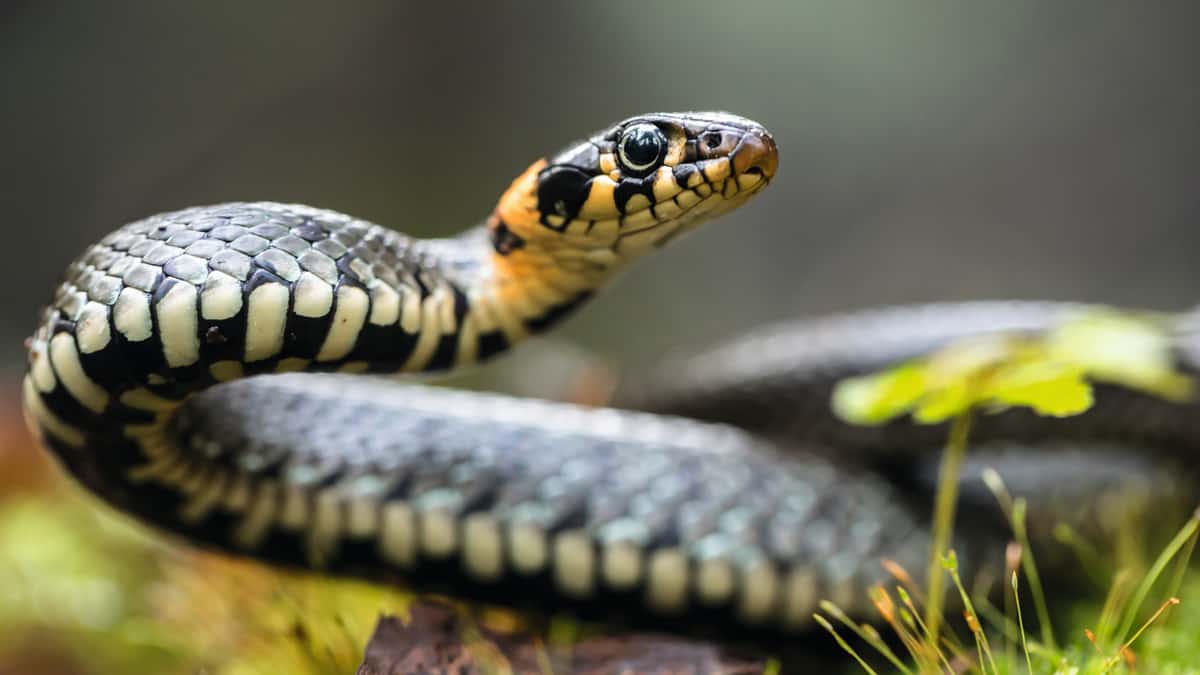
Hardly any native snake deserves a better reputation than the smooth snake. Completely non-venomous, rare and strictly protected – and yet it is killed time and time again. Its only ‘crime’: it looks similar to the common viper. For some people, that’s reason enough. They beat the smooth snake to death, mistaking it for a venomous snake or simply out of a hatred of snakes. It’s a bitter situation for both: the smooth snake and the common viper.
A closer look reveals the truth: the smooth snake has round pupils, a slender body and no continuous zigzag band along its back, as is typical of the common European adder. Instead, it has a pattern of dark spots and speckles. Reaching a maximum length of 80 centimetres, it also remains considerably smaller and less conspicuous than many of its relatives.
It owes its name to a particular hunting technique. It wraps itself around larger prey and suffocates them. Its diet consists mainly of lizards, slow worms, shrews and voles. If necessary, it will also eat earthworms or insects.
The smooth snake loves the warmth. It basks on rocks, dry stone walls, forest paths and trails. This is often its undoing. Instead of fleeing immediately when danger threatens, it relies on its perfect camouflage. This often works surprisingly well against foxes, polecats, martens, hedgehogs or birds of prey. But not so much against a mountain biker travelling at 25 km/h.
At night, in the rain or in intense heat, the smooth snake does just as we do: it retreats to its private quarters – cracks in walls, piles of stones or hiding places amongst tree roots. Its territory covers several hectares, which it often uses for years on end. These snakes are considered to be extremely site-faithful. If a smooth snake is cornered, it will bite, but its small fangs usually leave nothing more than a few harmless scratches on humans.
The species was voted Reptile of the Year in 2013 and is now under strict conservation protection. Its greatest enemy is not the buzzard in the sky, but the creeping destruction of its habitats. Dry stone walls are disappearing, hedgerows are being cleared, and fallow land is being built on.
A constrictor snake can live for up to 20 years – provided it does not fall victim to one of its two greatest threats beforehand: human prejudice or human speed.
4 | Hawkmoth caterpillar
The False Snake
Anyone who comes across this caterpillar is sometimes startled for a moment. When in danger, it puffs out its front end, rears up and displays large eye-like spots. Suddenly, this harmless creature looks like a small snake. It’s a bluff that works surprisingly often.
The caterpillar belongs to the hawk-moth family, a group of spectacular moths. Some fly by day, others by night. There are around 20 species in Europe, including the famous death’s-head hawk-moth. Its name sounds like something out of a horror film, but in fact it is more of a cunning thief: with its long, powerful proboscis, it can tap into beehives and steal honey.
Even the caterpillars are impressive, let alone the fully-grown moths. Hawkmoths are regarded as the Formula 1 drivers of the insect world. Some species reach average speeds of over 50 kilometres per hour, with some measurements even significantly higher than that. Top speed: up to 100 km/h. Their wings beat up to 90 times per second. They hover motionless in front of a flower and sip nectar like a hummingbird – a feat that only a few insects can master.
Hawk moths have truly high-tech eyes for their nocturnal forays. Their so-called superposition eyes capture even the faintest moonlight, giving them astonishing night vision. Some species even have hearing organs that allow them to detect the ultrasonic calls of hunting bats. If danger arises, they swerve at lightning speed or go into a nosedive.
Caterpillars, on the other hand, lead a much more leisurely existence. They eat leaves, like to bask in the sun on warm paths and often crawl out in the open along forest tracks or trails. That’s where their camouflage ends. The ‘snake trick’ works against birds, but not against a mountain biker travelling at 30.
Some species of hawk-moths migrate thousands of kilometres across Europe every year. They fly from Italy to Sweden, making them some of the greatest travellers in the insect world. The caterpillars, on the other hand, often manage only a few metres a day. Perhaps that is precisely their problem: if you live on the trail, you need to be faster than a studded tyre.
Service life: A few weeks as a butterfly, several months as a caterpillar.
5 | Yellow-bellied toad
The one with the skull-like gaze
The yellow-bellied toad looks as though a designer had crossed a frog with a warning sign. Viewed from above, it is a nondescript speckled grey-brown. From below, its belly glows in a striking yellow and black. These warning colours mean: Leave me alone – I taste awful.
When this little amphibian feels threatened, it displays its famous toad reflex. It arches its body, stretches its arms and legs upwards, and ostentatiously displays the warning colours on its belly and the soles of its feet. It’s the animal equivalent of ‘This far and no further!’. In fact, its skin secretes a toxic substance that thoroughly puts predators off their food.
The yellow-bellied toad is a master of survival. Unlike many other amphibians, it does not favour idyllic forest ponds, but rather makes do with whatever is available: puddles, wheel tracks, water-filled ditches or newly formed pools. In the past, floods and torrents created such habitats. Today, this role is often taken on by construction machinery, gravel pits or forest tracks.
Their call does not sound like a frog’s croak, but rather like the distant ringing of a small bell. This is where their name comes from: toads do not ‘call’, they ‘toad’. On warm spring nights, a pond full of yellow-bellied toads sounds like a poorly tuned bicycle bell orchestra rehearsal.
The animals grow to barely five centimetres in length, but can live to a surprisingly old age. Their tadpoles develop at record speed because their habitats often dry up again after just a few weeks. Speed is vital for survival.
Unfortunately, this is precisely what is becoming a problem today. The yellow-bellied toad is one of the most endangered amphibians in Central Europe. Many of its habitats are disappearing because paths are being paved, puddles are being removed and damp areas are being drained.
This little toad is particularly at risk on trails and forest tracks. It loves shallow puddles in the ruts – exactly where mountain bikes and gravel bikes ride past. Measuring just a few centimetres in length, it doesn’t stand a chance against a wide tyre.
Service life: up to 20 years.
The greatest danger: The loss of small bodies of water, road traffic – and anything that moves faster than she can hop.
6 | Tree frog
The acrobat in bright green
When children draw a frog, they usually draw a tree frog. Bright green, round as a ball, with big eyes – the European tree frog looks just like the Frog Prince himself. Except that this fairy-tale hero has now become a rare sight.
The tree frog is a master climber. Its fingers end in tiny adhesive pads, which it uses to climb up reed stalks, window panes and even vertical glass surfaces. Where other frogs hop, it climbs. Where others would fall, it hangs upside down from the branches.
Its colour is no accident. This little acrobat can change it. On a green leaf, it glows emerald green; on tree bark, it turns darker or brownish. Camouflage is vital for survival, because whilst its diet consists of flies, beetles, midges and spiders, it is often the prey of other animals. Grass snakes, herons, storks, owls and corvids all prey on this little climber.
Its eyes are particularly impressive. In the dark, its pupils dilate so much that they almost fill the entire eye. This gives the tree frog astonishingly good night vision. Its brain is also larger in relation to its body size than that of many other frog species. Whether this makes it any smarter is an open question. It is certainly clever enough, however, to catch insects with its lightning-fast, sticky tongue. Movement is the trigger. Anything that doesn’t move might as well not exist for the tree frog.
It is famous above all for its voice. The males have a large vocal sac and can croak so loudly that their calls can be heard from over a kilometre away. On warm spring nights, they transform entire ponds into amphibian opera houses. The warmer it gets, the more active they become: at five degrees, their hearts beat just ten times a minute, whereas at 21 degrees they beat almost 70 times a minute.
During the day, the tree frog is often well hidden in bushes, reeds or even in the treetops. At night, it goes hunting. It can only survive where wetlands, hedgerows and near-natural water bodies are preserved. Pesticides, land drainage, road traffic and habitat loss have caused its populations to decline dramatically in many regions.
For mountain bikers, the tree frog is rarely a typical victim on the trails. This is because it usually lives too high off the ground. However, when young frogs leave their pools in summer or when frogs migrate between habitats, they too are run over by tyres – silently, unnoticed and often far too soon.
Service life: up to 15 years.



Dimitri Lehner
Editor