Balkan Express: A cycling adventure on the new ‘Amazon of Europe’ cycle route
Jörg Spaniol
· 19.11.2023


‘Amazonas’ is a powerful word. One that conjures up all sorts of images: the jungle. Piranhas. Boas. The howls of monkeys. Half-naked indigenous people with blowpipes in narrow boats, and all sorts of other clichés. Yet on the ‘European Amazon’, commonly known as the Danube, things look rather different at the moment: Instead of sharp-toothed piranhas, there are pound-heavy freshwater fish from the carp family in a pot, and our contact from the indigenous community is called Slobodan – a relaxed, smiling elderly gentleman in a well-worn outdoor jacket, who shows us how to prepare the local fish stew after a canoe trip with his son Ljubisa has worked up a hearty appetite.

Quite exotic: cycling through the Amazon of Europe
No, this isn’t Brazil. We’re in Serbia, on a kilometre-long backwater of the Danube. And that in itself is quite exotic: foreigners rarely stray this far, and even the locals are mostly silent anglers. Not a sound to be heard apart from the occasional cry of a bird and the splash of a fish. No smell except that of damp earth, the thin smoke from Slobodan’s cooking fire, and the paprika powder that he throws into the soup by the handful. His son Ljubisa, known as Ljuba for short, teaches us our first words of Serbian: his father, a former fisherman, is a ‘salas’, a man of the river. The remote houses, where professional fishermen, amateur anglers and the occasional day-tripper gather, are ‘csardas’. The electricity supply out here consists of two old car batteries powering an old radio. Brazil’s Amazon region could hardly be more exotic. A large glass of schnapps helps you get into the spirit of the place.

When, after many hours, we finally set off on our bikes, this remote corner of Serbia had begun to take shape in our memories – and the concept behind the new cycle route had worked to some extent: Ljuba, who had to cut short his studies abroad due to the pandemic, connected us to his homeland as our guide and translator. And his fledgling outdoor company had gained two satisfied customers.
A cycle route through history
The European Union has provided a total of three million euros in funding for the ‘Amazon of Europe’ project in Austria, Slovenia, Croatia, Serbia and Hungary. Serbia is not part of the EU (though it does have candidate status), yet it is indispensable to the route – and investment there is also likely to help ease tensions. In Osijek, on the Croatian riverbank, stands a sombre monument: A small red Fiat perched on top of a Russian tank serves as a reminder of Serbia’s attack on its Croatian neighbour during the Balkan Wars of the early 1990s. For where foxes and herons now say goodnight to one another, the front line ran at the start of the war. Bullets and shrapnel still lie embedded in the walls of Osijek’s houses. The shelling left 800 people dead. And it seems that, even today, German cycle tourists are more likely to cross the border bridge than Croatian day-trippers.

It’s a right bumpy ride along the top of the dyke above the tall, marshy floodplain forest. The panniers bounce, our hands cramp up. If the lines on the GPS map are to be believed, we’re constantly switching back and forth between Serbia and Croatia – unnoticed – along tiny tarmac roads, dirt tracks and gravel paths. But this is merely a historical border that once ran down the middle of the river, before the Danube once again carved out a new course for itself. The broad river itself, which the map shows as being very close by, remains out of sight for hours on end. Is this Serbia, Croatia, Hungary? And where is the river anyway? The trees, birds and bees don’t seem to mind. And for long stretches, that’s all we see: the area between the dykes on both banks is up to 15 kilometres wide and, at high water, fills with the floodwaters of the Drau and the Danube. Large parts of the wild floodplain forests are more or less strictly regulated protected areas and bear the label ‘UNESCO Biosphere Reserve’ – an area in which sustainable management practices are tested and promoted.
At our destination: the open Danube and a magnificent sight
Ultimately, it is Hungary that brings the cyclist and the river back together – following a bitter interruption to the natural idyll. A short distance beyond the rather unspectacular border between Serbia and Hungary, an EU member state, soldiers in black pick-up trucks had kicked up a cloud of dust; a sharply cleared swathe had disrupted the gentle harmony of forest and floodplain: Hungary is building a gleaming border fence three or four metres high, topped with coils of barbed wire and watched over by sentry towers. Anyone familiar with the remains of the ‘zone border’ in Germany can picture it. Then, just a few kilometres further on, everything is relaxed and idyllic once more. Here too, amateur anglers sit by another backwater of the Danube. Nameplates at each spot indicate whether it is Gabor or Istvan casting their lines into the water.

But we park our bikes on a small, fenced-off plot and meet Endre, recognisable as a national park ranger in his hunting-green outfit. “There are more anglers than footballers in Hungary,” he jokes. But part of his job is to introduce groups of young people to the river’s natural environment without them immediately eating its inhabitants. Our fibreglass canoe glides across the still backwater into a flooded floodplain forest. It’s a slalom course through the trees, and every time Endre stops the boat, he’s spotted something new: huge white-tailed eagles, lightning-fast kingfishers – even black storks are at home here. With light strokes of the paddle, we glide on over waterlogged forest tracks and through canals. Then a gentle current pushes brownish water into the flooded forest. “It’s been raining in Germany and Austria,” says Endre, “the water’s rising.” Shortly afterwards, the floodplain forest and watercourse give way to a magnificent sight: we’ve reached the open Danube – smooth, yet alarmingly fast-flowing water. Brownish and at least 200 metres wide, the river flows past us towards Croatia, Serbia, Romania and the Black Sea. We carefully turn the bow back towards the cycle car park. We mustn’t capsize – after all, there might still be piranhas lurking here after all!?
Information about the Amazon of Europe cycle route
The concept
The “Amazon of Europe Biketrail” not only comprises a signposted route through five countries, but is also intended to provide – through additional experiences selected via the booking centre, known as “amazing moments” – selected via the booking centre, and to involve larger sections of the population in the tourism sector in regions that are, in some cases, structurally disadvantaged. Examples of such activities include nature walks, canoeing trips or preparing local specialities together. The concept was supported by the World Wide Fund for Nature (WWF) and the European Union.
GPS data
You can find the GPS data for the MYBIKE circular route along the ‘Amazon of Europe’ cycle route on the DK Tour Portal
At this point, you will find external content that complements the article. You can display and hide it with a click.
Best time to visit
Spring and autumn. The height of summer is often hot and there are plenty of mosquitoes from the floodplain forests.
Getting here
Rail: Travelling by train to the starting point in Osijek requires a bit of enthusiasm. The journey from Munich to Zagreb, including bike transport, takes around ten hours. From there, it’s another five hours at least (280 kilometres). Trains with bike transport cannot be booked online.
Bus: Flixbus takes 15 hours to travel from Munich to Osijek. If you book in good time, the journey costs just 40 euros – but only if you don’t take a bike with you; you’d have to hire one there.

Accommodation
Apatin, Serbia: Hotel Marina, Tel.: +381 (0)25 5150068, www.marinaapatin.rs
A modern apartment hotel situated right on a river branch, with views of the harbour full of fishing boats. Overnight stay in a double room approx. 40 euros.
Zmajevac, Croatia: Baranjski Dvori, Tel.: +385 (0)91 200 58 85, baranjskidvori.com.hr
A former small farmstead with a spacious courtyard and excellent regional cuisine. The friendly owner speaks English. Double room with breakfast approx. 60 euros.

General information
The most comprehensive information and GPS data for all sections of the ‘Amazon of Europe Biketrail’ can be found on the website aoebiketrail.com. This booking centre also offers organised trips covering individual sections of the route. The one-week ‘Explorer’ option includes transport to and from Mureck (near Graz) as well as the majority of our route.
Conclusion by travel writer Jörg Spaniol
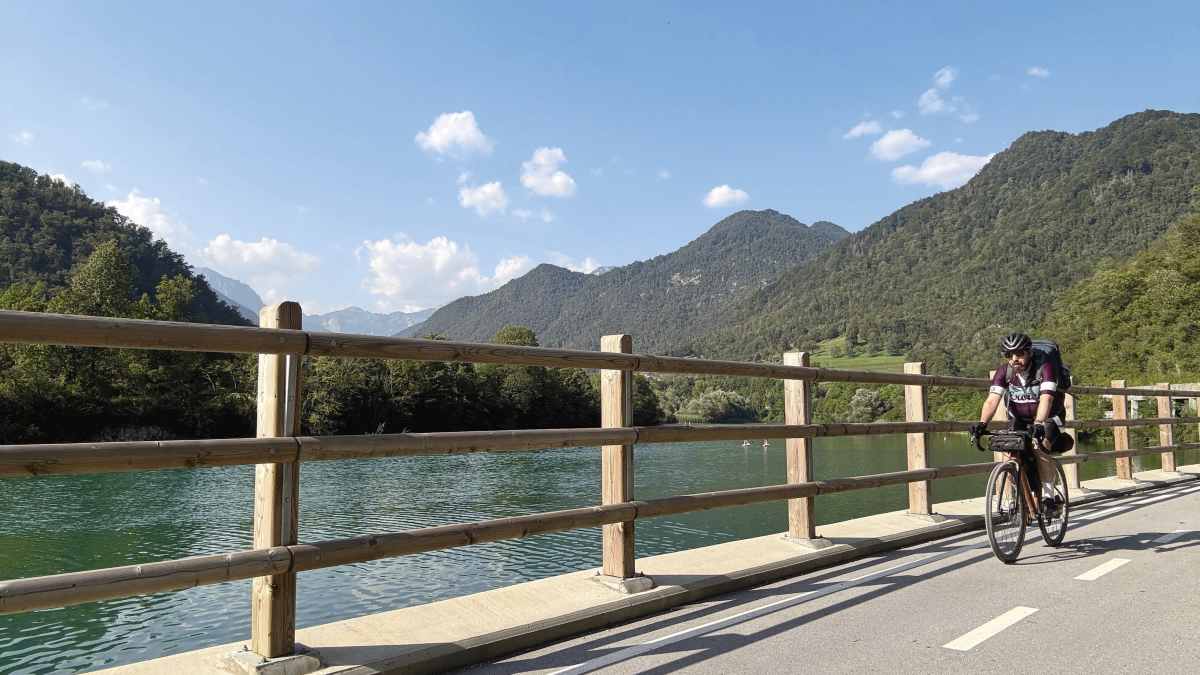
The total length of the ‘AOE Biketrails’ is just over 1,200 kilometres and runs mainly along the Drava and later along the Danube through five countries. The section we describe is the eastern part, starting from Osijek in Croatia. We have combined the northern and southern routes into a circular tour of around 270 kilometres, divided into four stages. It passes through Croatia, Serbia and Hungary. Organising your own travel to and from the route can be quite a hassle. Those with more time who are travelling by public transport should start further west. On the section we cycled, part of the predominantly flat route runs along dirt and gravel tracks, almost always with very little traffic. Thick tyres or a suspension fork are advisable.