


We at BIKE magazine have an enviable job: we get to choose the bikes for our long-term tests. We then ride them for one or two seasons, take them on trips, put them through their paces on trails and put them through their paces in the mud – and report on how they perform. The manufacturers are pleased to get some exposure, and we’re delighted with the bikes. Ideally, everyone benefits. A classic win-win situation.
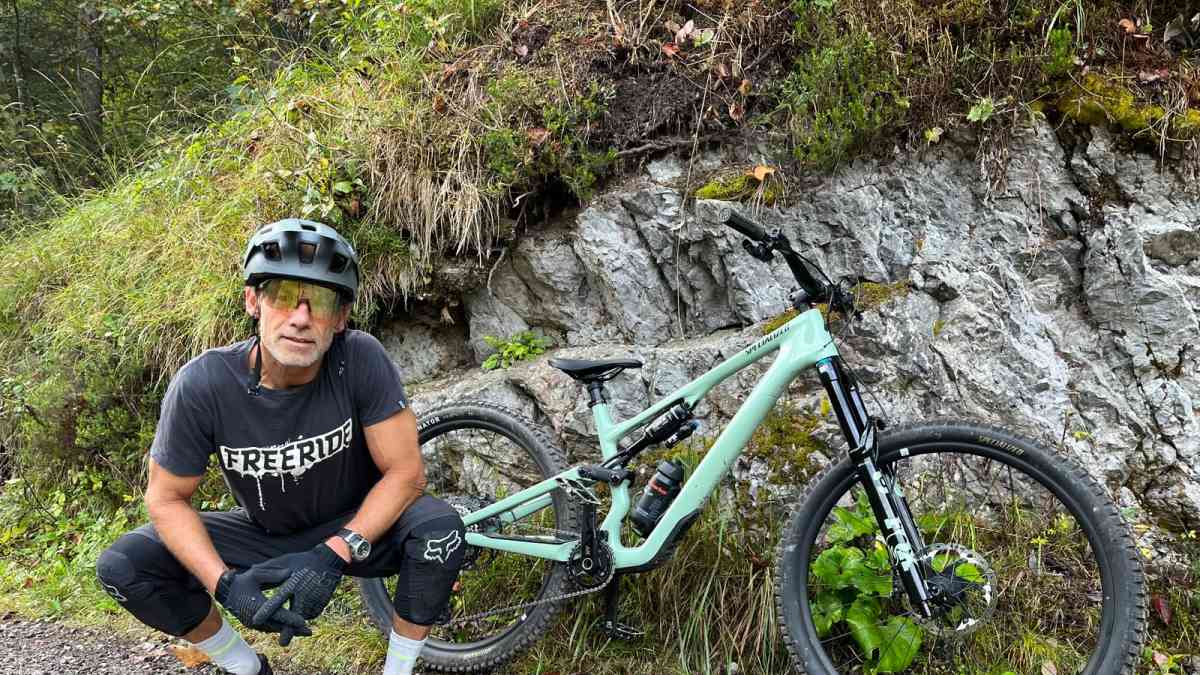
When I took delivery of my new long-term test bike at the start of the year – a Specialized Stumpjumper 15 Evo Expert – it gave me cause to look back. It’s amazing how small a fleet of bikes I’ve accumulated over the years. And, of course, it makes you feel a bit sentimental. Nostalgia mingles with romanticisation, technical specifications with memories. That’s why I’m sharing this retrospective. Here’s part one of my personal cycling history.
1991 – Raleigh USA Tangent: every beginning is rigid
My first mountain bike: a Raleigh USA Tangent. A hardtail, quite small (too small) and probably so cheap (250 dollars) because its origin was highly dubious. An endurance test in the truest sense of the word – except that the bike wasn’t provided by a manufacturer, but one I bought myself.
I cycled round Maui on this Raleigh and wrote my first travel feature about it. I sent it to BIKE and hoped for my big break. Of course, nothing came of it. Mountain bike magazines were in the midst of their boom years and were inundated with feature proposals. The internet was still a long way off commercially, and mobile phones were about as commonplace as electronic circuits. At the same time, I bought my first copy of BIKE magazine and practised wheelie drops, following a riding technique by Hans ‘NO WAY’ Rey.

Later, my Tangent was stolen outside the Cinedom in Cologne. I was heartbroken.
1993 – GT Avalanche AL: the kerb of horror
I bought my next bike myself again: a GT Avalanche AL. My idol, Hans Rey, rode a Zaskar – too expensive for me. At least the Avalanche looked similar and had a RockShox Mag 10. It felt as though it had no suspension travel, but even back then, a suspension fork was quite a sight to behold.
My fellow student Ulf wanted to have a go on the bike. “Let me have a go!” He took a run-up and rode straight into a high kerb.
Bang.
Then a long, drawn-out ‘Pfffffsssssssssst’.
Front tyre flat. I’m stunned.
"Are you daft?" I shouted.
Ulf shrugged: “It’s not my fault. The suspension fork doesn’t work at all!”
I kept the GT for a long time. A very long time. So long, in fact, that I even wore through the rims. Back then, there were still two rubber blocks pressing against the aluminium rims. Disc brakes were a thing of the future.
2000 – Scott G-Zero: now it’s getting professional
In 2000, I became an intern at BIKE. Suddenly, I had bikes at my disposal. So many and so brilliant that it left me speechless. One in particular caught my eye: the Scott G-Zero FX-2, my first full-suspension bike. With a short stem, it turned into a little freerider with an upright riding position. It was my first experience of full suspension: a steel-spring shock! Travel on the single-pivot bike: 110 millimetres. Price: 2,799 DM. But I had to be careful! If I pushed the seatpost too far into the shortened seat tube and the bike bottomed out on a drop landing, the tube would smash the shock. It happened to me. Afterwards, I got a telling-off from the test manager Markus Greber – one of the pioneers of the new freeride movement.
On the G-Zero, I attempted my first proper drop at the Munich ‘Bomb Crater’: perhaps 1.5 metres high, with a steep landing. It was known as the ‘Crater Edge’. Back then, it was a test of courage for the whole scene. There were two types of mountain biker: those who dared to take the drop – and those who didn’t. You could also say: men and mice.
My reputation was at stake. I wanted to be part of the team. So I went for the drop, even though my colleagues advised against it. They knew: the new trainee isn’t up to it. He’s got the courage, but his riding technique isn’t up to scratch. A nasty combination.
I used to fall over a lot. So often, in fact, that my colleagues didn’t even want to watch me when I took a run-up. Once, I fell so badly that my collarbone was torn from my shoulder. I ended up spending the ‘summer of the century’ in hospital. Even today, a lump on my shoulder serves as a reminder of that phase of my career.
Later, I gave the G-Zero to my little brother.
2001 – Rocky Mountain Switch: Freeride calls
The Rocky Mountain Switch was the coolest bike I’d ever seen. Angular tubes, a menacing paint job, a freerider vibe. That’s the bike I learnt to do wheelies and wheelies on, and rode along the Arctic Circle Trail in Greenland.
Technical specifications:
- Price: 3,990 euros/7,800 DM
- 16.1 kg
- 71° steering angle
- Suspension travel: 120/125 mm
- Fork: Manitou Black Elite
- Tyres: Maxxis Mobster 2.5
The Manitou Black fork was ‘the hottest thing around’ back then: 120 millimetres of travel. It wasn’t until the following year that the freeride fork came out: the Manitou Sherman. Three chainrings were still the norm. I switched to SRAM’s unusual twist shifter and was actually already riding my first tubeless tyres on Mavic rims.
2004 – Fusion Whiplash: Airtime
Now things were getting serious. The Fusion Whiplash – the name refers to whiplash – featured a specially developed Floatlink kinematic system with a floating shock absorber. It had been developed by Bodo Probst, a mastermind in the field of suspension kinematics and a former motorbike racer. In the BIKE test, the bike scored 10/10 – and still held that rating two years later.
The Whiplash gave me the confidence to tackle my first big drops and jumps that were truly worthy of the name.
I particularly remember one stunt by the River Isar. My colleague from BIKE, Florian Haymann, and I stood there, scratching our chins. Someone had placed a Northshore ladder at an angle against a fallen tree. It led steeply upwards and ended abruptly at the top. Behind it, the slope dropped off steeply. So first you went up, then straight back down again. Later, this stunt was given a name: the Boner-Log, for obvious reasons.
Florian was far more experienced than me and gave it a go first. Afterwards, he advised me against it. He’d been pushed to his limits himself.
I went anyway.
The Whiplash gave me the courage. With too much momentum, I shot up the ladder, flew over the edge and, for a brief moment, experienced that incredible sensation: weightlessness. Then gravity took hold, I plummeted downwards and actually managed to control my landing.
I rolled away.
That was it. That was freeride.
For the rest of the day, I was king.
Fun fact: Riding the Fusion Whiplash, Guido Tschugg became the first German to take part in the Red Bull Rampage in 2004 and was the first to clear the monstrous Bender-Sender.
2006 – Scott Ransom: more is more
By this time, the industry had discovered the oil press. Aluminium was given edges, corners and shapes, as if every bike had to look like a fighter jet. The Scott Ransom, designed by Peter Denk, was a prime example.
A true enduro bike, ahead of its time. At the touch of a thumb, the travel of the Equalizer shock could be reduced from 165 to 110 millimetres – handy for the climb back up. Weight: 14.9 kilos. Steering angle: 68.4 degrees.
On the Ransom, I went on long Epic Rides through the Bohemian Forest, explored Lake Como and secret trails around Lake Garda.
At Lake Como, I climbed over a stone wall to take a photo. Photographer Franz Faltermaier pressed the shutter at just the right moment. Apple and a defence contractor later bought the image for an advertising campaign. This earned Franz a rather handsome fee.
2008 – Trek Remedy: the new wave
Then came the Trek Remedy. Longer, flatter, lower: a new-school enduro bike, before the term had even become the norm. A test winner, aluminium, plenty of hydroforming – and a bike that rode so well that I really didn’t want to part with it. Weighing in at 12.9 kilos, the Remedy 8 had a wide range of uses. Price: €3,499. Head angle: 66.5°. Travel: 160 millimetres front and rear. The Lyrik 2-Step could be set to a lower position for uphill riding at the touch of a button and by compressing the suspension.
In 2008, we went on a trail hunt in Iceland; in 2009, to the Romanian Carpathians; in 2011, to the Abruzzo region; and in 2012, to Madeira.
So when I look back today, I don’t just see a row of bikes. I see places, falls, journeys, colleagues, friends and that brief moment before a drop, when you ask yourself whether you’re actually still in your right mind.
And that’s precisely why endurance test bikes are, after all, more than just test subjects. They become part of your own story. That was Part 1 of my endurance test bikes.

Dimitri Lehner
Editor