


K.I.S. steering stabiliser: Unfairly overlooked? “Guys, you’re letting so much potential go to waste”
Laurin Lehner
· 24.07.2026

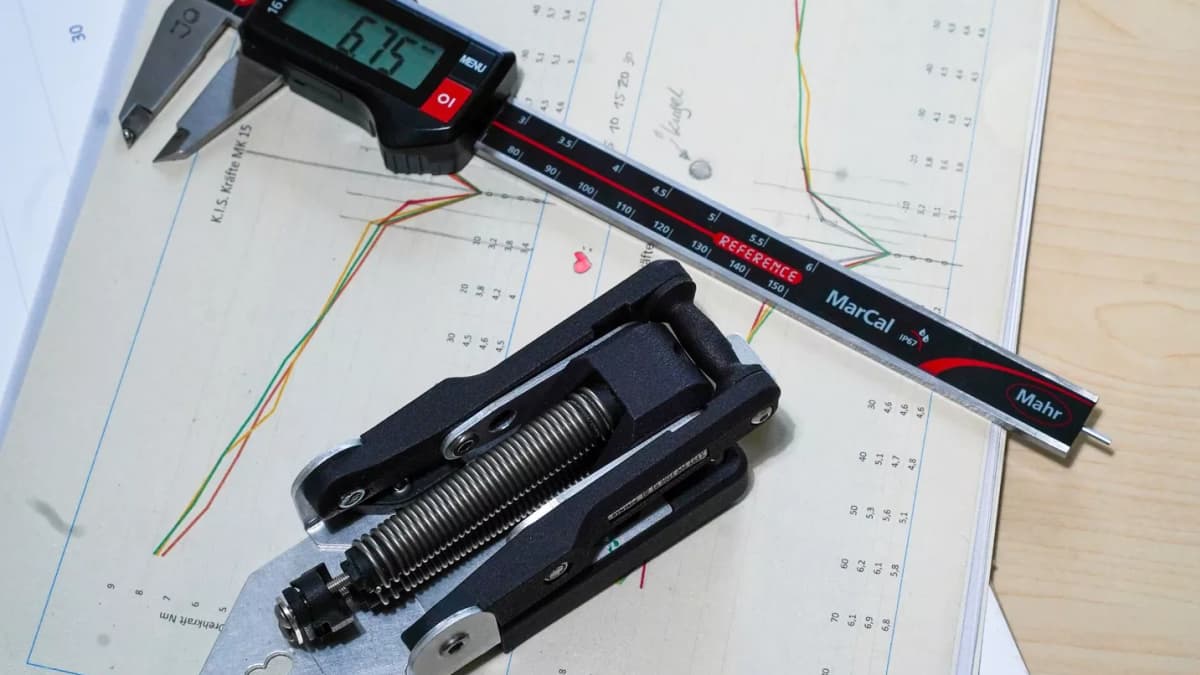
K.I.S. is a spring fitted inside the head tube of a mountain bike that dampens and stabilises steering movement. It subtly influences the bike’s handling and reduces the front wheel’s tendency to wobble – making the bike feel noticeably smoother and more stable when riding in a straight line. A nice side effect: K.I.S. is designed to eliminate the negative aspects of shallow steering angles.
In 2022, we tested this brand-new innovation. Some testers only noticed a difference once they’d increased the spring preload, whilst others could feel the effect even at the lowest setting. “I got on best with the lowest spring preload, because that way you don’t lose too much steering precision or ground feedback,” concluded tester Pablo. Tester Max only sees the benefits when things get fast and rough: “That’s when K.I.S. stabilises the bike efficiently and keeps the handlebars steady!” On alpine trails with lots of hairpin bends, we’d hoped that K.I.S. would compensate for the annoying tendency to tip over. But that didn’t happen.
Canyon now fits K.I.S. to its Spectral and Strive ON models, as well as the Sender downhill bike. Many testers rate K.I.S. highly. However, the handlebar stabiliser does not seem to have won everyone over, as other manufacturers have not jumped on the K.I.S. bandwagon.
The advantages and disadvantages of K.I.S.
+ Centre-alignment prevents unnecessary compensatory movements and, consequently, weaving. You no longer need to oversteer or overcorrect when steering, but can stay perfectly on course.
+ In slippery conditions, when there is a brief loss of grip on the front wheel, the system’s spring force still provides feedback on just how sharply you’re turning, which improves control.

+ Thanks to the balanced steering forces, you can steer more precisely despite the optimised straight-line stability, and get an even finer feel for what’s happening at the front wheel.
+ K.I.S. consists of just a few parts, is extremely durable and incurs only minimal material costs.
- The system adds between 60 and 70 grams to the weight.
- For integrated installation, you need space in the top tube.
Interview: “K.I.S. works just as well on the street.”

Robert, you watched the Tour de France – and it annoyed you. Why?
Because there’s no K.I.S. fitted. I sit there, watching the pros drive, and think: guys, you’re wasting so much potential.
After all, the system was designed for speed over rough terrain.
I once put a mate on a bike with an aero attachment – one of those long triathlon handlebars. He’d never held one in his life. Normally, the first time you ride one, you end up weaving all over the place, as if you were drunk. With KISS switched on, he rode dead straight from the very first metre. I’ve never seen anything like it. That was proof enough for me.
More important than frame stiffness?
Absolutely. And I’m not just saying that – I’ve tried it out. The effect of K.I.S. on handling is incomparably greater than if you were to double the stiffness of the frame. That sounds extreme, but it’s true.
Have you looked into that using data loggers as well?
Yes, on the road. And that’s where something interesting happens: at first glance, the data says ‘well, sort of’, but your gut feeling says ‘wow’. That gut feeling is much, much stronger than what the measurements show. But if you know what you’re looking for and take a closer look, you’ll see it in the data too.
What exactly is happening there?
You’ll be riding with a lower frequency. The turns you take will become longer and smoother. Every bike needs a bit of a wobble to stay balanced – that’s just physics. But with K.I.S., this wobbling motion is dampened and smoothed out. As a result, you simply ride in a straight line. Uphill, downhill – it doesn’t matter.
Are there situations where it gets in the way?
Pedalling out of the saddle feels a bit odd at first, because of that bobbing motion, that precise turning of the front wheel in sync with every body movement – that takes some getting used to. But you do get used to it. The only real limitation: riding hands-free at low speeds doesn’t work very well anymore. The steering inputs needed to balance are too large, which is where the suspension comes into play. From 25 km/h and above? No problem.
Back to mountain biking. Do you reckon K.I.S. is one of the major MTB innovations – alongside wheel size, single-chainring drivetrains and dropper posts?
Yes. I’d even draw up a ranking: first place goes to the evolution of bike geometry over the last ten years. Second place goes to the dropper seatpost, which has become the norm. And K.I.S.? Third place, perhaps. Given the impact it has on riding dynamics, the amount of material used is negligible.
Canyon has fitted it to some of its models. Why aren’t others following suit?
I’ve been wondering the same thing. All the engineers who’ve looked into it seriously – from Canyon to others – have been unanimously enthusiastic. But those who are sceptical have, as a rule, simply not tried it. It’s the classic obstacle to innovation: ‘That’s a solution to a problem that didn’t even exist yet.’ To be honest, that was my first reaction too. But it’s the wrong approach. You just have to give it a go.
You’ll see the benefits not just with road bikes and MTBs.
Exactly. And the answer might come as a surprise: trekking bikes or city bikes. The people who ride them are the least capable of cycling. The handlebar geometries of these bikes are often too twitchy anyway. And with K.I.S., the handling would become so much smoother that it would be an absolute game-changer. For inexperienced riders, that would be truly revolutionary.
And a road bike fitted with K.I.S. in the Tour de France – you don’t think that’s a pipe dream?
No. At first, I also thought there was no need to use K.I.S. on smooth tarmac. But that was a mistake. K.I.S. works just as well on the road.

Laurin Lehner
Editor