In this article, we use so-called affiliate links. With every purchase through these links, we receive a commission from the merchant. All relevant referral links are marked with . Learn more.
The fact that tyres play a part in the overall system of bicycle aerodynamics is not a completely new insight. Mavic was the first manufacturer to experiment with tyre/wheel systems in order to optimise aero performance. However, the most successful so far has been a co-operation between Swiss Side, Continental and DT Swiss: the Conti Aero 111 showed remarkably good properties in the TOUR wind tunnel test. The special profile prevents the airflow on the front wheel from breaking off - and this over a wide speed range from leisure to racing speed. According to our wind tunnel tests, the advantage for the overall system can amount to several watts. In addition, the handling of the tyre improves in gusty winds and the front wheel wobbles less when the aero tyre is fitted.
New tyre shape on the Pirelli
Pirelli now wants to do something similar with the new P Zero Race SL-R have achieved. However, the Italians' trick looks a little different. Pirelli relies on a slick tyre and manipulates the shape of the tyre to make the airflow more compliant. Specifically, Pirelli thickens the tyre just above the rim flange. The tyre thus merges more steeply into the rim, the sidewalls are almost vertical and - viewed in cross-section - do not take on a pear shape. Pirelli calls this patented feature "PAAS", which stands for Pirelli Advanced Aero System. It was developed in a virtual wind tunnel and tested in four (!) physical wind tunnels. The flow management system is designed to work with different rim shapes and widths.


Our test model is the slimmest version of the tyre and is nominally 28 millimetres wide; on a rim with an inner width of 23 millimetres, it bulges to a width of 30 millimetres; on the 25 mm rim, which is not compatible according to ETRTO rules, it is even 31 millimetres wide. Above the rim flange, the tyre leaves a gap of 1.8 millimetres.
The lightweight tubeless-ready carcass can be fitted by hand, and with a high-flow reserve fillmore valve, the tyre immediately pops into the rim flange. With the classic Presta/Sclaverand valve, we had to remove the valve core in order to quickly pump enough air into the tyre.
The 277 gram tyre rolls very easily on the bike. It steers agilely, corners well and is very quiet. When riding in gusty winds, the front wheel runs smoothly, but this may also be due to the aerodynamically good-natured Leeze rim. The grip of the tyre is always difficult to judge when riding freely. However, the tyre behaves flawlessly and feels secure at all times, even on wet roads.
Wind tunnel test
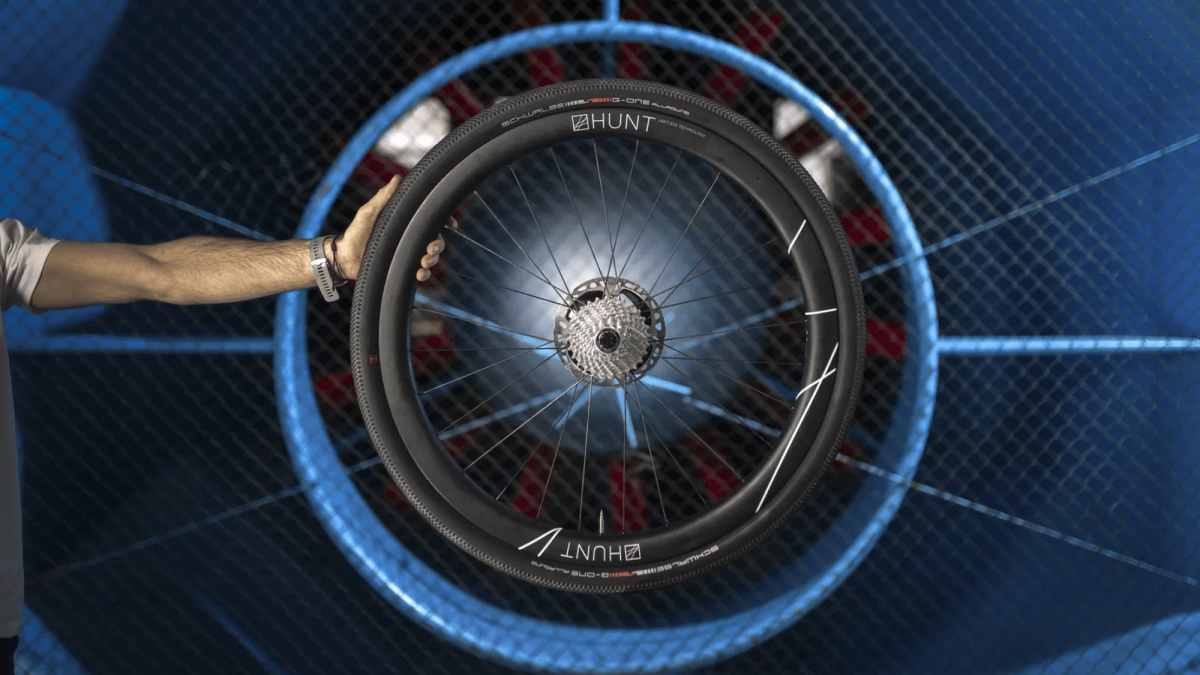
The aerodynamics test that we carried out in the GST wind tunnel in Immenstaad reveals how much the tyre contributes to the aerodynamics of the wheel and exactly what the characteristics look like. We used our standard set-up for wheel tests, consisting of the Canyon Ultimate, our reference bike for wind tunnel tests, manned with the pedalling leg dummy.
Pirelli has not designed the P Zero Race SL-R as a special front tyre, but rather for the front and rear wheels, partly because the rolling resistance has also been optimised. In our experience, however, measurable aerodynamic benefits from the tyre can only be expected on the front wheel. We have therefore limited our aero tests to the front wheel in order to save valuable wind tunnel time.
We tested the tyre on three wheels with inner widths of 19 to 25 millimetres and rim heights between 40 and 60 millimetres. To better assess the handling below racing speed, we not only tested the tyre at the standard speed of 45 km/h, but also added measurements at 37.5 and 30 km/h.
The measurements show that in terms of aero performance, Pirelli just beats the Conti GP 5000, which is always good in this discipline, but does not achieve the aero performance of the specialist Conti Aero 111. On a fast rim - we use a 50 millimetre high DT Swiss ARC 1100 - Pirelli is on a par with the Conti Aero 111 with frontal airflow and small yaw angles. However, the Conti tyre was only available for the comparison in the slimmer 26 millimetre version, which slightly favours the result.

However, the Conti Aero 111 clearly works better with a diagonal flow beyond 12 degrees yaw, and the lower the speed, the better. This doesn't matter for racing, because there the current comes more or less from the front due to the high speed. But at lower speeds and in strong winds, the "sailing potential" of the Conti tyre is greater. Weighted across all angles, the slimmer Conti Aero 111 is therefore 1 to 1.5 watts faster. In strong crosswinds at large angles, the Conti tyre saves 4 to 10 watts compared to the Pirelli. With the same tyre width, Conti and Pirelli are probably even closer together.
On a Zipp 404 wheel, Pirelli's 28-millimetre tyre is slightly faster aerodynamically than a Conti 5000 in 25 millimetres, but behaves very similarly in terms of its characteristics. On a wide Leeze wheel with an inner diameter of 25 millimetres, however, the Pirelli tyre fits very well into the good-natured airflow pattern of the rim. There is no break-off of the flow up to 20 degrees diagonal flow. In terms of handling, this means a safe ride even in gusty winds. There are predictable forces and no abrupt changes.
Our impression: Thanks to the manipulated shape of the tyre, Pirelli does not intervene as aggressively in the airflow as Continental with its deep tread pockets, but achieves a very good compromise and leaves other easy-rolling tyres behind that have not undergone wind tunnel optimisation.
Rolling resistance
This brings us to the rolling resistance. As usual, we use our manufacturer-independent measurement method to measure the rolling resistance on two surfaces, a very fast concrete track and a rough track. According to this, the P Zero Race SL-R belongs to the group of the fastest tyres at the level of special time trial tyres. At 35 km/h, we measured a rolling resistance of just 13.2 watts at 5 bar for a system weight of 85 kilograms. In terms of measurement accuracy, this is the level of the Conti TT time trial tyre with a width of 28 millimetres and an excellent value. The new Pirelli tyre beats the Conti GP 5000 S all-rounder in terms of rolling resistance and fulfils the promise of being faster than the P Zero RS.

The tyre works particularly effectively on rough surfaces. To put it in perspective: Pirelli's racing pellet rolls more easily on the very rough test track than an average tyre on perfectly smooth asphalt. Fascinating!
Despite the great smoothness, the tyre offers enough rubber for a normal mileage. In the centre, the tyre is only 1.9 millimetres thick, which is very little. Thanks to the very thin carcass, around 1.5 millimetres of this is accounted for by the rubber layer - a normal thickness for a lightweight racing tyre, which should therefore have a range of several thousand kilometres. A thin puncture protection layer is integrated, but only has a below-average effect. We measured 330 newtons of puncture resistance, which is at the lower end of the spectrum. Pirelli puts the puncture protection on the healing power of the sealant in the tubeless setup.

Conclusion on the aero road bike tyre
With the P Zero Race SL-R, Pirelli has succeeded in creating an outstandingly fast racing tyre that combines many characteristics: the smooth running is excellent, as with a time trial tyre, the aero performance is better than most other tyres and it works on three rim types in the test. The rubber and puncture protection are appropriate for the intended use.
At the start of sales, the tyre is available in 28 and 30 mm widths, with a 32 mm model to follow after the summer. The recommended retail price is 99.99 Euro per tyre. The tyre is manufactured in Bollate near Milan.