


Race Face Atlas 55 Handlebar Review: Plenty of rise, a fair price, not much to get excited about
Max Fuchs
· 23.09.2026


In this article, we use so-called affiliate links. With every purchase through these links, we receive a commission from the merchant. All relevant referral links are marked with . Learn more.
Conclusion by Max Fuchs, BIKE test editor
The Race Face Atlas 55 makes no secret of the material it uses: instead of a delicate carbon frame, it features solid 7000-series aluminium. The result is an unspectacular ride – and that’s exactly what makes it so good. The Atlas feels like a stable, ultra-reliable gravity-riding handlebar, whilst still allowing for a little vertical give.
In a direct comparison with the the Race Face Era 55 Carbon we tested It lacks that distinctly comfort-oriented feel. On the other hand, at 89.99 euros, the Atlas costs almost half the price of the carbon model, which retails at 170 euros. For those looking for high handlebars on a downhill-oriented bike and who prefer sturdy aluminium to ultra-lightweight construction and finely tuned carbon flex, the Atlas offers a straightforward solution.
Key facts
- Model: Race Face Atlas Riser
- Rise: 55 mm
- Width: 800 mm
- Clamping: 35 mm
- Material: 7000 series aluminium
- Weight: 318 g
- Backsweep: 8°
- Upsweep: 5°
- can be shortened to: 760 mm
- Suitable for: Downhill, bike park, freeride, all-mountain, enduro and e-MTB
- Price: 89.99 euros >> available here
55-millimetre rise for the high front end
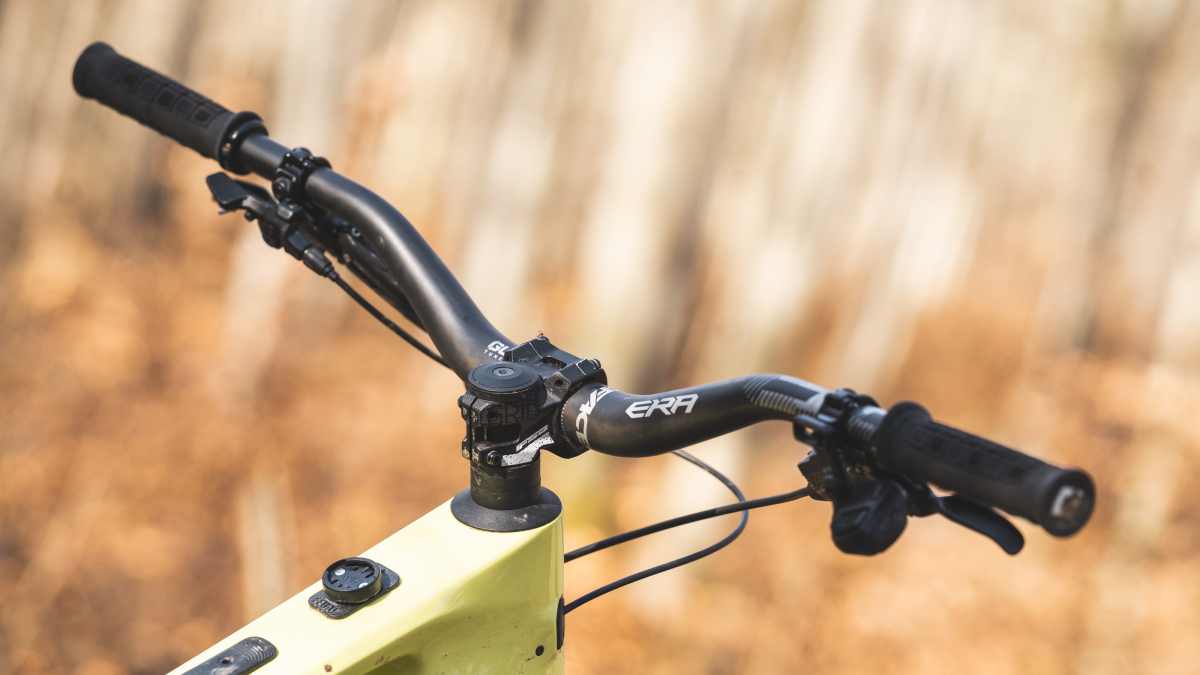
With a rise of 55 millimetres, the Atlas is one of the taller handlebars in the MTB sector. The basic concept is already familiar from the Era 55 Carbon: a high front end can create a more upright, central and safer riding position, particularly on modern, long-wheelbase bikes. As well as a safer riding position, this also increases the range of movement on the bike, making it easier to handle overall.

The Atlas adopts the key specifications of its carbon counterpart: 55-millimetre rise, 8-degree backsweep, 5-degree upsweep and 35-millimetre clamping. At 800 millimetres wide, it comes out of the box at a generous width and can be shortened to 760 millimetres.
Aluminium instead of carbon, but still with GL-Tune
The main difference compared to the Era 55 lies in the material. The Atlas is made from 7000-series aluminium and weighs 318 grams. By contrast, the Era 55 Carbon, which we tested previously, weighs in at 230 grams and features a carbon construction designed for flexibility and comfort. Although, on paper, the Atlas also features GL-Tune – which is designed to dampen vibrations – the effect is significantly less pronounced on the aluminium model than on its carbon counterpart.
The difference compared to the Era 55 Carbon
Anyone familiar with the Era 55 will quickly notice the difference. The carbon handlebars have a noticeable give and provide a slightly springy feel on rough terrain. It is precisely this combination of precision and comfort that was the key insight behind the lightweight high-rise handlebars.
The Atlas also allows for a degree of flex, but does not quite match the level of comfort offered by the Era 55. It feels solid and less supple.
However, that needn’t necessarily be a disadvantage. On a gravity-oriented bike in particular, a solid aluminium handlebar can subjectively inspire confidence. This is less a measurable technical characteristic than a matter of personal feeling: carbon feels more delicate, whilst aluminium feels more familiar and safer.
And following a heavy impact, the thought of a traditional aluminium cockpit simply feels more reassuring to some riders. Regardless of the material, the following naturally applies: after a crash, the handlebars must be inspected and, if there is any visible damage, replaced. The manufacturer’s specified assembly and torque settings must also be adhered to, even though carbon is significantly more sensitive to over-tightened bolts than aluminium.
Driving impressions: Low-key is good here
On the trail, the Atlas 55 is rather unremarkable. It rides just like a sturdy 35-millimetre aluminium handlebar, just with a slightly greater rise than usual.
It does allow for a little flex, but the solid, indestructible feel is the dominant characteristic. It lacks the characteristic, slightly springy feel of the Era 55 Carbon.
However, this approach works particularly well on a gravity-oriented bike. The handlebars require no special getting used to and have no noticeable quirks. If you’re looking for a defined high level of comfort, the Era is the better choice. If, above all, you want a tall, robust and confidence-inspiring handlebar, the Atlas is the more suitable option.
Price: significantly cheaper than carbon
The Atlas also plays its aluminium card when it comes to price. The recommended retail price is 89.99 euros. At present, the 55-millimetre Atlas is already on sale at lower prices in some German shops.
By way of comparison: according to our test, the Race Face Era 55 Carbon costs 170 euros. This means there is a price difference of just over 80 euros between the two models.
Even when compared with other aluminium handlebars, the Atlas remains within the usual price range. By way of comparison: the Deity Highside 35 with a 50-millimetre rise, for example, is priced at 84.99 euros.
So the Atlas isn’t a cheap handlebar; in terms of price, it’s pretty much exactly where you’d expect a high-quality Gravity aluminium handlebar to be.
Editorial commentary
The Race Face Atlas 55 takes a different approach to the Era 55 Carbon. Whilst the carbon handlebars combine low weight with controlled flex and a high rise, the Atlas offers a superb blend of aluminium, stability and an indestructible ride feel.
This makes it an attractive option for riders who want to raise their cockpit without having to spend 170 euros on a carbon handlebar. Even those who are generally sceptical about carbon fibre in the cockpit will find this an exciting alternative.
The downside is just as clear: at 318 grams, the Atlas is significantly heavier than the Era 55, which weighs just 230 grams. And when it comes to riding comfort, the aluminium counterpart cannot replicate the finely tuned flexibility of the carbon handlebar.

Max Fuchs
Editor