


A revolution from within: How Pinion is making its mark in the challenging e-bike market
Josh Welz
· 16.06.2026


The cycling industry is currently going through a turbulent phase: whilst some manufacturers are struggling with insolvencies and pressure from new, aggressive competition from Asia, the gear system specialist Pinion is forging its own confident path. The Denkendorf-based company has been revolutionising the market since 2008 with internal gear hubs that are mounted directly on the crankset rather than on the rear wheel. Since 2023, Pinion has been combining this automotive technology in a pioneering motor-gear unit (MGU).
Following the recent merger under the umbrella of “Rotax Bike Technology” (RBT), Pinion is now joining forces with the system architecture of the FIT brand. In this interview, Dirk Menze, Head of Marketing at Pinion, explains why the e-bike of the future requires less maintenance and more system integration, why the “arms race” trend in motors is leading to a dead end, and why Pinion remains firmly committed to its production base in Germany.
Thomas Geisler, BIKE/Pd-f: Dirk, Pinion is known for shifting gears not at the rear wheel, but centrally within the frame. What exactly is the advantage of this technology, and where does the company stand today?

Dirk Menze: We have shaken up the bicycle market to some extent since 2008. At its core, our central gearbox technology is based on tried-and-tested automotive gearbox technology. We are bringing these standards to the bicycle industry because we believe that bicycles are serious modes of transport within the modal mix, not toys.
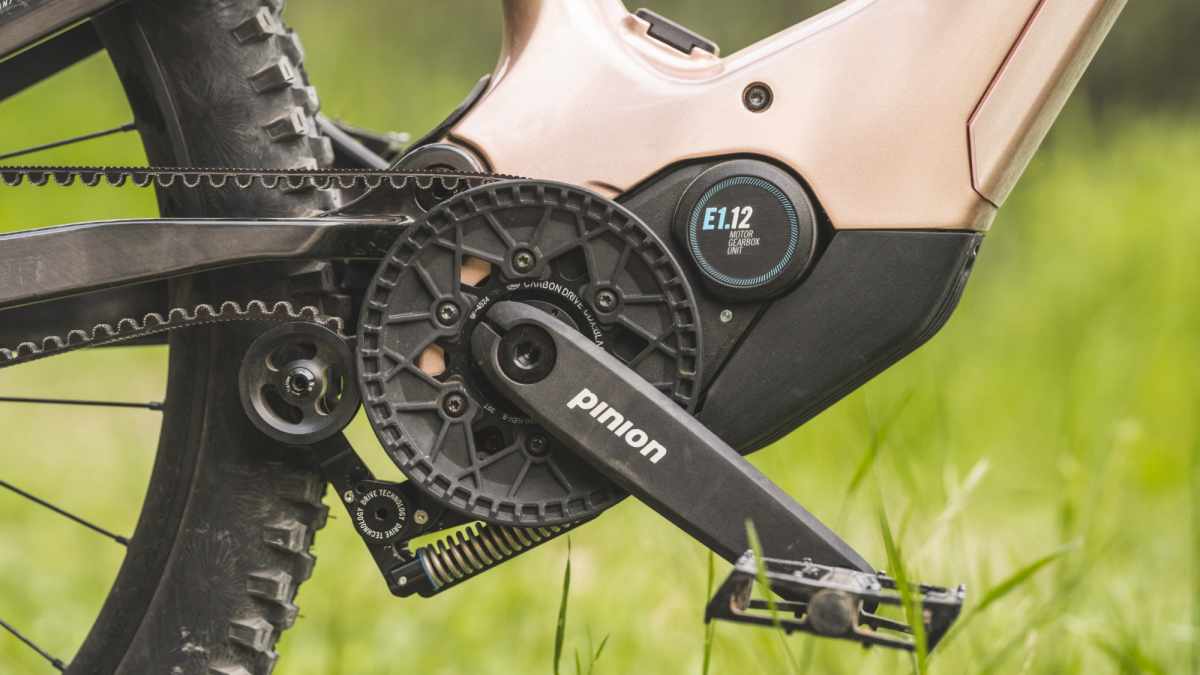
The aim is to offer consumers a low-maintenance, wear-free complete system. We now supply around a hundred brands across Europe. The year 2023 marked a major milestone when we unveiled our Motor-Gearbox Unit (MGU). It literally brought together what belongs together: the motor and gearbox combined into a single, enclosed unit.
There’s a lot of talk in the cycling industry at the moment about a sense of crisis and insolvencies. Does that leave Pinion unscathed?
Dirk Menze: Yes, many market players are facing extremely challenging circumstances. We are deliberately taking the opposite approach by joining forces. At Eurobike, we will be presenting ourselves in partnership with the FIT brand under the auspices of RBT, which stands for Rotax Bike Technology is part of. RBT, in turn, is part of the large Canadian group Bombardier Recreational Products (BRP), of which Pinion has been a part for some time. Thanks to this partnership, we now operate as a single, cohesive unit and have extremely strong partners in Rotax and BRP behind us. We are pooling our resources across our structure, processes and service organisation. This gives us tremendous staying power.
So far, Pinion systems have mainly been found in the absolute premium segment, for example at Riese & Müller. Are there any plans to bring this high-tech system to the wider mass market?
Dirk Menze: Of course, we already work with major partners such as Kettler and Pegasus, who have a very strong market presence across the board. But it’s true: thanks to the combination of sophisticated gear technology and a mid-drive motor, we operate in a premium niche. Our products come at a price, but they also offer absolute ‘peace-of-mind benefits’, such as service intervals of just every 10,000 kilometres. Nevertheless, we definitely have ideas for setting other price points. At this year’s Eurobike, this isn’t yet a major topic for the public, but the collaboration in service and infrastructure will pave the way for this.
An interesting trend is emerging in the US: Lectric, the American e-bike giant, is offering a compact bike for under $2,000 that combines a Pinion gearbox with a rear motor. Is this a model for the future?
Dirk Menze: Whilst our integrated motor-gearbox unit (MGU) is primarily used in Europe, the US example of Lectric demonstrates just how well our gearbox platform works with rear-mounted motors. Here in Europe, we also collaborate with brands such as Stromer, Opium and the Mahle rear-motor system. North America has a completely different understanding of e-bikes than Central Europe. There, the bike is less of a car replacement or prestige product, but rather needs to be affordable and simply fun to ride. Such rear-motor configurations allow for very different price points and help with market penetration. Nevertheless, Europe remains our main market.
Another key consideration for the mass market is ease of use. You have been offering fully automatic gearboxes for some time now. How has this been received?
Dirk Menze: Absolutely brilliant. We’ve been using fully automatic gear changes in our MGU for over two years now, and since the start of the year we’ve also been offering automatic modes for our single-speed transmission solutions. For many everyday riders, this is a real no-brainer: you no longer have to think about changing gears, you always have the right cadence and can simply enjoy the tailwind. At the same time, however, we also cater to performance-oriented customers in the e-mountain bike sector via the electric gearshift. There – much like in rallying – you can change gears lightning-fast and reliably in absolutely any riding situation, something that isn’t possible with a traditional derailleur.
The e-bike boom has also sparked a debate about increasingly powerful motors and tuning. A Chinese manufacturer is currently making inroads into the European market with bikes boasting extreme performance figures. Is more regulation needed here, or should the motto be ‘higher, faster, further’?
Dirk Menze: This is a very broad topic. I believe the current regulations in Europe are good and important for safety reasons. We are increasingly hearing feedback from dealers that many end customers are already overwhelmed by the current power output of the motors and are even causing accidents. More power does not automatically mean a better product. We see this in the debate about battery sizes too: two years ago, everyone still thought we needed huge 1,500-watt-hour batteries. Today we know that we need smarter technologies and better energy efficiency.
When new players focus solely on raw power figures and sheer torque, it is often a marketing strategy designed to set themselves apart. However, an extremely powerful engine will, in the long run, damage the transmission components if the system is not designed as a whole. This leads to high follow-up costs and frustration for the customer. We rely on discerning customers who recognise that a maintenance-free, finely tuned drivetrain is far more valuable than simply outdoing the horsepower figures.
Despite the price pressure from Asian suppliers, you remain firmly committed to manufacturing in Germany. Why is this so important to you, and how does it make economic sense?
Dirk Menze: Firstly, because this is where we’re based. I don’t want to move abroad just to produce more cheaply for a market that’s actually right here in Central Europe. Our entire corporate culture is built on the expertise of the local automotive industry and its supply chain; this is where our key players in the network are based. Of course, there is an aggressive Asian pricing policy based on different subsidies and lower wages. And there will always be customers who have to focus primarily on the euro.
But we offer the sustainable alternative. A huge advantage of our location is that our systems are 100% repairable. Because we manufacture centrally in Europe, we can replace individual parts instead of simply throwing away faulty drives. This is the circular economy in action, rather than a throwaway mentality. That is why we remain absolutely committed to Germany as a business location.
Josh Welz
Editor-in-Chief