


Upside-down suspension forks: An uneven contest: top dog Fox Podium vs. underdog KYB
Laurin Lehner
· 08.09.2026


Upside-down forks are enjoying a revival. Yet this inverted design faced strong opposition for a long time – even from specialist magazines such as BIKE. Its supposed shortcomings: insufficient stiffness and excessive weight. Funnily enough, nothing has changed technically, but the spirit of the times is a fickle thing, and it’s taken a shine to upside-down forks. The criticism has died down – because a) weight no longer plays such a major role in bikes in this downhill category. And because b) soft forks certainly have their appeal – they cause less fatigue for the rider and carve their way through rough terrain with a headstrong elegance. The result: more traction! Another nice side effect: the oil is always in contact with the seal – which improves responsiveness.
Just a trend?
In the World Cup, the trend towards greater flex is becoming increasingly apparent: frames, handlebars and wheels are once again increasingly made of aluminium rather than stiff carbon. Fox got the ball rolling in 2024 with its Podium single-crown fork. Others are now following suit – Cane Creek, for example, or KYB.
The Dominator: Fox Podium
In 2025, we tested the Fox Podium for the first time. And because only comparative tests provide genuine insight, we included the top dogs of the enduro fork market – the Fox 38 and RockShox ZEB (the 2025 models at the time). On paper, the Podium caused some concern beforehand: a full 300 grams heavier than the 38 Factory of the time and almost twice as expensive as the ZEB Ultimate from RockShox. Ouch. Early criticism, and of the negative sort. But out on the trail came the surprise: the Podium is a force to be reckoned with. It swallows up rough terrain, craves traction and spares the rider’s arms with an almost caring consistency. It even came out on top in our rankings, ahead of the class leaders, the RockShox ZEB Ultimate and the Fox 38 Factory. That’s why we’ve now ordered it again for our challenger, KYB.

The challenger: KYB
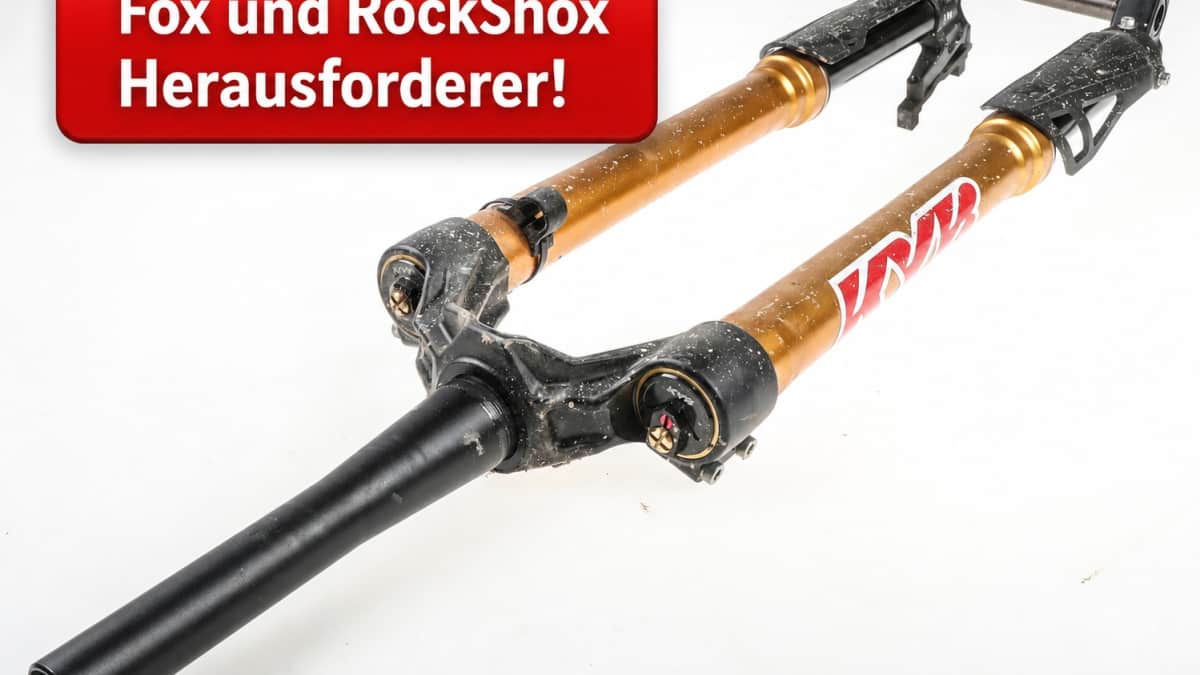
KYB – ever heard of it? Even industry insiders shrugged when we mentioned Forke. Yet KYB is one of the world’s largest manufacturers of hydraulic systems and shock absorbers. Founded in 1919, the company produces suspension components for motorbikes, cars and construction machinery, as well as hydraulic pumps and concrete mixers. Now KYB is making a push into the MTB market – and forgot to give the fork a name in the process. The rather plain model name is BFF-160-G1, which sounds like a forgotten IKEA shelf. We were given exclusive access to test it and didn’t make things easy for it by choosing the Podium as its sparring partner. The weight will make gram-counters howl – the KYB is a further 160 grams heavier than the already chubby Podium, and it has a travel of just 160 millimetres. The motorbike influence is evident in the set-up: Phillips-head screws and a rebound adjustment that is set at the top of the fork crown – rather than at the dropouts, as with conventional forks. The compression damping adjustment, on the other hand, is located at the fork leg. The left stanchion houses a conventional steel coil spring, as is common in the motocross sector. The right stanchion houses the damping cartridge with an Air-Assist air chamber, which allows the spring rate to be further adjusted using air. At 1,800 euros, the KYB is no bargain, but it is still a full 600 euros cheaper than the Fox Podium Factory.
The laboratory speaks...
…as expected, both forks demonstrate lower stiffness in the laboratory than conventional suspension forks such as the Fox 38 or RockShox ZEB. In terms of torsional stiffness, the Podium is almost half as stiff as its counterpart, the Fox 38. The KYB, however, is a touch softer still. Whilst low torsional stiffness in a fork can certainly be seen as a positive, high compression stiffness is always better. Here, the Podium achieves better results than the Fox 38 or the RockShox ZEB. The KYB has the lowest – and therefore worst – laboratory result in this respect. Weighing 2,949 grams, the KYB is also 500 grams heavier than the Fox 38.
Hands-on review: Fox Podium Factory
Fox is still Fox. Setting up the Podium Factory is just as intuitive as with all Fox Factory forks. A sticker provides the recommended air pressure for the rider’s weight – along with click-based guidance for compression and rebound damping. No guesswork, no frustration. The high- and low-speed compression can be adjusted on the fork crown without tools, with 8 and 18 clicks respectively. Setup enthusiasts will also be delighted to find high- and low-speed rebound adjustment.
Let’s go!
A real ‘aha’ moment right from the start: On our rough, root-strewn test track, the Podium not only treated us to a comfortable ride but also delivered impressive traction – we felt this particularly in root-strewn bends, where other forks tend to bounce around; the Podium cut into the bend as if on rails. We certainly noticed the lower torsional stiffness – but it was entirely positive and provided a noticeable boost to comfort. When the pace picked up and things got serious, the Podium ensured impressive stability at the front. Steps, ridges, thick root trunks – the Podium absorbed them like a slot machine swallows a gambler’s coins – in, gone, on to the next! Only on small, rapid impacts did its rival, the KYB, respond with even greater sensitivity. Even intensive experimentation with the rebound damping didn’t help. However, there’s one thing the Podium does better than the KYB: absorbing big, hard impacts. It utilises its full suspension travel and remains pleasantly progressive towards the end of the stroke – force peaks are cushioned, whilst control is maintained.
- Adjustment options Air pressure, high- and low-speed compression and rebound damping, volume spacers
- Max. disc diameter / Weight limit 230 mm / 169 kg
- Riser pipe Ø 38 mm
- Available suspension travel 160, 170 mm
- Weight 2,786 grams
- Installation length 595 mm
- Torsional stiffness / Braking stiffness 17.3 Nm/° / 355.1 Nm/°
| Fox Podium Factory | |
| Comfort (30%) | 1.0 |
| Assessment (30 per cent) | 1.3 |
| Handling (20 per cent) | 2.0 |
| Weight (15 per cent) | 3.5 |
| Braking stiffness (5 per cent) | 1.0 |
| Overall mark | 1.7 |
Conclusion
The Fox Podium Factory is a real cracker. Comfort, traction, speed – it excels in every area and, in practice, even outperforms the test-winning Fox 38 fork. Only two things mar the picture: the price (!) and the weight.
Practical test KYB BFF 160-G1
First of all, everything’s different. The small red dial at the top of the fork crown adjusts the rebound – with two turns, without clicks. That might not sound like much, but even half a turn makes a noticeable difference. At the bottom, near the dropout, only the single compression stage can be adjusted (20 clicks). All adjustments require a flat-head screwdriver. With a ride weight of around 80 kilos, we managed fine with the medium steel spring – though we were at the upper end of the range. Further adjustment can be made here using air on the cartridge side.
Departure: The element of surprise
Run number 1: The testers can’t believe their eyes. Instead of surrendering like a docile sacrificial lamb, the KYB puts up a real fight against the mighty Podium – and surprises with sensitive responsiveness and massive downhill potential. And that’s despite having less travel. Just like the Podium, the KYB builds up plenty of traction, gives the rider control and sends a clear message: “Keep your foot off the throttle, I’ve got this under control.” With its slightly lower torsional stiffness, it practically glides through fields of stones and tangles of roots, actively seeking contact with the ground and skilfully absorbing impacts. On small, rapid bumps, it even plays its greatest trump card – here it performs with even greater finesse and control than the Podium. It’s only when faced with big bumps, drops, steps and gaps that it reacts less controlled and releases the suspension travel too quickly. Here, the Podium pulls ahead, though it also benefits from an extra centimetre of suspension travel.
- Adjustment options: Steel spring, air-assisted suspension, single compression and rebound damping
- Max. disc diameter / Weight limit 203 mm / 120 kg
- Riser pipe Ø 32 mm
- Available suspension travel 160 mm (soon to be 170 mm)
- Weight 2,949 grams
- Installation length 580 mm
- Torsional stiffness / Braking stiffness 13.3 Nm/° / 252.8 Nm/°
| KYB BFF 160-G1 | |
| Comfort (30%) | 1.3 |
| Assessment (30 per cent) | 1.3 |
| Handling (20 per cent) | 2.0 |
| Weight (15 per cent) | 4.0 |
| Braking stiffness (5 per cent) | 2.5 |
| Overall mark | 1.9 |
Conclusion:
A successful debut – please stay, preferably with more suspension travel. The KYB impresses with superb responsiveness, power and traction. The set-up takes some getting used to, and the hefty weight limits its range of use.
How BIKE carries out its tests
Laboratory: Our suspension forks are tested by our test laboratory. As well as weighing, the programme also included stiffness measurements.
Practice: To ensure maximum comparability, we tested KYB’s upside-down competition model on identical test bikes. We rode them on various trails at the Geisskopf Bike Park. For the set-up, we initially followed the manufacturer’s recommendations and then gradually fine-tuned the settings to find the optimum configuration.

Reactions to the match:
I’m no advocate of lightweight components, certainly not when it comes to enduro bikes – yet both forks weigh in at quite a lot. You’ve got to really want that and ask yourself why you don’t just go for a Fox 38 Factory or a RockShox ZEB Ultimate straight away.
Max Fuchs, BIKE test editor
Wow, I wouldn’t have thought that the newcomer from Japan would come so close to the big player from Fox. Sure, the KYB weighs a further 160 grams more than the already rather chunky Podium – but in practice, on the descents, I didn’t notice any difference. What’s more, it’s a full 800 euros cheaper.
Dimitri Lehner, BIKE test editor
The Podium from Fox was the clear favourite, whilst the KYB – which has no real model name – was the challenger with supposedly slim chances; after all, the Podium had set the benchmark in the last comparative test. The fact that the KYB is closing the gap so closely is a real treat for testers.
Laurin Lehner, BIKE test editor

Laurin Lehner
Editor