


In this article, we use so-called affiliate links. With every purchase through these links, we receive a commission from the merchant. All relevant referral links are marked with . Learn more.
KYB – ever heard of it? Even industry insiders shrugged when we mentioned Forke. Yet KYB is one of the world’s largest manufacturers of hydraulic systems and shock absorbers. Founded in 1919, the company produces suspension components for motorbikes, cars and construction machinery, as well as hydraulic pumps and concrete mixers.
KYB Goes MTB
Now KYB is making a push into the MTB market – and forgot to give the fork a name in the process. The rather plain model name is BFF-160-G1, which sounds like a forgotten IKEA shelf. We were given the exclusive opportunity to test it.
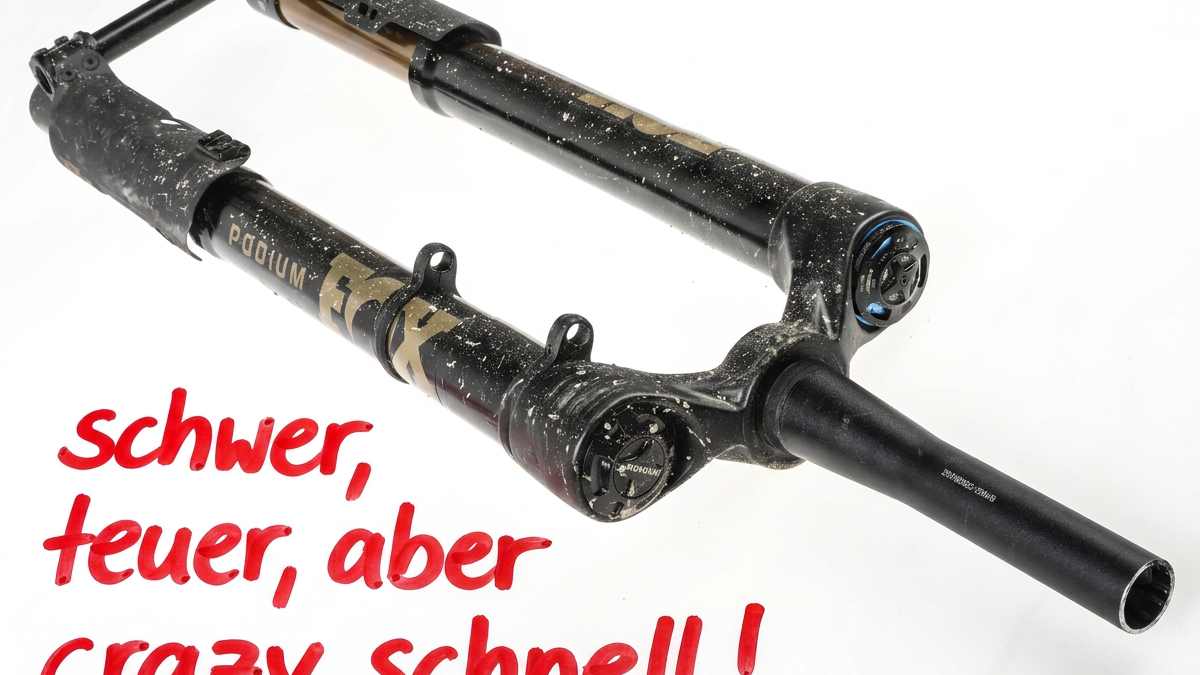
The weight is enough to make gram-counters howl – the KYB is a further 160 grams heavier than the already chunky top-of-the-range Fox Podium upside-down suspension fork. And it only has 160 millimetres of travel. The motorbike influence is evident in the setup: Phillips-head screws and a rebound adjustment that is set at the top of the fork crown rather than – as with conventional forks – at the bottom near the dropouts. The compression adjustment, on the other hand, is located at the fork leg.

The left stanchion contains a conventional steel coil spring, of the type commonly used in the motocross sector. The right stanchion houses the damping cartridge with an air-assist chamber, which allows the spring rate to be further adjusted using air.
At 1,800 euros, the KYB isn’t exactly a bargain, but it is a full 600 euros cheaper than the Fox Podium Factory. According to KYB, sales will begin in December 2026.
Test: KYB BFF -160 - G1
Adjust first, then drive.
The set-up: Unusual
First of all, everything’s different. The small red dial at the top of the fork crown adjusts the rebound – with two turns, without clicks. That might not sound like much, but even half a turn makes a noticeable difference. At the bottom, near the dropout, only the single compression stage can be adjusted (20 clicks). All adjustments require a flat-head screwdriver. With a ride weight of around 80 kilos, we managed fine with the medium steel spring – though we were at the upper end of the range. Further adjustment can be made here using air on the cartridge side.
Departure: The element of surprise
Run 1: The testers can’t believe their eyes. The KYB surprises with its responsive handling and massive downhill performance – despite having just 160 millimetres of suspension travel. The KYB builds up plenty of traction, gives the rider control and sends a clear message: “Keep your foot off the throttle, I’ve got this under control.”
With its very low torsional stiffness, it practically glides through rocky terrain and tangles of roots, actively seeking contact with the ground and skilfully absorbing impacts. On small, rapid bumps, it even plays its greatest trump card – here it performs with extreme sensitivity and control. It is only on large impacts, drops, steps and gaps that it reacts somewhat uncontrollably and releases the suspension travel too quickly.
Conclusion:
A successful debut – please stay, preferably with more suspension travel. The KYB shines with superb responsiveness, power and traction. The set-up takes some getting used to, and the hefty weight limits its range of use.
In a nutshell
- Adjustment options: Steel spring, air-assisted compression, single compression and rebound damping
- Max. disc diameter: 203 mm
- Weight limit: 120 kg
- Riser pipe: Ø 32 mm
- Available suspension travel: 160, (expected to be 170 mm soon)
- Installation length: 580 mm
- Torsional stiffness / braking stiffness: 13.3 Nm/° / 252.8 Nm/°
- Weight: 2,949 grams
- Price: 1,800 euros (According to KYB, sales will begin across Europe in December)
How BIKE conducts its tests
Laboratory: Our suspension forks are tested by our test laboratory. As well as weighing, the programme also included stiffness measurements.
Practice: To ensure maximum comparability, we tested KYB’s upside-down competition model on identical test bikes. We rode them on various trails at the Geisskopf Bike Park. For the set-up, we initially followed the manufacturer’s recommendations and then gradually fine-tuned the bike to achieve the optimal set-up.


Laurin Lehner
Editor