


In this article, we use so-called affiliate links. With every purchase through these links, we receive a commission from the merchant. All relevant referral links are marked with . Learn more.
The two leading brands, Fox and RockShox, have relaunched their enduro forks this winter. The rivals have been vying for the favour of cyclists for years. We are the Fox 38 rode a Mondraker Foxy on our test tracks at the Geißkopf Bike Park until we’d formed a definitive opinion of the fork.
The relaunch of the Fox 38 – here’s what’s new
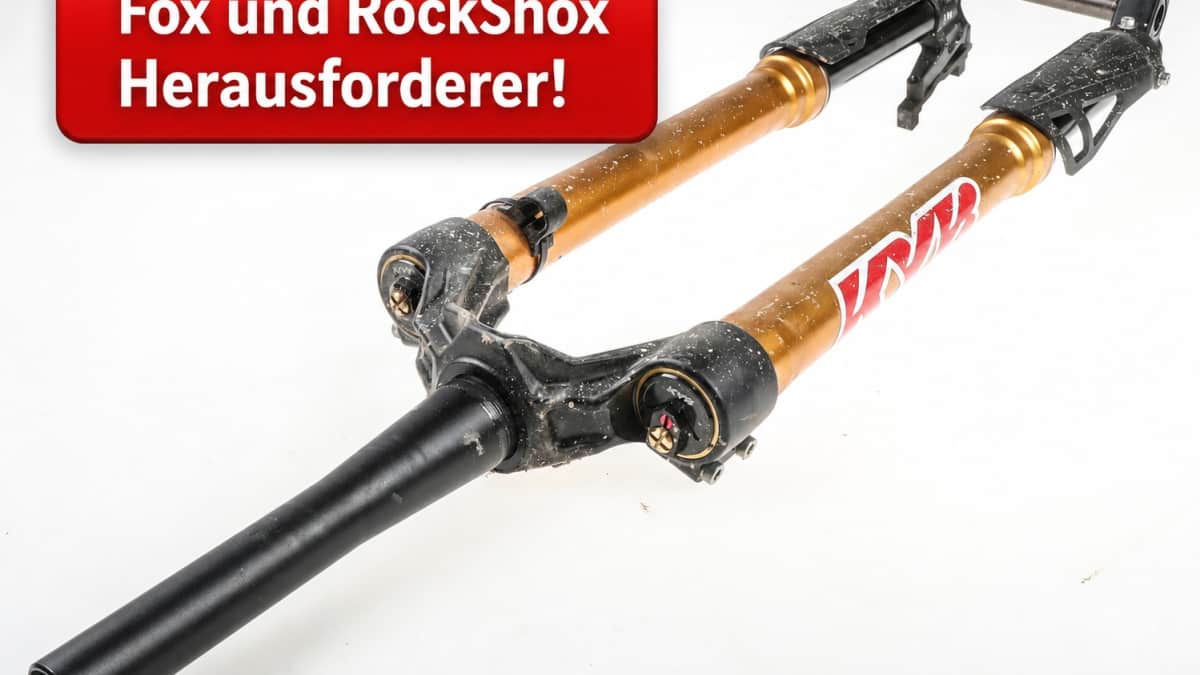
The external changes to the 38 are subtle. Like the Fox 40 and the 36, the Fox 38 now also features an open-work crown. In addition, the Californian manufacturer has redesigned the bleed valves on the rear of the fork. Inside, however, much more work has gone into the design. Fox has moved away from the previous tube-in-tube air spring construction and is instead using the so-called GlideCore air spring, which we are already familiar with from the Podium and the 36.
Its unique selling point: the air spring is mounted in a floating arrangement inside the fork. This decouples the stanchion from the air chamber, allowing the piston to move more freely when the fork is subjected to torsional forces. The result: less friction. The greater air volume is also intended to produce a more linear response curve – though not quite as extreme as with RockShox. Nevertheless, the new 38 is said to utilise the travel more effectively. But that’s not all: thanks to the optimised oil flow in the GripX2 damping unit, the adjustment range has shifted slightly further from stiff towards soft. The idea behind this is to provide greater comfort.


Review: The Fox 38 Factory put to the test
Adjust first, then drive.
The set-up – complicated, but precise:
A lot remains the same here. The high- and low-speed compression can be adjusted with clearly defined clicks. However, instead of 8 and 18 clicks respectively, half that number would have been enough – to achieve a more noticeable effect per click. The same applies to the rebound. Unlike its rival, the ZEB, this model features both high- and low-speed rebound settings. It sounds like a professional setup, but in practice it makes tuning rather complicated. In our view, this is unnecessary. A sticker on the fork leg provides recommendations – including for air pressure. We found we got on much better with around 10 PSI less. As always, the manufacturer’s specifications are a starting point, not the end of the tuning process.
Downhill: smooth and confident
The Fox 38 rolls out the red carpet and speaks like warm butter on toast – velvety, creamy, smooth. She skilfully parries even the slightest jibes. That is precisely what she does better than her predecessor, thereby eliminating his greatest weakness.
Even on rough terrain, the 38 always stays in control. It generates plenty of grip and skilfully absorbs impacts – which is easy on the wrists. Hard landings after drops? No problem! Even without ABO (Adjustable Bottom Out), the 38 withstands bottoming out thanks to its smooth end-stroke progression – fewer force spikes, more comfort. The bike stays on track, the rider stays relaxed. The 38 feels pleasantly stiff. The Fox 38 Factory is and remains the benchmark – though alongside the RockShox ZEB. We’ve ridden both forks. There are differences, but they relate more to character than to pure performance.
CONCLUSION:
In our test, the Fox 38 Factory impressed with its power, sensitivity and traction – and sets new standards thanks to its enhanced comfort. In short: you can’t go wrong with this fork. BIKE rating: 1.3.
In a Nutshell
- Adjustment options: Air pressure, high- and low-speed compression and rebound settings, volume spacers
- Max. disc diameter / weight limit 220 mm / N/A
- Riser pipe Ø 38 mm
- Available suspension travel 160, 170, 180 mm
- Weight 2,447 grams
- Installation length 590 mm
- Torsional stiffness / Braking stiffness 30.6 Nm/° / 294.6 Nm/°
- Price: 1,499 euros >> available here

HOW BIKE CONDUCTS ITS TESTS
Laboratory: Both suspension forks were tested by our test laboratory. As well as weighing, the programme also included stiffness measurements.
Practice: To ensure maximum comparability, we tested both forks directly on identical test bikes, namely the Mondraker Foxy. We rode them on different trails at the Geisskopf Bike Park. For the set-up, we initially followed the manufacturers’ recommendations and then gradually fine-tuned the settings to achieve the optimum configuration.

Laurin Lehner
Editor