


Clash of the Titans: Head-to-head: Fox 38 versus RockShox ZEB – there can only be one winner
Laurin Lehner
· 08.08.2026


In this article, we use so-called affiliate links. With every purchase through these links, we receive a commission from the merchant. All relevant referral links are marked with . Learn more.
When Fox and RockShox relaunch their flagship enduro models in the same winter, it’s a clear challenge. The Fox 38 and the Rockshox ZEB have been leading the enduro segment of suspension forks for years and have been vying for the title of best in class at every level of specification. Now both manufacturers have fine-tuned their flagship models, pursuing the same goal: reduced friction losses, a more linear response curve and greater comfort. Yet the paths they’ve taken to get there could hardly be more different.
How BIKE carries out its tests
Laboratory: Both suspension forks were put through their paces in our test laboratory. As well as weighing them, we also carried out stiffness tests.
Practice: To ensure maximum comparability, we tested both forks side by side on identical bikes (Mondraker Foxy). At the Geisskopf Bike Park, we rode the forks on different trails. For the set-up, we started with the manufacturers’ recommendations and worked our way step by step towards the optimum settings.


Stiffness & Weight
Stiffness – good or bad? A ‘soft’ fork isn’t necessarily a bad thing. Whilst high torsional stiffness ensures more precise steering, it can also reduce traction because the front wheel is more likely to skid. The situation is different when it comes to braking stiffness: the higher it is, the less the fork bends backwards during braking. This reduces stress in the system and enables a more responsive behaviour under load.
Our laboratory results These factors therefore tend to favour the Fox 38: it combines high braking stiffness with comparatively moderate torsional stiffness. Fox also has the edge when it comes to weight. Also worth noting: the stiffness figures for the current Fox 38 differ only slightly from those of its predecessor. The differences are more pronounced with the new ZEB – it is just under 13 per cent stiffer in compression whilst exhibiting around 15 per cent less torsional stiffness.
Showdown: Fox versus RockShox. Two major players go head to head.
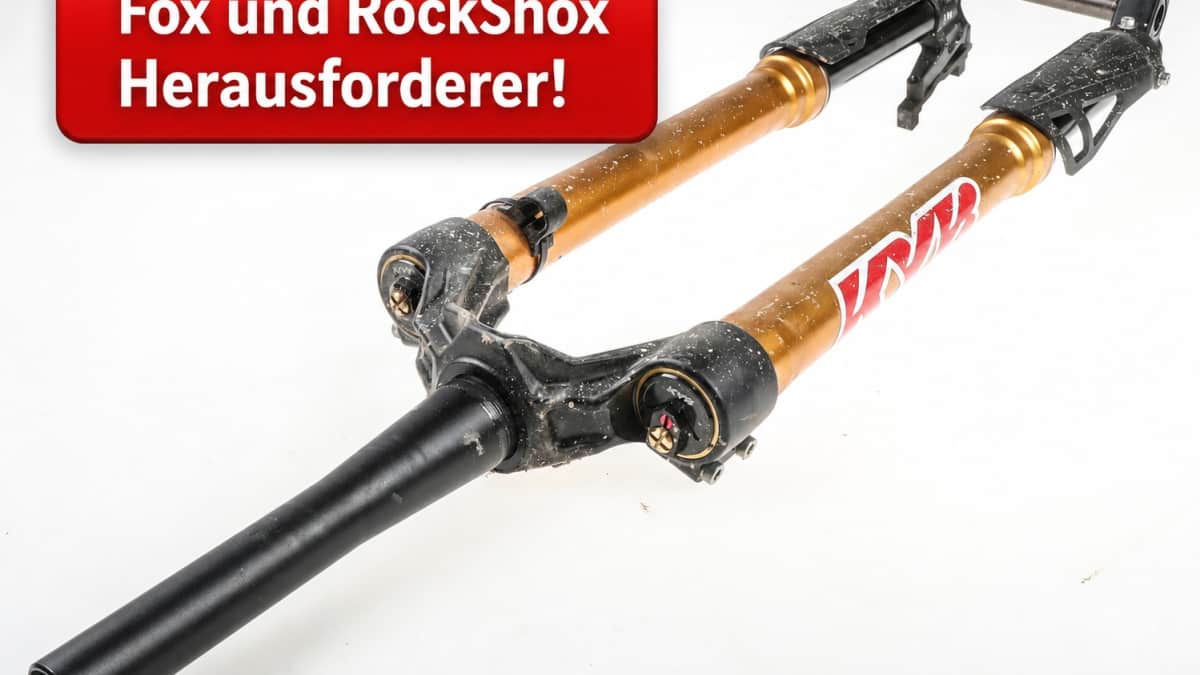
Fox 38 Factory
The set-up – complicated, but precise:
A lot remains the same here. The high- and low-speed compression can be adjusted in clearly defined clicks. However, instead of 8 and 18 clicks respectively, half that number would have been enough – to achieve a more noticeable effect per click. The same applies to the rebound. Unlike its competitor, the ZEB, this model features both high- and low-speed rebound settings. It sounds like a professional setup, but in practice it makes tuning rather complicated. In our view, this is unnecessary. A sticker on the fork leg provides recommendations – including for air pressure. We found we got on much better with around 10 PSI less. As always, the manufacturer’s specifications are a starting point, not the end of the tuning process.
Downhill: smooth and confident
The Fox 38 rolls out the red carpet and rides like warm butter on toast – velvety, creamy, supple. It skilfully absorbs even minor bumps. This is precisely where it outperforms its predecessor, thereby eliminating its biggest weakness. In this respect, it’s on a par with the RockShox – tester Dimitri even reckons it outperforms the ZEB here. Even on rough terrain, the 38 always stays in control. It generates loads of grip and absorbs impacts skilfully – which is easy on the wrists. Hard landings after drops? No problem! Even without ABO (Adjustable Bottom Out), the 38 withstands bottoming out thanks to its pleasant end-stroke progression – fewer force spikes, more comfort. The bike stays on track, the rider stays relaxed. In a direct comparison, the 38 feels slightly less stiff – but that’s not necessarily a disadvantage, as it means it’s more forgiving of the odd messy line. The Fox 38 Factory, together with the ZEB, is and remains the benchmark. There are differences, mind you, but they relate more to character than to pure performance.
Conclusion:
In this comparison, the following stood out the Fox 38 With plenty of power, responsiveness and traction – and comes out just ahead of the ZEB. Top marks in the test thanks to its superior comfort.

Fox 38 Factory: In a nutshell
- Price: 1,499 euros >> Available here at a reduced price
- Adjustment options: Air pressure, high- and low-speed compression and rebound settings, volume spacers
- Max. disc diameter / weight limit 220 mm / N/A
- Riser pipe Ø 38 mm
- Available suspension travel 160, 170, 180 mm
- Weight 2,447 grams
- Installation length 590 mm
- Torsional stiffness / Braking stiffness 30.6 Nm/° / 294.6 Nm/°
Rockshox ZEB Ultimate
The setup – simple and effective:
Rockshox stays true to itself and relies on the simple low-speed rebound – we think that’s great! Keep it simple. With the numbered high- and low-speed compression settings (5 and 15 clicks respectively), you can quickly find the right setup. A new feature is the ABO (Adjustable Bottom Out) – a mechanical bottom-out protection system with eight clicks. Here, too, there’s a sticker on the fork leg giving recommendations – though, unlike with Fox, these are only for air pressure. As always: we found we got on much better with around 10 PSI less than with the manufacturer’s specifications.
Downhill: Direct, sharp, racing-style
The ZEB Ultimate Feels like a sports suspension in a direct comparison: firmer and more direct. Despite having the right amount of sag, it provides the rider with more feedback. It also feels slightly stiffer than the Fox, which responds more gently, offers greater comfort and maintains a smoother line on descents. After high drops and hard landings, the ZEB compresses surprisingly deeply thanks to its linear travel curve. However, the lack of end-stroke progression can be compensated for. Three clicks on the Adjustable Bottom Out (ABO) were enough. From then on, there were no more bottom-outs – not even when we deliberately tried to provoke them. The more we put the ZEB through its paces on the test tracks, the more we liked it. With its direct and precise feedback, it has a real race-ready character. In the mid-travel range, it provides more feedback – a characteristic we’d previously associated more with its competitor, Fox. In short: RockShox has given the ZEB more resistance. That’s cool, but it comes at the cost of some comfort, which casual shredders in particular are likely to miss.
Conclusion:
The new Rockshox ZEB Ultimate It’s powerful, direct, responsive and easy to adjust – though not quite as comfortable as the Fox 38, which glides down the slope a bit more effortlessly.

RockShox ZEB Ultimate: In a nutshell
- Price: 1,415 euros >> Available here at a reduced price
- Adjustment options: Air pressure, high- and low-speed compression, low-speed rebound, ABO (Adjustable Bottom Out), volume spacer
- Max. disc diameter / weight limit 220 mm / 170 kg
- Riser pipe Ø 38 mm
- Available suspension travel 150, 160, 170, 180 mm
- Weight 2,565 grams
- Installation length 585 mm
- Torsional stiffness / Braking stiffness 37.7 Nm/° / 263.9 Nm/°
Findings from the testers
When two products are so closely matched, it’s the details that make the difference – and this is where the RockShox really shines. The clearly labelled, intuitive adjustment system makes setting it up pleasantly straightforward. Added to this are generous service intervals. Two details that make everyday use of the fork noticeably easier – and which I really appreciate. Max Fuchs, BIKE test editor
I was also surprised by the recommended tyre pressure. Both manufacturers print their recommendations on the inner tubes – but in both cases, we found the figures to be significantly too high. In the end, we ran them at around 10 PSI lower, which worked noticeably better. In my experience, however, this only applies to the top-of-the-range models. Dimitri Lehner, BIKE test editor
Fox or RockShox? When it comes to top-of-the-range models, both manufacturers have been locked in a neck-and-neck race for many years. The differences have mostly come down to personal taste. That’s how it was back then, and that’s how it is today. Up until now, I’ve definitely been Team RockShox: more responsive, smoother – just my thing. After this test, I’m slightly more inclined towards the Fox. Laurin Lehner, BIKE test editor

Laurin Lehner
Editor