


Conclusion by Max Fuchs, BIKE editor
The E-Epona comes with a hefty price tag, and its looks may not be to everyone’s taste. Consequently, the target audience is quite niche. However, those who have the necessary funds and appreciate its distinctive design need not make any compromises when it comes to riding performance: In terms of geometry, the bike is an outstanding climber, confident on descents and pleasantly natural to handle. C-Duro has done a really good job here.
It all began in 1995 on the white water. Two Czech mechanical engineering students were fed up with their carbon paddles constantly snapping in their hands whilst canoeing. So Ondrej Uher and Vítek Šprdlík simply set about building their own paddles in their garage at home. In the process, they came across a manufacturing method that they have been perfecting ever since: filament winding. In this process, continuous fibres – in this case carbon fibres – are impregnated with epoxy resin under tension and wound around a rotating core to form a hollow body. That’s a very simplified explanation, of course.
What began as a garage-based duo and a hand-operated winding machine later grew into Compotech – a company with around 60 employees that manufactures carbon fibre structures for the aviation, agricultural, marine, automotive and mechanical engineering sectors. What once began by hand is now carried out fully automatically by huge robots at the company’s own factory in Sušice, right on the edge of the Šumava National Park.
Even more special bikes:
From a sailing mast to an e-mountain bike
It stands to reason that an automated manufacturing process for hollow carbon components would eventually lead to the creation of a bicycle frame. After all, it makes little difference to the winding robot whether it is shaping a filament into a sail mast or a down tube. A few bike-mad Compotech employees came up with precisely this idea – and couldn’t resist the temptation. Why build carbon structures just for other industries when they could also be used to create their own bike? In 2017, a team of seven set about realising the idea. Taking a break from their day-to-day work and armed with the expertise and technical resources of the parent company, they produced the first prototypes of an enduro bike with a single-pivot rear suspension. The sister brand C-Duro was born.

C-Duro E-Epona: A lightweight e-mountain bike with a Maxon drive system
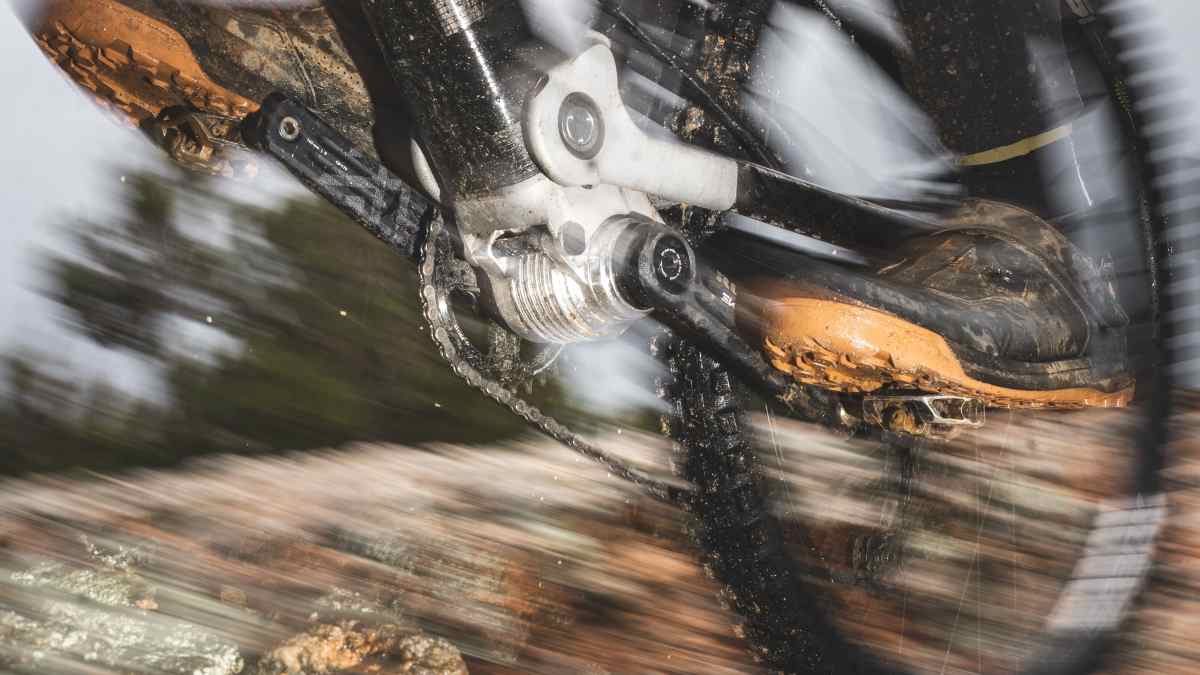
Today, eight years on, the Czech company’s first e-mountain bike is here in our editorial office. The single-pivot rear suspension and the clean, linear design have remained the same. What’s new, however, are a few aluminium parts produced by a 3D printer, which Maxon motor in the bottom bracket area and the chunky down tube with an integrated 400 Wh battery. The key specs: a 160 mm fork, 150 millimetres of rear suspension travel and 29-inch wheels. And the best for last: despite aluminium wheels, enduro tyres and plenty of robust components, the E-Epona weighs in at a mere 19.3 kilograms.
| Price | 7,500 euros (frame set with drivetrain and shock absorber) |
| Weight | 19.3 kg (excluding pedals) |
| Suspension travel | 160/150 mm |
| Training wheels | 29 inches |
Frame production: automated and perfectly straight
And that brings us back to where it all began: in the white water. Filament winding – the technique Ondrej and Vítek once used to build their own paddles, and which today is used to manufacture carbon frames by robots. After all, carbon frames are still usually made by hand. To begin with, fibre mats are laid into a negative mould. Depending on the component – be it the head tube or seat stay – the number and overlap of the layers vary in order to optimise stiffness and stability in a targeted manner. The frame is then cured in an autoclave under extremely high pressure and intense heat. This is followed by finishing work: sanding down sharp edges, bonding in metal parts and milling bearing seats.
C-Duro takes a unique approach to frame construction. For the main frame of the E-Epona, a robotic arm does the bulk of the work. For ten to twelve hours, it moves along six axes around the positive moulds of the head tube, top tube, seat tube and down tube. The same machine then wraps the finished tube sections in a kind of high-pressure adhesive tape. The pressure compacts the fibres and squeezes excess epoxy resin out of the composite. The components then spend a night at 45 degrees in what is known as a ‘thermobox’. To achieve their final strength, they are subsequently cured at 150 degrees for a further night in a special oven.
Instead of assembling the individual tubes into a frame later using sleeves or adhesive joints, the robot weaves the tubes together using continuous carbon fibre loops in a second pass. As a result, peak loads are transferred through the fibre itself – not through an adhesive joint. C-Duro thus promises a connection of maximum stability. Finally, the puzzle comes together: the open tube ends are connected using a 3D-printed aluminium component that combines the bottom bracket shell, main pivot and motor mount. One last night at 45 degrees – then the carbon frame is ready for the trail.
Automated process, a design that takes some getting used to
The obvious drawback of this method is that it can only handle straight shapes. No curves, no organic designs, no scope for modern frame aesthetics. That is precisely why the E-Epona looks the way it does: no-frills, angular, stripped back to the essentials. Form follows function – and after all, the manufacturing process was originally intended to produce robust, dead-straight canoe paddles, not to win design awards for mountain bikes.
How it rides: the C-Duro E-Epona put to the test
Long chainstays, a very steep seat angle and a generous reach: with this geometry, the E-Epona proves to be an outstanding climber. With plenty of pressure on the front wheel and ample traction at the rear, you can tackle even tricky, steep sections in a controlled manner. The bike also feels very confident on descents. The high stack height positions the rider securely and centrally behind the handlebars. The flat head angle and long wheelbase keep the bike on track with ease, even at high speeds and on rough terrain. Despite its comparatively simple rear suspension system, the suspension impresses with a successful blend of shock absorption, traction and stability. Thanks to its low overall weight, the E-Epona isn’t just capable of full throttle on the descents – it can also be steered playfully and precisely along the trail – well done!
| Pro | Cons |
| Top climbing performance | Extremely expensive |
| Superb handling | A look that takes some getting used to |
| Smooth running, natural handling | |
| Very quiet |
You can find more test impressions specifically about the engine here:

Max Fuchs
Editor