


The tricky thing about hydraulic disc brakes is that they always decelerate somehow, even until shortly before total failure. Because the brake calliper adjusts automatically, you don't notice how thin the pads become - until the metal hits the disc and it's too late. If you don't check your brakes regularly, you run the risk of disc damage, which can turn a simple pad change into an expensive repair.
I say it again and again: check your rubbers. Not once a season - after every mud fight, after bike park trips, before the next holiday. A look at the brake caliper costs ten seconds. A new disc because you've waited too long costs 40 to 80 euros. - Max Fuchs, BIKE test editor
The rubbers: Visual check and measurement

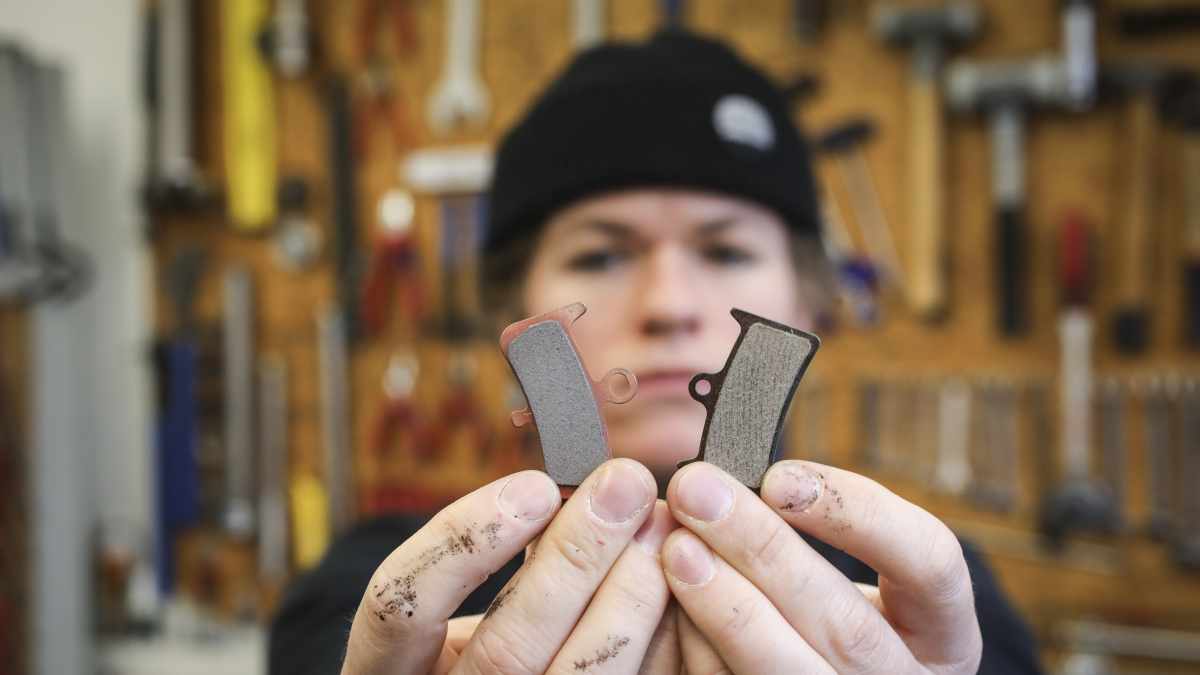
Brake pads consist of a metal backing plate and the actual friction material on it. The rule of thumb: As long as at least 1 mm of friction material is still present, the pad is still OK. Below that, it becomes critical.
How to check: Shine a torch into the side of the brake calliper. When pulling the lever, you can see how much space is left between the backing plate and the brake disc - the less space, the thinner the pad. If in doubt, remove the pad and measure it. Some pads have stamped wear markings or coloured lines as an indicator.
The clear warning signal: A metallic scratching or grinding noise when braking means that the carrier plate or the pad return spring is already rubbing on the disc. If this is the case, stop riding if possible - any further braking will cut grooves into the disc. That's why it's always worth having a pair of spare pads with you - they weigh virtually nothing and take up little more space than a few spare coins.
The disc: Measure the minimum thickness
Brake discs wear more slowly than pads, but they do wear. The manufacturer's approval - the so-called minimum thickness (MIN TH) - is stamped on the disc and varies depending on the manufacturer and the original material thickness of the disc. Measuring is only possible with a caliper gauge - the eye is reliably deceptive here. Measure at the thinnest point of the friction surface: If the manufacturer's limit is reached or not reached, the disc must be removed.
Visual warning signals on the windscreen
Deep grooves and scoring on the friction ring occur when dirt particles or - worse - the metal backing plate of worn pads scrape across the disc. In extreme cases, such grooves can impair the braking effect, but in any case they accelerate the wear of new pads.
Blue discolouration or tempering colours indicate that the disc has run too hot - either due to incorrect braking, rubbing pads or simply excessive loads. If the disc also wobbles in the brake calliper and rubs against the pads, it has warped under the thermal load and needs to be replaced.
Always think of pads and disc together
Fitting new pads on a heavily worn disc is not a solution - the friction coefficients are worse and the wear of the new pads is accelerated. Therefore: Replace the disc and pads together as soon as the disc reaches its wear limit.


Max Fuchs
Editor
