


The world’s lightest MTB wheels: Testing the Specialized Roval Control World Cup
Max Fuchs
· 12.07.2026


Conclusion by Max Fuchs, BIKE editor
On paper, the Specialised Roval Control World Cup is a show of strength: a mass-market manufacturer has broken the 1,000-gramme barrier – without skimping on either the permitted system weight of 125 kilograms or the warranty. In testing, the wheels impress with their relentless forward momentum and razor-sharp handling, but offer hardly any comfort. This makes them ideal for short distances on cross-country race courses; on everyday trail riding, however, they demand a lot of stamina and constant, intense concentration.
However, our workshop inspection following a season of continuous use has revealed some sobering findings. The rims, spokes and truing are in impeccable condition, but the hub bearings are running rough and stiff. Lifetime guarantee or not: for a wheelset costing just under 3,000 euros, we believe the bearings should last considerably longer than just a few months.
Facts: Specialized Roval Control World Cup
- Weight: 991 grams (wheel set including valves and rim tape)
- Rim material: carbon fibre
- Price: 2,950 euros
- Inner rim width: 28.5 millimetres
- Rim design: Hookless
- Compatible tyre widths: 1.9 to 2.6 inches
- Maximum tyre pressure: 40 psi (2.8 bar)
- Spokes: carbon with titanium fittings, 304 millimetres in length
- Hubs: Roval Low Flange Mountain Hub (LFM23), DT Swiss EXP system
- Bearing: Sinc Ceramic
- Freewheel: 36 detent positions
- Freehub compatibility: Shimano HG MTB, Shimano Micro Spline, SRAM XD
- Maximum disc size: < 200 millimetres
- Structural weight limit: 125 kilograms
- Intended use: XC racing (ASTM Category 3)
- Warranty: Lifetime
Lightweight construction down to the last detail
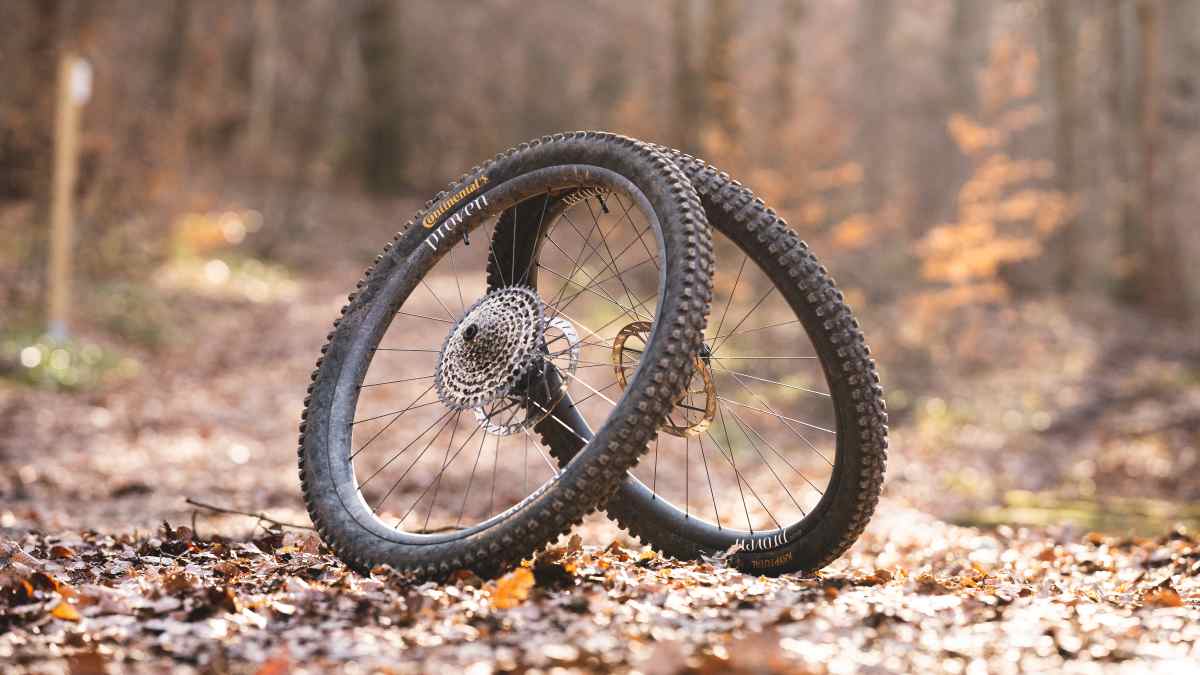
To get below the 1,000-gram mark, Specialized has optimised every gram. An optimised rim lay-up saves around 36 grams compared to the Control SL Team – according to the manufacturer, without compromising on durability or performance. The biggest weight saving comes from the carbon spokes with titanium hardware: compared to equivalent steel spokes, this saves around 102 grams. Even the accessories have been fine-tuned – an ultra-light rim tape developed in collaboration with 3M saves just under 10 grams, and the tubeless valves weigh only 1.5 grams each. They are just long enough to fit standard pump heads.

Hubs, spokes and freewheels
At the heart of the system are the Roval LF hubs – essentially heavily stripped-down versions of the DT 180 hubs. They share the bearings, freehub internals and freehub body with the standard version, which is intended to make sourcing spare parts easier. Ceramic bearings are fitted. The freehub has 36 engagement points. An XD freehub body is supplied as standard. An HG or Micro-Spline variant is available as an option. The 20 carbon spokes on each wheel have a practical feature: the spoke length is identical at the front and rear, and on both the left and right sides – so you only need a single spare spoke length for the entire set. Four spare spokes are included with each wheel.
Driving impressions from endurance test driver Max Fehr
These test impressions come from our long-term test driver, Maximilian Fehr. He has been using the set for a whole season on his BH Lynx SLS He took it for a spin. His impression: you can feel the light weight straight away – in fact, even before the bike has started moving. Just lifting it, you notice what a huge difference there is compared to the standard wheels. With the Roval Control World Cup, the bike feels downright feather-light.
The ‘aha’ moment comes no later than the first turn of the cranks. Never before has the force I’ve applied to the pedals been converted into forward momentum so directly and efficiently. The acceleration is impressive and downright addictive. Sprinting in between, accelerating out of bends or powering up small hills – it all feels effortlessly easy and is simply great fun.
However, this uncompromising lightweight design comes at a price. With the Roval wheels, my bike feels noticeably more twitchy. Bumps and landings are transmitted more directly to my hands and arms; overall, the bike feels less stable on the trail and is more prone to skidding on rough terrain. The wheels demand precise line choice and offer little forgiveness for riding errors.
That’s why, particularly on longer descents, I felt I was losing a bit of confidence in the bike. At the same time, you tire more quickly because maintaining constant concentration takes its toll. Anyone who mainly rides cross-country races will love the explosive propulsion. For everyday trail riding, however, I find the overall package a bit too uncompromising.
Workshop check – here are the results of our inspection
The rims and spokes are in immaculate condition. The spoke tension is even on both wheels, and there is no significant lateral or radial runout.
The hub bearings, on the other hand, have come in for criticism. On the front wheel, both bearings run roughly and are stiff. On the rear wheel, there is a clear imbalance: whilst the bearing on the sprocket side turns smoothly, the one on the disc side is noticeably stiff. For a wheelset in this price range, that is an absolute no-go.

Max Fuchs
Editor