


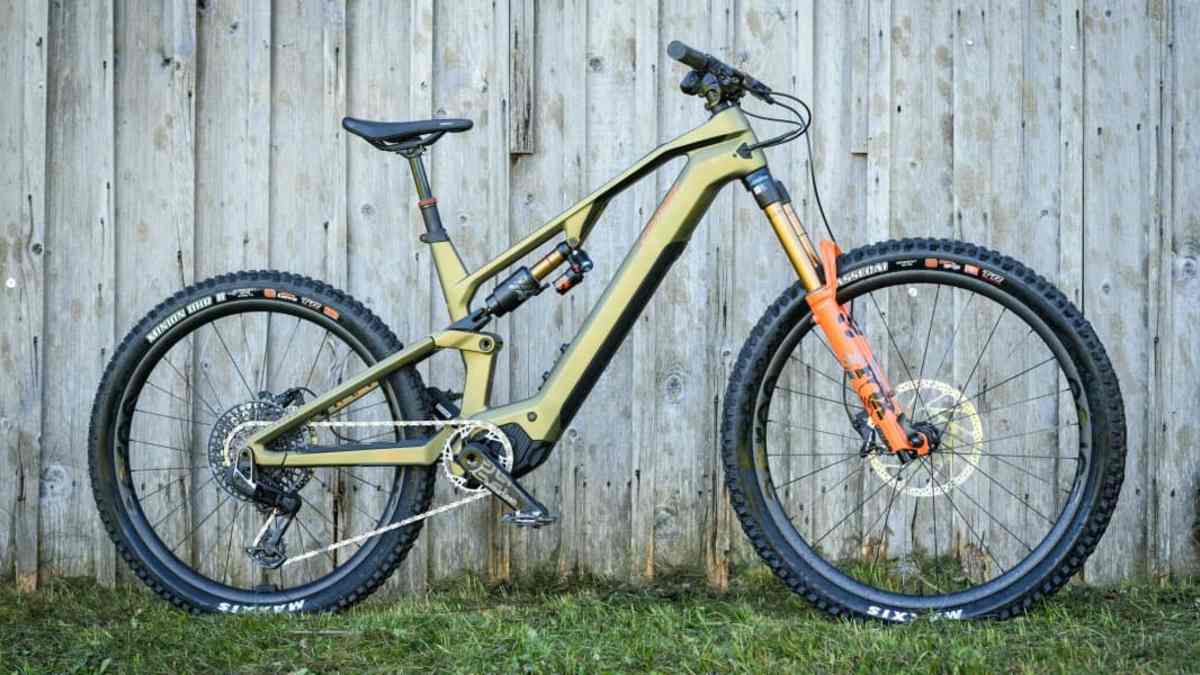
At Conway, ‘Ryvon’ remains a name steeped in history, but from the 2027 model year onwards it will represent a different concept. Until now, the Ryvon has been a light e-MTB featuring a Bosch SX drive, a 400 Wh battery and 170 millimetres of suspension travel. The new range moves into the full-power class: the Avinox M2S delivers massive power, the battery capacity increases to 800 Wh, whilst the suspension now offers only 160 millimetres of travel. At the same time, the weight increases significantly.
Our verdict on the new Conway Ryvon
The new Ryvon moves away from the ‘light e-MTB’ concept. It combines significantly more motor power and battery capacity with a dedicated trail setup. In terms of geometry, the new Ryvon closely resembles its predecessor, although it loses one centimetre of suspension travel. Conway is sending a clear message to the competition with the Ryvon 8.0: for €5,999, you get a carbon frame – the Avinox M2S – an 800 Wh battery and Fox Factory suspension. That’s quite a statement!

From the Light E-MTB to the Full-Power concept
Why is Conway taking this step? Light bikes are simply no longer in vogue, especially not since the Avinox powerhouse hit the market. The Chinese motor packs a mighty punch, yet remains super-compact and lightweight in design. So Conway is now entering the Enduro Ryvon in a different class – albeit in a different weight category too. Because even though the Avinox motor itself is quite light, it still needs a large battery to quench its thirst. The wheel configuration has remained the same: like its Mullet predecessor, the new Ryvon rides on 29-inch wheels at the front and 27.5-inch wheels at the rear.
The key difference, then, lies in the drive system. In Boost mode, the Avinox M2S delivers up to 150 Newton-metres of torque and up to 1,500 watts of peak power – figures that are more than double those of the previous Bosch SX motor. For steep climbs and heavier riders, this means more assistance in all situations, but especially at low cadences.
Double the battery capacity, but also heavier
Conway is also taking a different approach to power supply. The previous Ryvon LT 10.0 featured a 400 Wh battery integrated into the frame, and a second battery could be carried along. In the BIKE endurance test, the range was limited to short, low-altitude laps, particularly in wintry conditions. The new Ryvon now features a permanently integrated 800 Wh battery. This doubles the nominal capacity. As a result, the Ryvon loses some of the nimble handling that characterised the LT model. Depending on the spec, the new Ryvon weighs between 21.5 and 22.5 kilograms. The previous Ryvon LT 10.0 weighed 18.9 kilograms in our test. Anyone who frequently rides alongside non-motorised cyclists or regularly has to carry the bike will notice this difference.
According to Conway, the frame is also designed to accommodate the 700 and 800 Wh Avinox batteries. However, only the 800 Wh battery will be available when the new Ryvon models are launched.
More stack and a tidier frame
Conway continues to use carbon for the frame, but has altered its geometry. According to the manufacturer, the new frame in size L offers 4 mm more stack and a 10 mm longer head tube – meaning more vertical height at the cockpit. The manufacturer states that this results in a slightly more upright, more central riding position. The head angle remains at a moderate 64 degrees, whilst the seat angle is a steep 77 degrees.
The design of the new Conway Ryvon in size L
| Seat tube | 440 mm |
| Top tube | 618 mm |
| Head tube angle | 64° |
| Stem length | 40 mm |
| Seat angle | 77° |
| Chainstay length | 442 mm |
| Head tube length | 135 mm |
| Reach | 478 mm |
| Stack | 645 mm |
| Wheelbase | 1,278 mm |
The new Ryvon takes over the integrated cable routing from the head tube from its predecessor, and also features a Fidlock mount for magnetic water bottles and an SP-Connect attachment on the stem. This allows a smartphone to be positioned centrally in front of the rider for navigation or tour data. From frame size M upwards, depending on the seatpost used, there should be space for a 200-millimetre Vario seatpost.
The new Ryvon range is available in sizes S to XL, in a total of five colour options, across three trim levels.
Three trim levels, a clear price difference
The three models all feature carbon frames, an Avinox drive system, an 800 Wh battery, 160 millimetres of suspension travel and the Mullet wheel configuration. The differences lie in the suspension, brakes, gears and wheels.
Even the Ryvon 6.0, priced at €5,199.95, comes equipped with a Fox 36 Rhythm fork, a Fox Float Performance shock, four-piston brakes and a Shimano Deore XT LinkGlide gear system. This provides a solid technical foundation for an e-trail bike, especially as the carbon frame, large battery and powerful Avinox drive aren’t exclusive to the more expensive models.
The Ryvon 8.0, priced at 5,999 euros, looks particularly interesting. For an extra 800 euros compared to the 6.0, you get a Fox Factory suspension, Shimano Deore XT four-piston brakes, Newmen wheels and a carbon handlebar from Race Face. Compared to the 11.0, the 8.0 saves you 2,000 euros, but you’ll have to do without the RockShox Lyrik Ultimate fork, TRP EVO Pro brakes and the wireless SRAM X0 AXS drivetrain.
Key information about the Conway Ryvon
- New platform: The Ryvon is making the switch from a Light e-MTB with Bosch SX to a full-power trail bike with Avinox M2S.
- Engine: Avinox M2S with 130 Nm of torque and 1,300 W peak power (150 Nm and 1,500 W in Boost mode).
- Battery: 800 Wh, permanently integrated into the carbon frame. According to Conway, the frame is also designed to accommodate a 700 Wh battery.
- Chassis: 160 mm suspension travel at the front and rear.
- Bicycle wheels: Mullet mix with 29-inch front and 27.5-inch rear.
- Sizes and colours: Sizes S to XL, five colour options in total.
- Details: 2-inch OLED touchscreen in the top tube, SP-Connect mount on the stem, Fidlock base and concealed kickstand mount.
Conway Ryvon 6.0
- Price: 5,199.95 euros
- Weight: 22.5 kg
- Fork: Fox 36 Rhythm
- Damper: Fox Float Performance
- Circuit: Shimano Deore XT LinkGlide, 11-speed, cassette with 11 to 50 teeth
- Brakes: Tektro HD-M5141, four-piston
- Brake discs: TRP RS01E, 203 mm front and rear
- Bicycle wheels: Contec Xeta with Formula hubs
- Tyres: Schwalbe Romy Trail Pro, soft radial casing
- Cockpit: Level 9 Race e35.0 Handlebar and stem
- Display and operation: Avinox DPC100 with BC100 remote
Conway Ryvon 8.0
- Price: 5,999.95 euros
- Weight: 22.0 kg
- Fork: Fox 36 Factory
- Damper: Fox Float Factory
- Circuit: Shimano Deore XT LinkGlide, 11-speed, cassette with 11 to 50 teeth
- Brakes: Shimano Deore XT, four-piston
- Brake discs: Shimano RT-6B750, 200 mm front and rear
- Bicycle wheels: Newmen Performance 30 TRQ with Newmen Basic TRQ hubs
- Tyres: Schwalbe Romy Trail Pro, soft radial casing
- Cockpit: Race Face Era Stealth Carbon handlebars and Race Face Aeffect stem
- Display and operation: Avinox DPC100 with BC100 remote control
Conway Ryvon 11.0
- Price: 7,999.95 euros
- Weight: 21.5 kg
- Fork: RockShox Lyrik Ultimate XL
- Damper: RockShox, model not specified
- Circuit: SRAM X0 AXS drivetrain, 12-speed
- Brakes: TRP EVO Pro, four-piston
- Brake discs: Model and size not specified
- Bicycle wheels: Model not specified
- Tyres: Schwalbe Romy Trail Pro
- Cockpit: Model not specified
- Display and operation: Avinox display with touchscreen function and electronic sliding aid

Josh Welz
Editor-in-Chief