


In this article, we use so-called affiliate links. With every purchase through these links, we receive a commission from the merchant. All relevant referral links are marked with . Learn more.
BIKE’s verdict on the Specialized Turbo Levo 4 Evo Pro
The Specialized Levo 4 EVO Pro It impresses as a high-performance e-enduro. Thanks to the power update, the motor now matches the peak power output without losing any of its exemplary controllability. The sporty geometry and powerful Rock Shox suspension make the Evo Pro a real downhill beast. High-end spec and impressive performance justify the price of €10,999 for enduro riders with deep pockets.
Family line-up: The role of the Evo in the Specialized range
Specialized’s range of e-mountain bikes is highly diverse. On the one hand, there is the Levo SL series, which comprises ‘minimal-assist’ models designed for classic trail riders, offering low weight and a natural riding feel. At the other end of the spectrum, the standard Turbo Levo platform caters to the full-power crowd, designed for maximum versatility and well-balanced all-mountain performance.
The new Turbo Levo 4 EVO occupies a unique niche in between. It’s all about delivering the best possible downhill performance on rough terrain. The key difference lies in the geometry and suspension design: with flatter angles and modified kinematics, the Levo EVO is modelled on modern gravity and enduro bikes. It’s built for riders who choose the toughest lines on the descent.
Carbon fibre and durability: the Levo 4 EVO Pro in detail
At the heart of the Levo 4 EVO Pro is a frame made entirely from Fact 11m carbon. It combines high stiffness with a comparatively low weight and elegantly integrates the battery into the down tube.

The geometry follows the modern ‘long, slack and low’ trend, but can be customised via adjustable headset cups and a flip chip on the Horst-Link. The head angle is noticeably flatter than on the standard Levo, which gives the bike exceptional stability at high speeds, whilst the short rear end, thanks to the mullet wheel configuration, maintains agility through corners.
When it comes to the suspension, Specialized has fitted the brand-new RockShox Zeb Ultimate fork at the front, offering a generous 180 mm of travel. At the rear is the RockShox Vivid Ultimate Air Linear shock, which has been specially developed for tough, long descents. This combination ensures maximum traction, responsive handling on rough terrain and enormous reserves of energy for big jumps and hard impacts.
The Pro model’s specification is consistently geared towards the premium segment. Gear changes are controlled electronically via the SRAM XO Eagle transmission, whilst the robust SRAM Maven Silver four-piston braking system ensures the necessary, uncompromising stopping power. This premium package is rounded off by the elegant Roval Traverse carbon rims.
The geometry of the Turbo Levo Evo
| S2 | S3 | S4 | S5 | S6 | |
| Reach | 425 mm | 445 mm | 470 mm | 495 mm | 520 mm |
| Stack | 625 mm | 633 mm | 646 mm | 659 mm | 672 mm |
| Steering angle | 63.6° | 63.6° | 63.6° | 63.6° | 63.6° |
| chainstay | 435 mm | 435 mm | 435 mm | 435 mm | 435 mm |
| Wheelbase | 1,208 mm | 1,232 mm | 1,263 mm | 1,294 mm | 1,325 mm |
| Seat tube angle | 76.0° | 76.0° | 76.0° | 76.0° | 76.0° |
| BB height | 356 mm | 356 mm | 355 mm | 355 mm | 355 mm |
Digital doping: the Specialized Motor unit
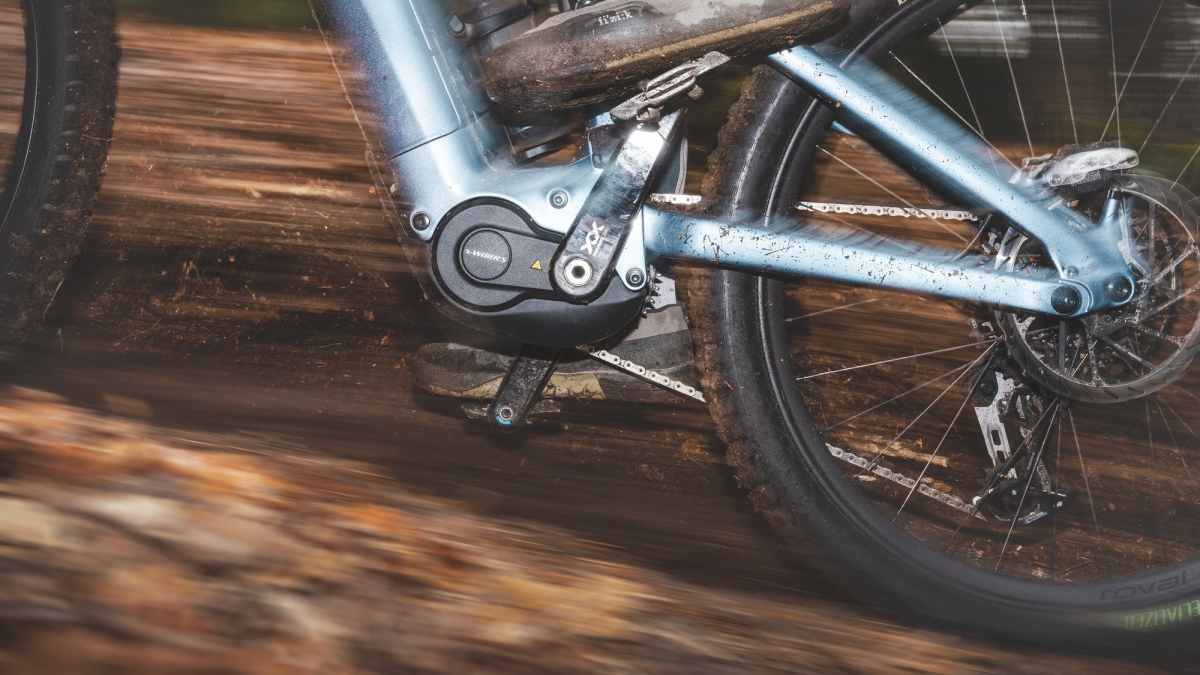
A key highlight of the fourth generation is the built-in Specialized 3.1 motor unit. Whilst physically unchanged, the drive system has seen a significant boost in performance thanks to an over-the-air software update. Peak power has risen by 22 per cent to up to 810 watts, whilst torque has increased by 4 Newton-metres to 105 Newton-metres. What makes this system special is its smooth power delivery.
A comparison with the competition: Bosch in the rear-view mirror, Avinox ahead
How does the Specialized motor stack up in a direct comparison with its competitors from the 2026 model year? Bosch has also followed suit with its Performance Upgrade 2.0 for the CX motor, available via an app update. Although the peak power remains capped at 750 watts, the torque increases to 120 Newton-metres in certain situations and the assistance level rises to up to 600 per cent. Bosch relies here on a brief, intelligent boost in technical sections, which can be finely adjusted when riding uphill.
In contrast, there is the segment’s undisputed powerhouse: the DJI Avinox M2S. With a maximum power output of up to 1,500 watts in short-term boost mode and a continuous torque of 130 Newton-metres (150 Nm in boost mode), this Chinese newcomer is in a league of its own when it comes to performance. Compared to the brute power of the DJI drive, the Specialized motor seems almost understated, but scores highly with its smooth performance on the trail. One interesting aspect regarding the Avinox M2S’s peak performance is that the new motor only achieves its maximum power when paired with particularly high-capacity batteries. To this end, Avinox has developed a new, ultra-slim battery weighing just 3.18 kilos and offering 700 watt-hours. With this, the spec sheet lists a continuous output of 1,500 watts and 130 Newton-metres, whilst the boost function releases up to 150 Nm for short bursts. With the new removable batteries (600 or 800 watt-hours), however, the full 1,500 watts is only available in short-term boost mode; in regular modes, the maximum is 1,300 watts. And with the familiar, permanently fitted 600 and 800 watt-hour batteries, which many manufacturers continue to use, the peak power is generally limited to 1,300 watts.
Evo Pro versus Evo Comp: A world of difference?
Anyone put off by the €10,999 price tag for the Pro model will find the Turbo Levo Evo Comp, priced at €7,499, a more attractively priced alternative. Both models share the same platform and feature the high-quality Fact 11m carbon frame. The difference therefore lies in the components chosen. When it comes to the drivetrain, Specialised has fitted the more affordable Comp model with an electronic SRAM groupset as well, albeit ‘only’ the S1000 Eagle AXS transmission. The Pro justifies its higher price tag with its top-of-the-range Rock Shox suspension (Zeb/Vivid Ultimate), the extremely responsive Maven Silver brakes, the higher-spec XO groupset and lighter carbon wheelsets. The Comp model, by contrast, has to make do with simpler suspension components, heavier aluminium wheelsets and less powerful brakes.
The facts about the Specialized Levo 4 EVO Pro
- Price: 10,999 euros >> available here
- Weight: 24.4 kg (size M, measured by BIKE)
- Suspension travel: 180/170 mm
- Engine: Specialized 3.1 with software update (max. 810 watts power, 105 Nm torque)
- Battery size: 840 Wh (permanently fitted)
- Display: MasterMind TCU, integrated into the top tube
- Impeller sizes: Mullet configuration (29-inch front, 27.5-inch rear)
- Suspension fork/shock absorber: Rock Shox Zeb Ultimate / Rock Shox Vivid Ultimate Air Linear
- Circuit: SRAM XO Eagle drivetrain (electronic, 12-speed)
- Brakes: SRAM Maven Silver
- Wheels: Roval Traverse Carbon

Josh Welz
Editor-in-Chief