


Editor’s conclusion:
This news is more than just a bike launch. This announcement seems to make it clear: the revolutionary Gobao X1P e-CVT unit will go into mass production in spring 2027. The Alutech ePelmo is likely to be just the first of a new generation of e-mountain bikes. It comes as a surprise that Alutech, of all companies – a small German manufacturer – is the first to unveil a production bike featuring Gobao’s X1P. The concept looks really well thought-out and leaves you wanting more. - Florentin Vesenbeckh, Test Editor
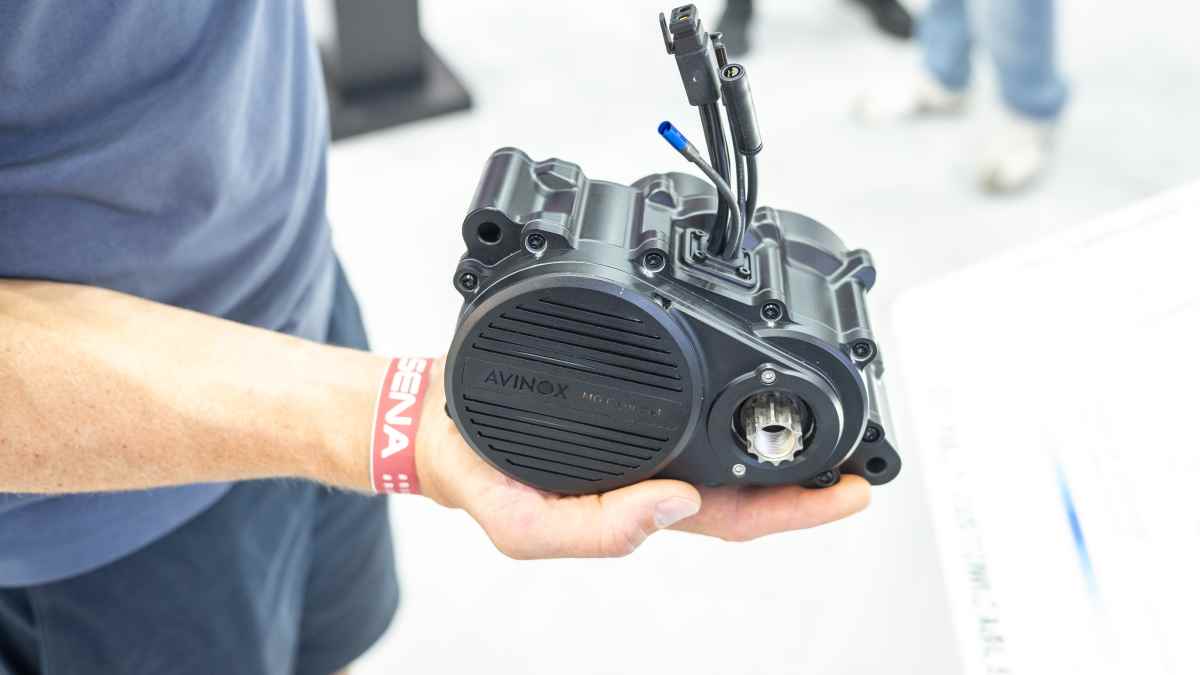
With the Alutech ePelmo X1P, the Gobao drive – which was the subject of much discussion at Eurobike 2026 – is being transformed for the first time into a tangible, high-performance e-MTB that will actually be available to buy. It is not just the performance that makes it special. Gobao’s revolutionary approach with the X1P: the motor and the electronically controlled, continuously variable transmission are housed in a compact unit at the bottom bracket. The cassette and rear derailleur are eliminated; power is transmitted to the rear wheel via a belt.

Alutech is thus addressing a topic that we covered in our article on Gobao X1P with gear-shift system As we have already noted: motor-gearbox units promise fewer exposed components, a more centralised weight distribution and a different gear-changing feel. However, only a thorough practical test will reveal whether Gobao’s concept lives up to the promises made by the data when put through its paces on tough trails.
Facts about the Alutech ePelmo X1P
- Engine: Gobao X1P with continuously variable transmission
- Battery: 750 Wh, 3.6 kg, removable
- Suspension travel: 170 millimetres (front and rear)
- Adjustable rear suspension progression: 20–24 per cent
- Wheel size: Mullet (29/27.5 inches)
- Adjustable dropouts: 437 mm or 450 mm KS length
- Approved for ASTM Category 5
- Four sizes: A, M, L, XL
- Availability: available to order now, delivery at the end of March/beginning of April
Gobao X1P: 150 Nm, 1,500 watts and continuously variable transmission
The Gobao X1P is the more powerful model in the new X series. According to the manufacturer, the magnesium unit weighs 3.85 kilograms and delivers up to 150 Newton metres of torque and 1,500 watts of peak power. In the Alutech ePelmo, it is clear to see that the unit’s design remains remarkably slim and compact.
Instead of fixed gears, the E-CVT technology operates with a continuously variable gear ratio. Gobao quotes a range of 500 per cent. The automatic system is designed to adjust the gear ratio to suit speed, load and desired cadence. According to Gobao, those who prefer to take control themselves can also use a manual gear-shifting function.
For e-MTBs, this layout has two consequences. Firstly, the cassette and rear derailleur are no longer in the danger zone behind the rear axle. Secondly, mass is shifted from the rear wheel towards the bottom bracket. This reduces unsprung mass and gives designers greater freedom when it comes to the rear triangle. At the same time, the technical complexity within the drivetrain increases. Efficiency, durability, noise levels and serviceability will only be proven once the bikes are off the exhibition floor.
Newly developed frame
Alutech does not simply use the new drive unit in the familiar Pelmo frame. According to the North German manufacturer, the ePelmo X1P has been largely redesigned. This is particularly evident in the integrated belt tensioner. It is designed to control the tension of the Gates belt even under high drive loads, whilst also ensuring sufficient space and ground clearance.
The frame is unmistakably an Alutech: aluminium, solid tube cross-sections and a layout designed for tough enduro riding. The ePelmo X1P is approved for Category 5 and is therefore specifically built for jumps and fast descents over rough terrain. It features 170 mm of travel at both the front and rear. The spec of the Launch Edition is consequently tailored entirely to downhill riding.
Geometry: flat, long and with a variable rear triangle
The geometry of the ePelmo X1P is in keeping with Alutech’s usual progressive approach. All four sizes come with mullet wheels and an extremely flat head angle of 62 degrees. The effective seat angle is a steep 78 degrees, whilst the bottom bracket height is 348 millimetres. With reach values ranging from 430 to 510 millimetres, Alutech covers sizes S to XL. A special feature is the adjustable chainstays. You can choose between a very short 438 millimetres or a moderately long 450 millimetres.
| Size | Reach | Wheelbase | Chainstays |
| S | 430 mm | 1,218/1,230 mm | 438/450 mm |
| M | 450 mm | 1,238/1,250 mm | 437/450 mm |
| L | 480 mm | 1,268/1,280 mm | 437/450 mm |
| XL | 510 mm | 1,298/1,310 mm | 437/450 mm |
750 Wh battery and 30 A fast charging
The X1P system includes a 750 Wh battery weighing 3.6 kilograms. According to Gobao, with the optional 30-A charger, it should charge from zero to 50 per cent in around 16 minutes and to 80 per cent in 28 minutes. This is particularly useful for long days at the bike park and on tours, when a short break is actually needed to top up the range.
The system also aims to go beyond mere support when it comes to the cockpit: the Connectivity Control Unit is housed in the top tube and integrates smartphone functions. Gobao lists features such as tracking, alarms, geofencing and the ability to deactivate motor assistance remotely. It remains to be seen how reliably these functions work in everyday use and which of them will be available in the final production version of the ePelmo.
A bold launch of the series, featuring an open practical test
The Alutech ePelmo X1P is more than just an enduro bike with particularly impressive performance figures. It is a concrete attempt to rethink the drivetrain on an e-MTB. A belt instead of a chain, a gearbox instead of a cassette, and a continuously variable transmission instead of clearly defined gear ratios: the concept tackles many of the weaknesses of traditional drivetrains.
The combination is particularly exciting because Alutech does not treat the X1P as a futuristic showpiece, but instead integrates it into an uncompromising 170-millimetre enduro bike. However, the crucial question remains: does the automatic system feel intuitive on technical climbs, does it really run quietly on the descents, and does the drivetrain remain efficient under sustained load? As soon as a production bike is available for a test ride, we’ll find out whether the ePelmo X1P is a genuine alternative to a derailleur system or, above all, just a bold claim on the spec sheet.

Florentin Vesenbeckh
Editor CvD