


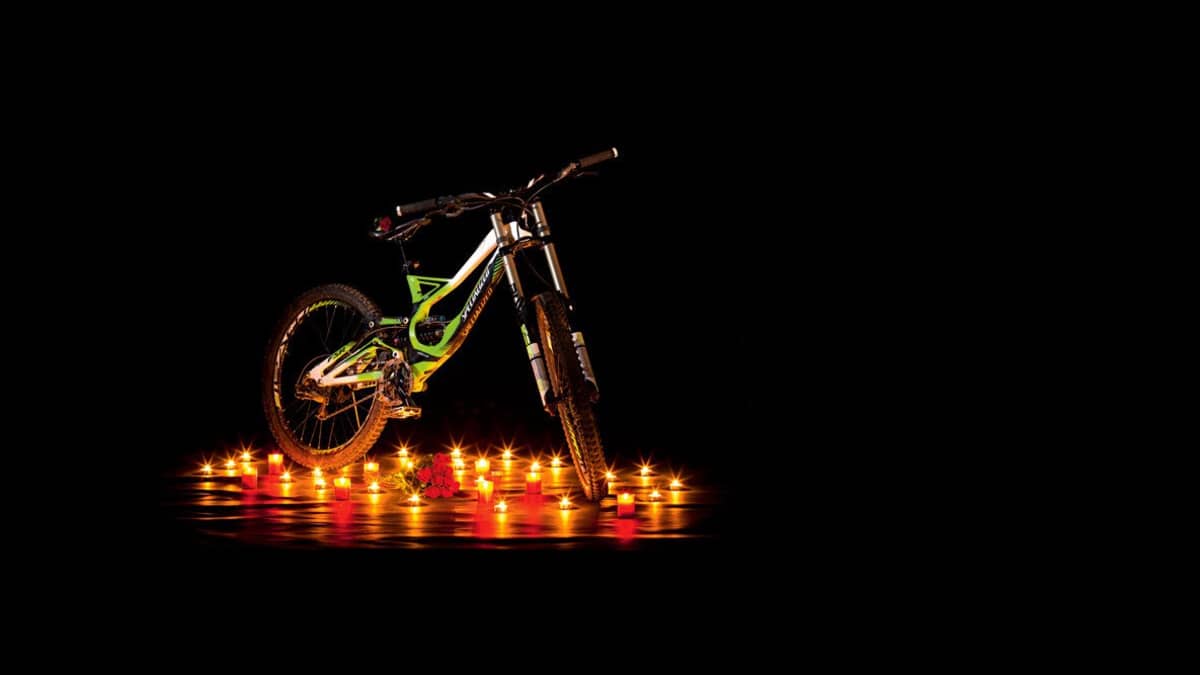
Before we get started, a quick demo rundown: The Specialized Demo is one of the best-known downhill bikes and has been on the market since the early 2000s (around 2003/2004). Over more than two decades, it has evolved from a massive freeride bike to an uncompromising World Cup racing machine. An important milestone followed in 2015 with the introduction of the first carbon version. The thing won World Cups (several), World Championships (e.g. 2010, Sam Hill) and Rampage events (Kyle Strait, 2004) and the hearts of many hobby racers. Striking: The feel-good geo, short chainstays and the successful balancing act between park use and downhill tracks.
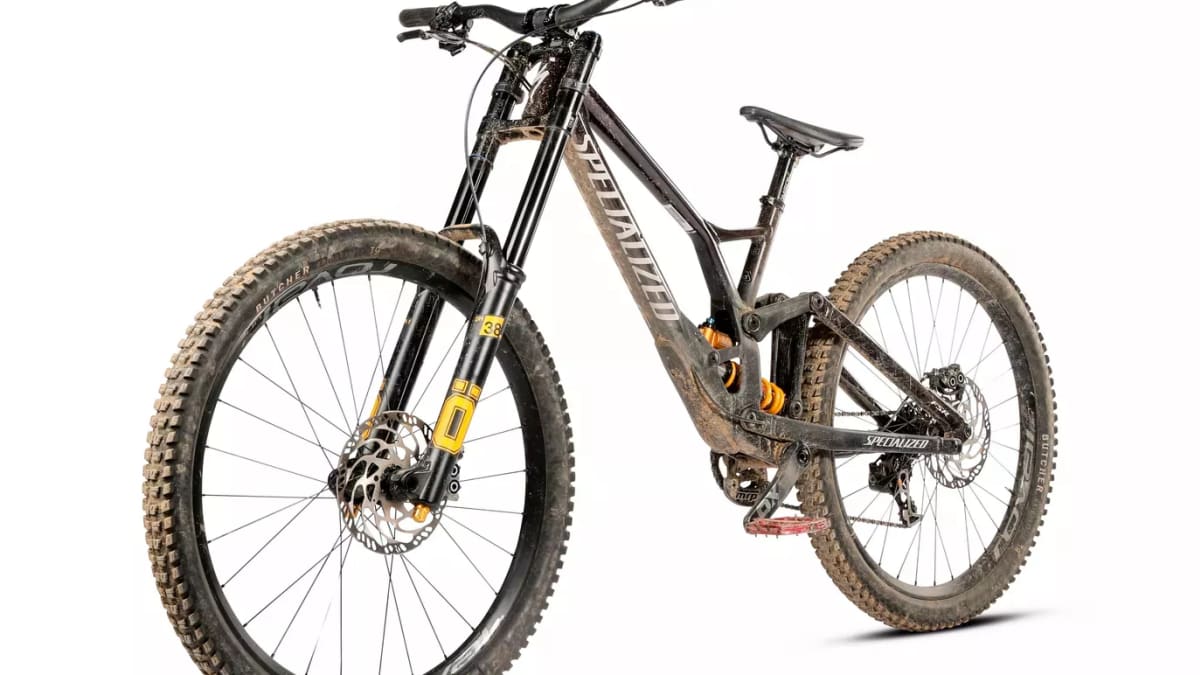
The Americans developed the Demo 11 over three years with several World Cup prototypes. The downhill bike utilises two separate systems: the HighGear transmission and the OBB rear swing arm. Both technologies are designed to improve suspension performance and keep pedalling forces away from the rear swing arm.
The BigBike has 200 millimetres of travel at the front and rear. The top model S-Works costs a whole 12,499 euros and weighs in at a hefty 18.3 kilos (frame size S4). Cheaper models are likely to follow.

HighGear gearbox with SRAM
The HighGear system is a patented transmission that increases ground clearance by 30 mm. A compact chainring on the crankshaft drives a countershaft. The final drive ring sits on the countershaft and drives the rear wheel. The position of the drive ring keeps the chain length above the chainstay constant. Chain forces remain independent of the rear wheel suspension, suspension forces independent of pedalling forces.
The reduced diameter of the drive ring and the higher position in the frame increase the ground clearance by 30 mm compared to the previous demo model. A protective housing shields the system from impacts and makes chainring damage unlikely. The chainring size can be adjusted for different routes.
The precise positioning of the drive ring decouples chain forces from the suspension. The suspension works independently over the entire suspension travel. The rear wheel axle path is optimised without pedal kickback. Angular impacts are absorbed cleanly and momentum is maintained. Specialised developed the system with SRAM.

OBB rear swing arm
The OBB (Over Bottom Bracket) rear swingarm enables independent adjustment of the wheel axle path, transmission ratio and braking behaviour. This decoupling allows precise control of impact force processing with full suspension activity, even under heavy braking.
A balanced wheel axle path should deliver speed without instability. Backward movement early in the suspension travel reduces bounce and maintains momentum. A controlled forward transition deeper in the suspension travel maintains wheelbase stability under load.
The characteristic curve shows 24 per cent progression. The suspension supposedly reacts predictably over the entire suspension travel. The system absorbs large compressions and works at speed through rough sections, says Specialised.

Self-aligning construction
The damper is driven by the chainstays and pulls between the main bearing and the rear axle. When pulling a load, it naturally stays on track. The rear wheel remains levelled and the bike remains stable and predictable thanks to the suspension travel.
With increasing loads, the design maintains significantly better alignment in the plane than traditional designs. The wheel runs where it should. Fewer corrections, less wasted energy. Loïc Bruni describes the riding behaviour: The bigger the bumps, the more stable and smooth the bike remains.
The frame (geometry)
The geometry has been adapted compared to its predecessor. The steering angle is now 63 degrees, which should enable smoother running at high speeds. The reach increases to 465 mm in size L. The chainstays measure 445 mm. The frame is made of carbon and utilises a monocoque design. The down tube has been reinforced to withstand the stresses of downhill use.
The geometry was developed directly with the Specialized Gravity Team. The front centre can be adjusted by 6 mm per frame size. Riders can adapt the fit and balance to track conditions, riding style and personal preferences without compromising the basic stability.
Size-specific rear centres ensure balanced handling across all frame sizes. Every rider gets the same predictable behaviour. The bottom bracket height can be adjusted by 7 mm. The reach adjustment is 6 mm per size.
The chainstays measure a demotypical short 435 mm for S3, 445 mm for S4 and 455 mm for S5.
Equipment & prices
The Demo 11 is available in several equipment variants. The top-of-the-range Demo 11 Pro version uses a RockShox BoXXer Ultimate fork and a RockShox Super Deluxe Ultimate shock. The brakes are from SRAM with Code RSC and 200 mm discs at the front and 180 mm at the rear. The drivetrain is based on SRAM X01 DH with a 7-speed cassette. The more affordable Demo 11 Comp version relies on RockShox BoXXer Select+ and SRAM GX DH components.
The Demo 11 S-Works complete bike costs a horrendous 12,499 euros. The Demo 11 S-Works frame alone costs 7499 euros. The prices of the more affordable models have not yet been finalised. Specialized did not want to tell us whether an aluminium model will follow.
Technical specifications:
- Frame: FACT 11m Carbon
- Drivetrain: HighGear gearbox with SRAM
- Rear swing arm: OBB system (Over Bottom Bracket)
- Ground clearance: +30 mm compared to previous model
- Characteristic curve: 24% progressive
- Sizes: S3, S4, S5
- Steering angle: 62.5°
- Stack (high): 640 mm
- Stack (low): 645 mm
- Reach S3: 445 mm; Reach S4: 475 mm; Reach S5: 500 mm; Reach adjustment: ±6 mm
- Bottom bracket height (high): 355 mm
- Bottom bracket height (low): 348 mm
- Bottom bracket adjustment: 7 mm
- Chainstays S3: 435 mm ; Chainstays S4: 445 mm ; Chainstays S5: 455 mm
- Wheelbase S3: 1260 mm ; Wheelbase S4: 1302 mm ; Wheelbase S5: 1335 mm
- Crank length: 165 mm
- Demo 11 S-Works price: €12,499
- Demo 11 S-Works frameset price: 7499 euros
Demo S-Works
- Frame: Carbon monocoque
- Suspension travel: 200 mm front, 200 mm rear
- Wheels: 29 inch front, 27.5 inch rear
- Fork: RockShox BoXXer Ultimate (Pro) / BoXXer Select+ (Comp)
- Shock: RockShox Super Deluxe Ultimate (Pro) / Super Deluxe Select+ (Comp)
- Drivetrain: SRAM X01 DH 7-speed (Pro) / SRAM GX DH 7-speed (Comp)
- Brakes: SRAM Code RSC (Pro) / SRAM Code R (Comp)
- Discs: 200 mm front, 180 mm rear
- Steering angle: 63 degrees
- Reach: 465 mm (size L)
- Chainstays: 445 mm
- Price: 12,499 euros
- Weight: 18.3 kg (S4)
- Availability: immediately


Laurin Lehner
Editor