


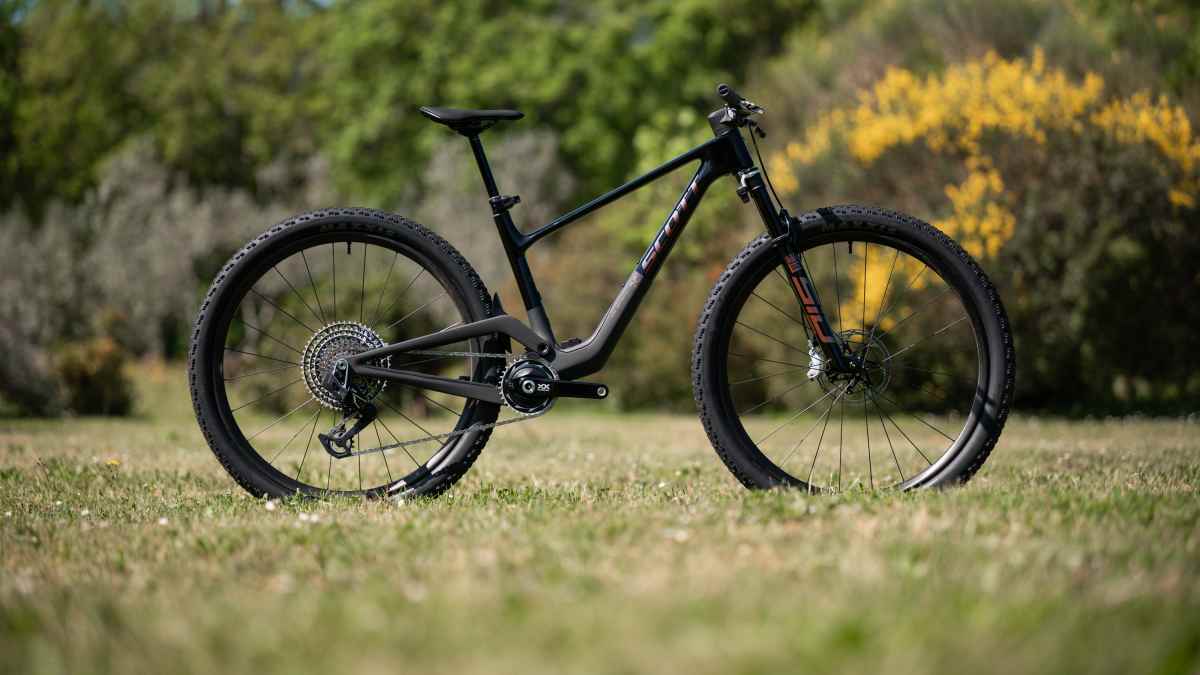
The new Wilier Urta Ultimate has been developed for the next generation of cross-country racing. XC races have changed significantly in recent years. The courses are getting faster, but at the same time more technical and demanding. For a modern race bike, it is therefore no longer enough simply to be as light and efficient as possible. Speed results from the interplay of propulsion, traction and control – and this is precisely where Wilier’s Urta Ultimate comes into its own. This new full-suspension mountain bike is designed to bring the experience gained from international racing directly onto the trail. The platform was developed in collaboration with the riders of the Wilier-Vittoria MTB Factory Team and further refined under real racing conditions – from the World Cup to the Cape Epic and the World Championships.
Conclusion
With the Urta Ultimate, Wilier is launching yet another exciting full-suspension cross-country bike. The variable geometry looks modern and promising – it’s only when it comes to seat tube length that the Italians remain conservative. Initial racing successes are already proving the developers right: in the right hands, the optimised Wilier Urta Ultimate is likely to be a really fast racing machine. - Jan Timmermann, BIKE editor
The Wilier Urta Ultimate in detail
- Intended use: Cross-country / Marathon
- Suspension travel: 120 / 120 mm
- Wheel size: 29”
- Frame material: carbon
- Frame weight: approx. 1700 g
- Price: from 7,500 euros
- Special features: Geometry adjustment via headset cups
The driver takes centre stage
One of the most significant innovations lies in the geometry. Wilier hasn’t simply made the Urta Ultimate longer and flatter, but has completely reworked the riding position. Five parameters played a key role for the developers: reach, stack, seat tube angle, bottom bracket height and head tube angle. In frame size L, the reach increases by nine millimetres. At the same time, the seat angle rises from 75 to 76.8 degrees. The seat tube is therefore significantly steeper, the riding position shifts forwards and the rider sits more centrally between the wheels.

This is intended not only to improve handling, but also to offer biomechanical benefits when pedalling. The design is supported by a lower bottom bracket and shorter cranks. The lowered centre of gravity is intended to improve handling, whilst the rider’s position is designed to enable more efficient power transfer. The stack, however, remains unchanged. The saddle and handlebar positions are thus intended to remain compact and central – characteristics which, according to Wilier, play a particularly important role in fast-paced cross-country racing. The frame of the new Urta Ultimate is made from the latest generation of Toray carbon and is designed to provide the necessary stiffness to transfer high forces with as little loss as possible.
The Urta Ultimate’s variable geometry is particularly interesting. In collaboration with the headset specialists at Acros, Wilier has developed a system that allows the bike’s handling to be adapted to the characteristics of the route. In the “Technical Race configuration”, the head angle is 66.5 degrees. This is designed to make the bike more manoeuvrable and controllable on technical sections. For fast race circuits, however, the Urta Ultimate can be adjusted to the “Fast Race configuration” with a 65.5-degree angle by swapping the headset cups. The flatter head angle is designed to provide additional stability at high speeds.
120 millimetres of suspension travel, reimagined
The Wilier Urta Max continues to offer 120 millimetres of suspension travel at both the front and rear in the 2027 model range. However, this is achieved through a completely redesigned kinematic system. Wilier claims to have engineered the rear suspension to fulfil different functions as effectively as possible across the entire travel range. In the first part of the travel, grip and responsiveness are the main priorities. In the middle phase, the suspension is designed to work as efficiently as possible whilst pedalling, whilst the final stage is intended to provide maximum support for hard impacts.
An adjusted gear ratio on the new Wilier Urta Ultimate is designed to make the rear suspension’s behaviour more linear and predictable. This promises benefits in the form of improved traction, particularly on technically demanding XCO courses. At the same time, the bike should remain efficient to pedal under load. By optimising the anti-squat value, Wilier aims to stabilise the rear suspension under load. The aim is to minimise the amount of energy lost to unwanted suspension movement. The rider should be able to convert their power directly into forward momentum – both uphill and on fast, undulating sections.
Like all modern high-end race bikes, the Wilier Urta Ultimate is also designed to accommodate electronic suspension systems. Both Fox Live Valve and RockShox Flight Attendant are compatible with the platform. This allows Wilier to offer the option of automatically or electronically adjusting the suspension depending on the riding situation and terrain.
Initial successes
A glance at the bike’s first race appearances shows that Wilier did not merely carry out theoretical development work on the Urta Ultimate. Even before its official debut, the bike competed in major races sporting the eye-catching Innovation Lab livery – and has already racked up several successes. Simone Avondetto rode it to victory in the Italian Cross Country Elite Championship. Juri Zanotti took silver in both the XCC and XCO events at the Elite European Championships. In Les Gets, Gustav Heby Pedersen also secured two victories in the U23 category – in the Short Track and the Olympic Cross Country events.
Models and prices
Wilier offers the Urta Ultimate in versions fitted with both Fox and RockShox suspension systems. Customers also have the choice between SRAM and Shimano drivetrains. All models feature carbon wheels from Miche and the brand’s own handlebar-stem combinations. This also applies to the entry-level model, which, at 7,500 euros, is already on the pricey side, but features a Rockshox Ultimate suspension fork. The expensive top-of-the-range model is equipped with the electronic Rockshox Flight Attendant system.
- Wilier Urta Ultimate Rockshox / Shimano XT Di2: 7,500 euros
- Wilier Urta Ultimate Fox / Shimano XTR Di2: 9,900 euros
- Wilier Urta Ultimate Rockshox / SRAM XX SL: 10,400 euros
- Wilier Urta Ultimate Fox / Sram XX SL: 10,900 euros
- Wilier Urta Ultimate Rockshox Flight Attendant / SRAM XX SL: 13,900 euros
What do you think: what’s the hottest new cross-country race bike for the 2026/2027 season? Let us know in the comments!

Jan Timmermann
Editor