


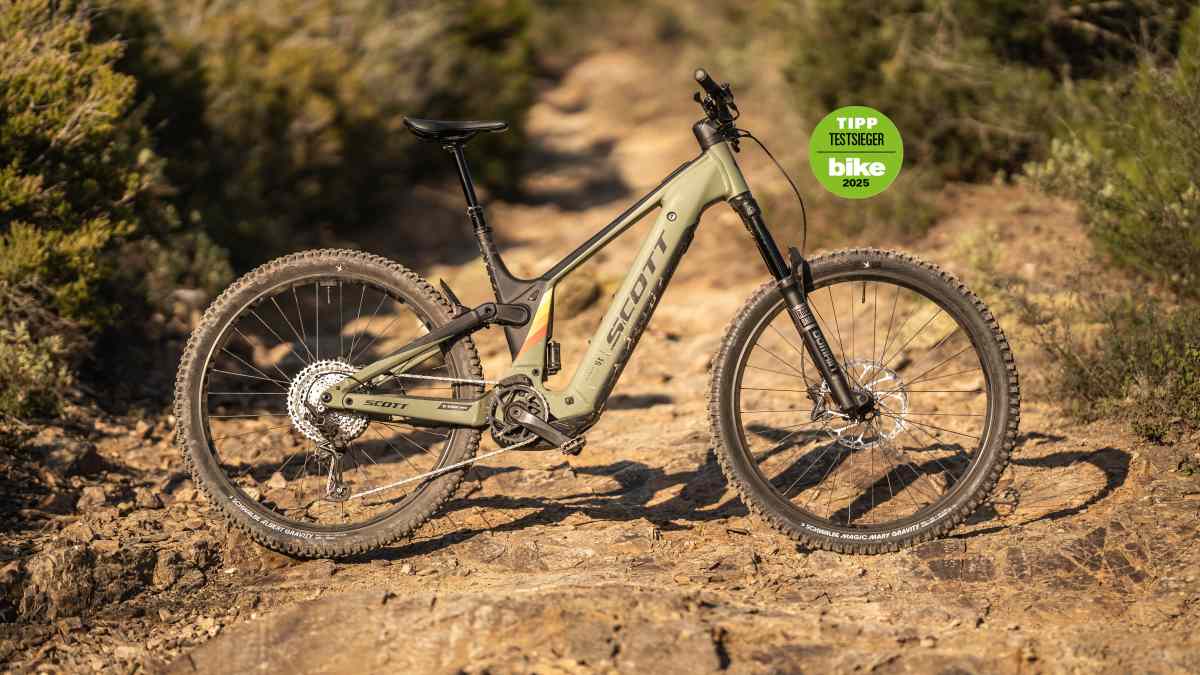
The concept is familiar, but the frame is completely new: the Strike is the accessible all-rounder among Scott’s e-MTBs. Moving away from carbon exclusivity and racing ambitions, yet with enough capability for challenging terrain, it’s designed to handle everything from everyday riding to mountain tours or Alpine cross. Four trim levels cover a wide range of prices and performance requirements. This means that the Strike, as before, sits below the Scott Patron All-Mountain (reviewed here) to.
A frame with a concept
The most striking technical feature is the cast bottom bracket shell, which includes the seat tube and has been manufactured by Scott as a single-piece component. This reduces the number of welds, minimises tolerances and is also designed to ensure stiffer, more reliable power transfer. The semi-integrated shock absorber is, of course, a standard feature on Scott bikes. However, the integration is discreet, ensuring that the shock remains easily accessible for set-up.
The rear suspension operates on the four-bar principle, offering 150 millimetres of travel and a linear response curve, which Scott has designed to prioritise comfort and predictability. This also applies to the moderate geometry. The very long chainstays, measuring 465 mm, are particularly striking; they are designed to make the bike highly controllable and stable, even when riding at a leisurely pace – both uphill and downhill. This is intended to conserve energy and give less experienced riders a greater sense of security. The 29er wheels on all frame sizes are also designed to provide stability.

The facts at a glance
- Engine: Bosch Performance Line CX, up to 120 Nm, 750 W, 600% assistance
- Battery: 800 Wh (Strike 10–30), 720 Wh (Strike 40)
- Display: Bosch Intuvia 200 (Strike 10 & 20), Bosch Purion 200 (Strike 30 & 40)
- Suspension travel: 150 mm at the front and rear
- Impeller size: 29 inches
- Sizes: S, M, L, XL
- Weight: 24.8 kg (Strike 20) to 25.7 kg (Strike 30)
- Prices: Four models priced between 4,199 and 5,799 euros
Powertrain: Bosch across the board
All four Strike variants rely on the Bosch Performance Line CX – the latest generation, with up to 120 Nm of torque, 750 watts of peak power and 600 per cent assistance. This is the most powerful motor in the Bosch range.
The Strike 10 and 20 come with the large Bosch PowerTube with a capacity of 800 Wh, as does the Strike 30. It is only with the entry-level Strike 40 model that the battery capacity drops to 720 Wh. All variants are compatible with the optional Bosch PowerMore range extender (250 Wh), should you be planning a long day in the mountains. Charging times do, however, vary depending on the model: the Strike 10 and 20 come with a 4-amp charger, whilst the Strike 30 and 40 have to make do with 2 amps – a detail that can certainly be relevant in everyday use.
Practicality for everyday use as a design objective
The Strike is a sporty mountain bike, but is also designed for everyday use. Cables for the front and rear lights are already routed through the frame and connected to the Bosch system. The frame is also designed to accommodate mudguards and a rear stand. The cable routing combines internally routed electrical cables with externally routed mechanical cables. Anyone who also uses their e-MTB for their commute to work will find this a well-thought-out base.
Facilities and prices: A clear hierarchy
Scott’s range includes four trim levels priced between 4,199 and 5,799 euros. The top-of-the-range Strike 10, priced at 5,799 euros, features Shimano XT gears and brakes as well as the Fox 36 Rhythm fork – a solid combination that won’t be overwhelmed on more challenging rides. The display is the Bosch Intuvia 200 with a separate mini remote.
The Strike 20 costs 5,399 euros and features the Fox AWL HD Sport fork. Furthermore, the brakes and gears are all from the Deore range. The Strike 30 (€4,999) and 40 (€4,199) switch to the more compact Purion 200 display, which combines controls and display in a single unit. The Strike 30’s suspension fork is from RockShox (Psylo Silver RC Air), whilst the Strike 40 is fitted with an SR Suntour suspension fork.
All models are fitted with Scott FSA cranksets, Alex rims, Formula hubs and Maxxis Forekaster tyres – 2.6-inch-wide on the Strike 10 to 30, and 2.4-inch-wide on the Strike 40. The new Strike is due to be available in shops from September.

Florentin Vesenbeckh
Editor CvD