


Not a race, not an adventure – both
Scott has completely reimagined the Addict Gravel. The result sits somewhere between a race gravel bike and a bikepacking adventure bike. The riding position is sporty but not aggressive, and the geometry is tuned for a smooth ride. The stack and reach have each increased by ten millimetres, whilst the cockpit is ten millimetres shorter. On fast gravel descents, this instils confidence without feeling sluggish.
The frame is available in HMX and HMF carbon. The HMX model weighs just 795 grams, whilst the HMF starts at 990 grams. Both versions share the same geometry and comfort concept. And both can accommodate tyres up to 57 millimetres wide. This means that not only fat gravel tyres, but also lightweight MTB tyres fit the bill. Fun fact: Scott does not recommend tyres narrower than 45 millimetres. You can tell that the chief designer of the new Addict is a mountain bike fan with a soft spot for off-road riding. A conversation with Jean-François Boivin You can find it here.
Suspension without springs
Scott replaces traditional suspension components with controlled flex. Delicate seat stays attach low on the frame, whilst the seatpost features a recess that can also accommodate a rear light. This is complemented by a special saddle clamp. That may sound like engineering poetry, but off-road it works in a surprisingly unpoetic way: It’s simply becoming more convenient.
According to Scott, vertical compliance increases by between 25 and 60 per cent at the rear, depending on the seatpost, and by around 30 per cent at the front. To demonstrate the flex, chief designer Jean-Francois Boivin hung heavy weight plates from the Addict’s frame, causing the carbon to bend like Mady Morriso doing yoga. On the Feldberg in the Black Forest, the Addict Gravel feels just as comfortable. The 50mm Schwalbe G-One RX tyres do the rest. They provide grip and comfort on rough gravel, roll smoothly on tarmac and make the bike feel confident even on descents. A race tyre would be faster – but you’d suffer more off-road as a result.

Light on their feet rather than nervous
The Addict Gravel 10 test bike comes with an HMX frame, SRAM Force XPLR and the distinctive wavy Fulcrum Soniq GR carbon wheels. With a 42-tooth chainring and a 10–46 cassette, the gear range is suitable for long climbs as well as fast gravel sections. A chain guide keeps the chain where it belongs on rough terrain.
The one-piece Syncros cockpit fits in well with the overall design. It saves weight, feels comfortable in the hand and looks elegant. The handlebars have little drop – which is handy when switching quickly between the upper and lower sections. We like that. However, the handlebars have little flare and look almost like road bike handlebars – we weren’t so keen on that, though it’s presumably a matter of taste.
My impressions from the test:
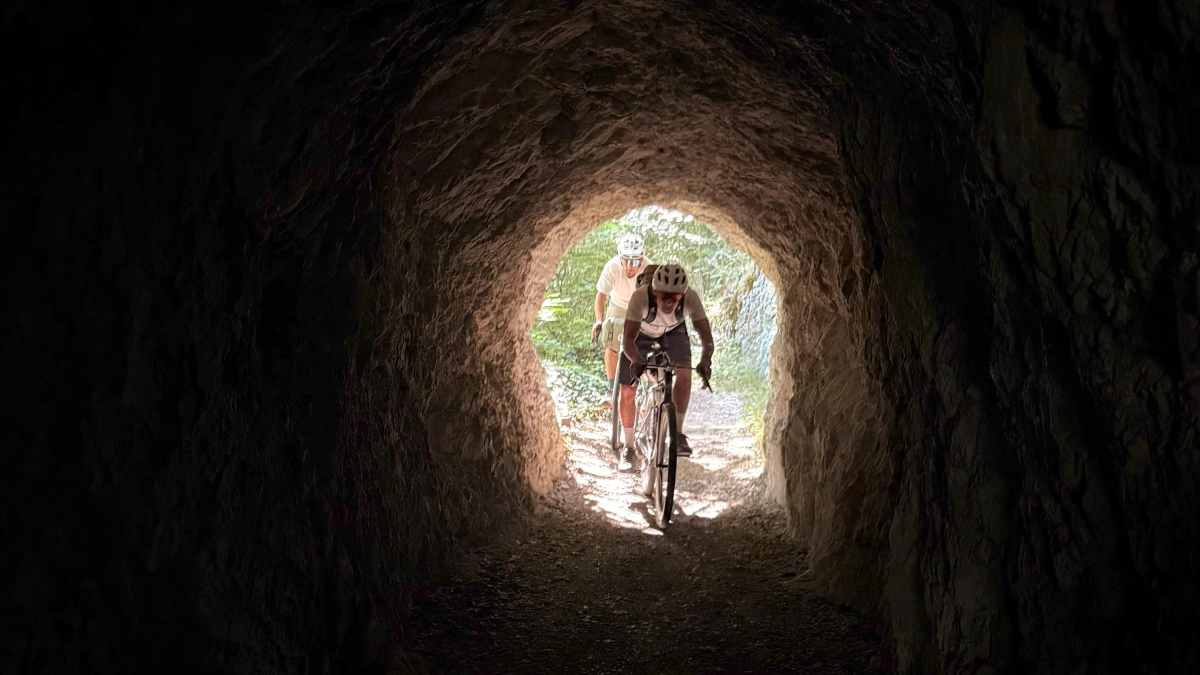
The Addict Gravel accelerates with ease, remains stable at speed and is still agile enough for quick changes of direction. It doesn’t ride like a road bike that’s accidentally ended up in the woods. Rather, it rides like a powerful gravel bike that belongs there. The Scott Addict handled the steep, root-strewn trails around the Feldberg better than the Pilot. In other words: better than me. Because when the ride gets too bumpy and jolting – my contact lenses slip in my eyes and my neck vertebrae rattle – I can’t help but think: this is missing the point; this isn’t gravel biking anymore. That’s just my personal opinion; others only really come into their own when their spinal discs start to creak. Very good: the frame’s flex doesn’t just work in the lab, but provided noticeable comfort off-road. This is aided by the thick 50-series tyres, which were inflated to mountain bike pressures: 1.6 at the front, 1.8 at the rear. On long, straight forest tracks, the Addict surges forward with plenty of drive. Here, you benefit from the light weight of this high-end model. Rather than further differentiating between disciplines, Scott offers the Addict as a platform that can be used as a fast gravel racer with a comfortable riding position, but can also be upgraded for adventure riding.
> Dimitri Lehner, Tester
Space for emergencies
Scott has also thought through the luggage arrangements without turning the bike into a packhorse. The down tube features a storage compartment for the ‘Save The Day Kit’, containing an inner tube, tyre levers and a mini pump. The frame triangle accommodates a bolted-on bag that remains easily accessible whilst riding. A mini tool and tubeless plugs are stowed away in the handlebar ends.
There are special bottle cages mounted on the fork. That means: two bottles on the frame, two at the front of the fork. Wow! I wonder who asked for that? Scott team rider Jonas Deichmann? The extreme sportsman has just cycled round Europe, covering 25,000 kilometres in 135 days. Mind you, he did so on the Addict Gravel’s predecessor. For those who want to take the Addict Gravel into full adventure mode, Syncros offers a matching bag system comprising frame, top tube, handlebar and saddle bags.
The all-rounder with a penchant for comfort
The new Addict Gravel aims to do a lot and can do a lot. It’s light enough for fast rides, comfortable enough for long days and robust enough for rough gravel. Its 57-millimetre tyre clearance opens up more possibilities than you’d expect from such a slim carbon frame.
The verdict is accordingly: Scott has struck a balance between race and adventure not through compromise, but through comfort. The Addict Gravel isn’t a specialist bike. And perhaps that’s precisely where its strength lies.
Technical Specifications – Scott Addict Gravel 10
| Frame | Carbon HMX, approx. 795 g |
| Ground clearance | up to 57 mm |
| Circuit | SRAM Force XPLR AXS, 1 × 12 |
| Translation | 42 teeth / 10–46 |
| Bicycle wheels | Fulcrum Soniq GR Carbon |
| Tyres | Schwalbe G-One RX, 50 mm |
| Cockpit | Syncros, one-piece |
| Weight | approx. 8.5 kg |
| Frame sizes | XXS to XXL |
| Frame sets | HMX €2,999, HMF €1,999 |
Model programme: Addict Gravel 40 from €2,799, Addict Gravel 10 €6,499, Addict Gravel Premium €8,999. All models come with a single-chainring drivetrain; the frame is not designed for double-chainring set-ups.

Dimitri Lehner
Editor