


Who is responsible if there is a crash while mountain biking? Whether trail or bike park - legal liability depends on the country, situation and parties involved. And how can you insure yourself against the consequences?
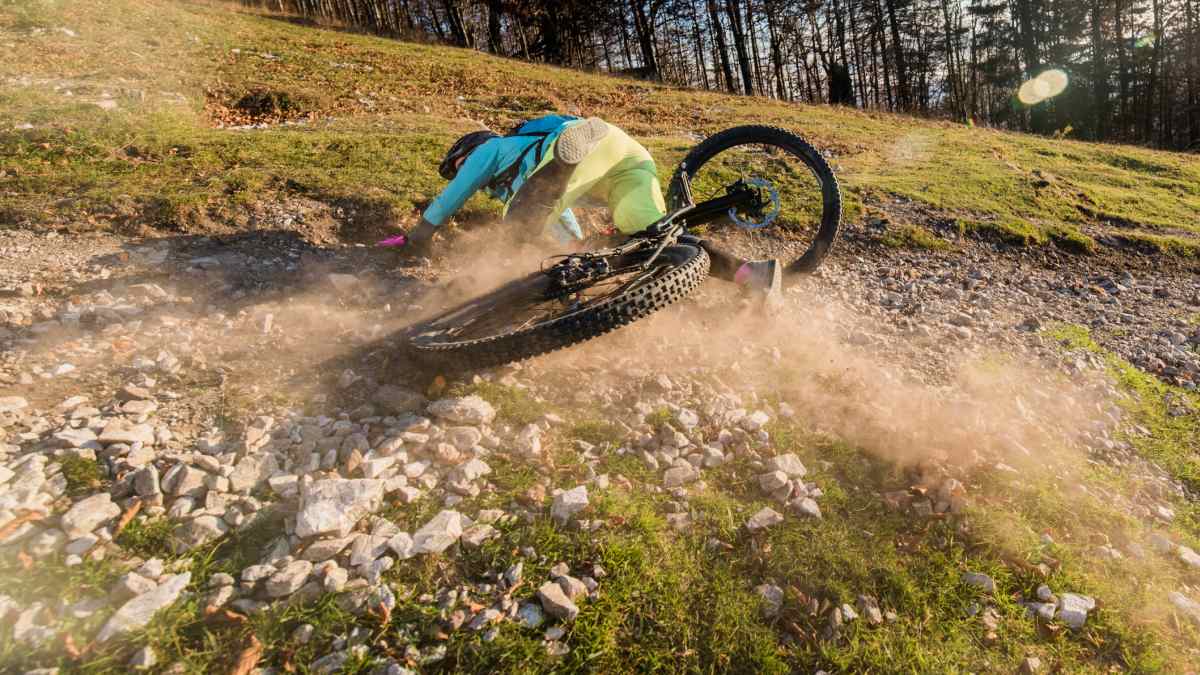
Mountain biking means freedom, experiencing nature and a sporting challenge - but also risk. Roots, stones, steep descents and changing weather conditions increase the risk of falling. If an accident occurs, the question of liability quickly arises: who is responsible for injuries or damage to property? In the vast majority of cases, the legal answer is soberingly clear: the rider himself or herself. Nevertheless, there are legal nuances in Germany, Austria and Switzerland that play a role in particular for track operators, forest owners and other parties involved. It also becomes more complex when two or more bikers are involved.
Principle: Personal responsibility on the trail
In all three countries, mountain biking is characterised by a strong principle of personal responsibility. Anyone who sets off on a trail on a bike consciously accepts the typical dangers of this sport. In legal terms, this is referred to as the "typical sporting danger". This includes loose stones, narrow paths, slopes, jumps or changing surfaces. If a mountain biker falls through no fault of their own, nobody is liable except themselves - neither the state nor the landowner or an association.

This basic attitude can be found in German civil law as well as in Austrian and Swiss liability law. Courts regularly emphasise that mountain biking is not an everyday cycling activity, but a risky leisure sport.
Liability of route operators and landowners
Nevertheless, route operators and landowners are not fundamentally exempt from all responsibility. The decisive factor is the so-called traffic safety obligation. It obliges those who open or maintain a source of danger to take reasonable measures to protect others from atypical, not readily recognisable dangers.
Germany
In Germany, forest owners or local authorities only have very limited liability for forest and nature trails. The Federal Forest Act privileges the right of free access, but largely excludes comprehensive liability. The situation can be different for man-made bike parks or designated trails: Gross construction defects, lack of safety features on artificial obstacles or misleading signage can give rise to liability.
Austria
Austria has a similar limitation of liability for trails in alpine terrain in the Forest Act. However, liability can apply if routes are specifically advertised, maintained and authorised for sport. Operators must then at least mark obvious dangers and rectify serious defects.
Switzerland
In Switzerland, too, there is a strong focus on personal responsibility. Landowners are only liable for exceptional, hidden dangers. In official bike parks or trail centres, however, higher requirements apply, particularly in terms of maintenance, signage and regular inspections.
In short: the more "natural" the trail, the lower the liability of third parties. The more a trail is designed, advertised or commercially operated, the more likely it is that operators will be held liable.
Riding in the bike park: exclusion of liability or insurance?
The question of liability arises particularly frequently in bike parks. Accidents, even serious ones, helicopter rescues, spinal injuries or head trauma are unfortunately part of everyday life there. The legal protection of the operators usually does not work via individually signed liability exclusions. In German, Austrian and Swiss law, these would only be effective to a limited extent anyway, especially in the case of gross negligence or personal injury. Instead, bike park operators rely on several other instruments:
- General Terms and Conditions (GTC):
Exclusions of liability and risk information are often part of the general terms and conditions that are accepted with the purchase of the lift ticket or day ticket. These clauses make it clear that use is at your own risk and that typical sporting risks are assumed. - Clear signposting and risk warnings:
Notices such as "Use at your own risk", difficulty levels, route classifications and the obligation to wear a helmet not only serve to ensure safety, but also to provide legal protection. They show that the operator is fulfilling its duty to provide information. - Traffic safety at a limited level:
Bike parks must regularly check and maintain their trails, but not make them "accident-free". The aim is to avoid atypical hazards - such as loose wooden components, rotten bridges or unrecognisable traps. - Public liability insurance:
The most important protection for operators is special public liability insurance. It takes effect if the operator can actually be proven to be in breach of duty - for example, inadequate maintenance or failure to secure a known danger zone.
These insurance policies are tailored to outdoor, sports and park operations and cover personal injury and property damage if the operator is liable. Without such a policy, the economic operation of a bike park would be almost inconceivable.
However, the decisive factor remains: even in the bike park, riders are expected to take a high degree of personal responsibility. Anyone who rides drops, jumps or downhill trails is consciously moving in a high-risk area.
The collision between two mountain bikers
Accidents in which two mountain bikers collide are particularly prone to conflict. The question here is who has breached their duty of care, and the basic rule applies in all three countries: Every rider must ride in such a way that they can stop or take evasive action at any time. Anyone travelling too fast, riding through blind passages or not paying attention to oncoming traffic is acting negligently.
Typical case constellations
- Rear-end collision: As a rule, the rear driver is primarily or solely at fault, as he should have kept a sufficient distance.
- Overtaking manoeuvre: Anyone overtaking has a special responsibility. If an accident occurs, the person overtaking is usually liable.
- Different directions of travel (uphill vs. downhill): There are rarely binding legal priority rules. However, bikers travelling downhill often have a higher duty of care as their speed is higher. In bike parks and trail centres, the direction of travel is usually specified or special uphill trails are explicitly signposted.
Courts always examine the individual case: speed, visibility, route character and driving ability all play a role. It is not uncommon for the result to be a liability ratio of around 50:50 or 70:30.
Insurance: How can you protect yourself?
In view of the risks, the question of sensible insurance arises - both for your own health consequences and for possible claims for damages by third parties.
Private liability insurance
It is the most important cover. In all three countries, it generally covers damage caused to others while mountain biking - for example in the event of a collision. It is important to look at the conditions: Races or competitions are often excluded.
Accident insurance
Private accident insurance pays out in the event of permanent health impairments, regardless of who is at fault. It is a sensible supplement to statutory cover, especially for recreational athletes.
Health insurance
Statutory health insurance (or compulsory insurance in Austria and Switzerland) covers medical treatment costs. Private supplementary insurance can cover benefits such as rescue costs, cover abroad or better rehabilitation measures.
Special sports or bike insurance
Some associations and insurers offer special policies for mountain bikers. These combine liability, accident and legal expenses cover and are particularly interesting for frequent or extreme sports enthusiasts.
Legal expenses insurance
If there is a dispute about fault and liability, legal expenses insurance can help to cover the costs of lawyers and courts.
Conclusion
In legal terms, mountain biking means one thing above all: personal responsibility. In most cases, the rider is liable. However, there are exceptions in the event of collisions, gross defects or operating trails. Good insurance is therefore not a luxury, but a sensible precaution.

Josh Welz
Editor-in-Chief