


The brake disc is one of the most safety-relevant components on a bike. And yet many people simply ride the material that is fitted ex works - without ever questioning whether it really suits their body weight, riding style and choice of route.
Because even the best brake is useless if the brake disc is undersized and fails due to heat or - conversely - the modulation suffers because the discs are too large for the system weight or the area of application.
Important: Before every brake disc upgrade, check the maximum and minimum disc size of the fork and frame.
Anyone who weighs 85 kilos and regularly brakes down long gravel descents will quickly turn a 180 mm disc black. I have seen this often enough: silver at the front, dark grey like a piece of coal at the back. In such a case, however, the brakes are not wrong, but the disc is undersized for the area of application. - Max Fuchs, BIKE editor
The physics behind it: Levers & heat
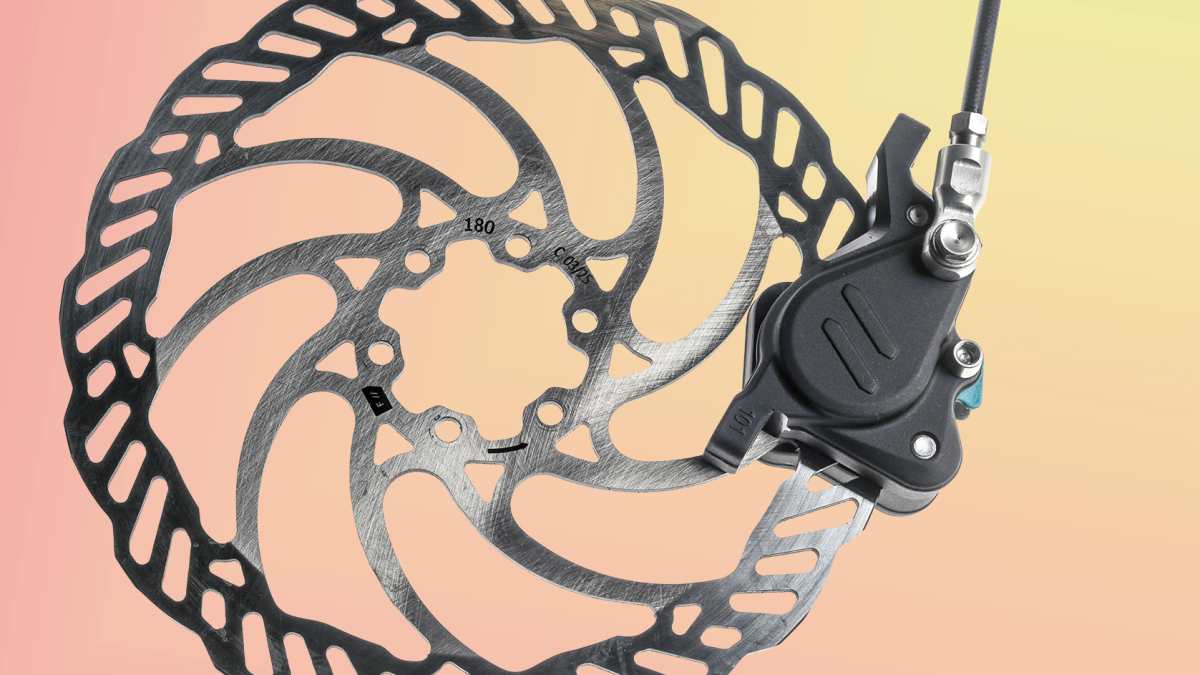
Larger brake discs work according to a simple law of leverage: the larger the radius of the disc, the greater the lever arm with which the braking force acts. If you change from 160 mm to 203 mm, this lever arm is extended by around 27 % - the same manual force generates significantly more braking force because you are literally sitting on the longer lever.
The second point is thermal management. A larger disc offers more friction surface, distributes the heat generated to more material and cools down more quickly due to the larger circumference. For all those who want to go one better: Many manufacturers now also offer their discs in different thicknesses. In our last comparison test, the disc thicknesses varied between 1.8 and 2.5 millimetres. The same applies to heat management for the thickness of the disc as for the circumference: The thicker the disc, the more heat it can absorb before the braking power decreases on long descents due to the heat.
140 mm: Only for XC and gravel bikes
The smallest common MTB disc size is the realm of weight fanatics. 140 mm discs work on flat terrain with a light rider, but they quickly reach their thermal limits on long descents. They are not an option for enduro, trail or even e-MTB, especially as most modern mountain bikes do not have the appropriate brake mount to fit such a small disc.
160 mm: Enough for racers, too short for the rest
Many manufacturers specify 160 mm discs on entry-level hardtails or lightweight race bikes, at least at the rear - as long as the descents are not too long and your body weight remains in the moderate range, this also works on undulating trails, as we know them from the cross-country race track.
For all those who use their hardtail or race fully as a touring bike and sometimes with a rucksack and collect a lot of metres in altitude, caution is advised. Especially on long gravel descents, when you tend to let the rear brake drag, 160 mm is not enough. You should definitely upgrade for this area of use!
180 mm: The standard
Front and rear 180 mm is now standard on most trail bikes. They offer the best compromise between braking power, heat resistance and without excessive weight. As the braking systems in the gravity sector are now so powerful, many enduro riders nowadays even ride 180 mm discs to reduce the brute braking force in favour of modulation.
203 mm and more: For heavy riders and long descents
If you regularly ride several hundred metres uphill at a time, weigh more than 85 kg or ride an E-MTB, you should consider 203 mm or 220 mm. These discs generate maximum braking power to reliably decelerate even high system weights without excessive manual force - provided you have the right brake system, of course. And even more importantly, the large rotors are more forgiving before fading occurs.
Also interesting:

Max Fuchs
Editor
