


In this article, we use so-called affiliate links. With every purchase through these links, we receive a commission from the merchant. All relevant referral links are marked with . Learn more.
Perfect performance on every ride: brakes and suspension components will only work reliably if they are free from grime. Especially in changeable weather and on challenging trails, dirt quickly builds up in the most sensitive parts of the bike. A thorough clean after every ride helps.
Safety first An aspect that is often underestimated: dirt can pose real safety risks. Brake pads contaminated with oil or mud lose a significant amount of their effectiveness. Cracks in the frame or faulty components also stand out clearly when cleaning – so a clean bike is also a bike that’s been properly checked.
Proud of your bike Admittedly, this point is subjective – but who hasn’t felt this way? A freshly cleaned bike simply makes you look forward to your next ride. And if you value your bike, you’ll look after it more carefully.
An interview with Mike Schinke, the ‘King of Mechanics’

BIKE: Mike, you say that lots of people clean their bikes the wrong way. What do you mean by that?
MIKE SCHINKE: Many people set their high-pressure washers to maximum pressure. This is often as high as 100 bar. That’s equivalent to the water pressure at a depth of 1,000 metres. Most outdoor watches are only water-resistant up to 30 metres. In other words, it’s a real nightmare for bearings and joints. Another common user mistake is that people spray their bike with the cleaner and rinse it off straight away. However, the ingredients need a certain amount of time to take effect; this is specified in the user manual.

So is the garden hose always the better option?
Yes, if you still want to use a steam cleaner, you should turn the pressure down and aim it at the floor first, as the pressure is higher at the start. If the dirt has dried on, I recommend giving the bike a quick rinse with the garden hose, then spraying it with the cleaner and working the cleaning agent in with the brush. After five minutes, you can then give the bike a final rinse. By the way: all the bearings and joints can easily withstand the pressure from the garden hose. So you can point it at any part of the bike without any worries.
Specialised bike cleaners are all the rage. Are there any affordable alternatives?
Sure, a bucket of warm water and washing-up liquid. That loosens the dirt too and works quite well.
Do I need to clean and lubricate my chain after every ride?
No, many people lubricate their chain too much and too often. You can tell this by the heavily soiled sprockets. You should judge when the chain needs oiling by looking at its condition. At the very latest, when the chain links are shiny, it’s time to oil it. Also important: after washing, wipe the chain dry with a cloth before oiling it again. You don’t need to oil the link. That’s why I wipe the outer sides dry again after oiling, so they don’t attract dirt.

How often should you clean the drive?
If you clean and oil the chain properly, you’ll also need to clean the drive less often. A lot of dirt often builds up on the derailleur pulleys. First, I scrape it off with a carpet knife. Then I spray on some drivetrain cleaner, work it in with a brush and leave it to soak in.
In spring and autumn in particular, many trail rides turn into a mud bath. How often do I need to clean my bike in summer when the conditions are dry?
Dust is worse than mud and slush. This is because, in mud, the small stones in the dirt are large enough that they do not easily find their way into suspension components and bearings. Dust is much finer and therefore penetrates more easily.
If parts on the bike squeak, many people apply some oil spray to sort it out.
Stay away from WD40 or penetrating oil! Because these products don’t just lubricate – they also clean. This means that the initial lubrication in the bearing is washed away, the balls are no longer lubricated and run dry. That spells the end for the bearing.
Products for cleaning bikes
These products make all the difference.
Grease remover
Special drivetrain cleaners can be used to thoroughly clean sprockets, derailleur pulleys and chainrings. The chain cleaner from Tunap has proved its worth in this regard. Not only does it degrease, but it also lubricates thanks to paraffin. What’s more, it’s easy to apply with a brush. €14.95 (300 ml).
Foam-maker
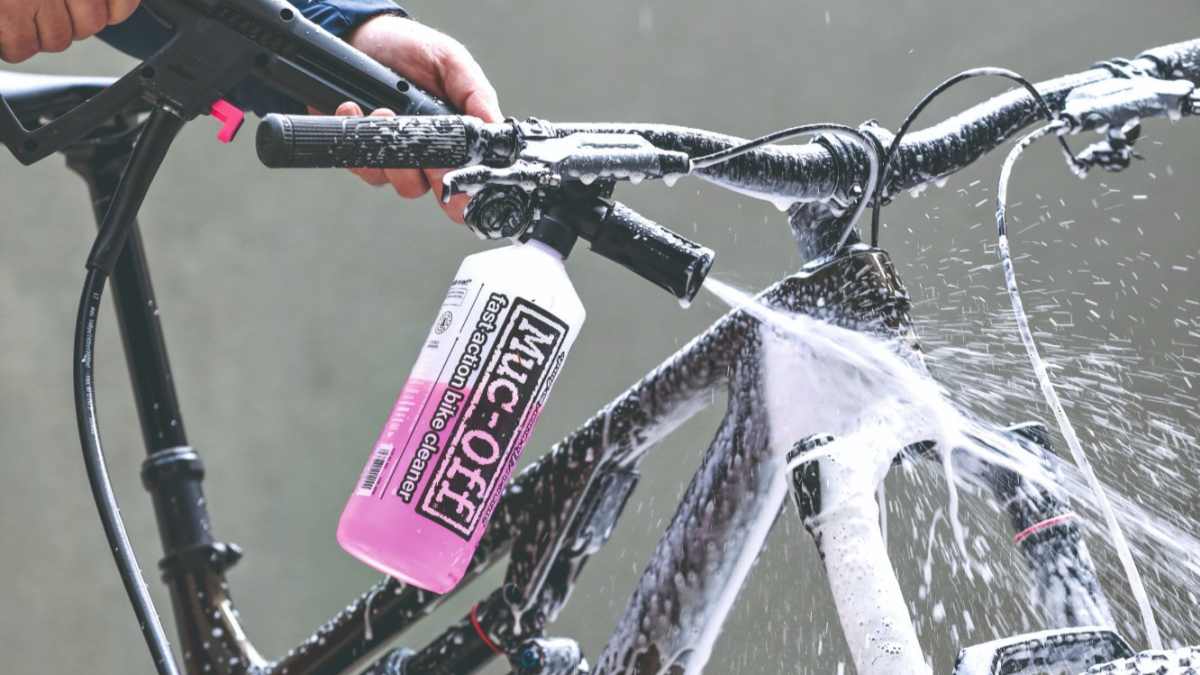
Gardeners often fill such spray bottles with plant protection products. Pump bottles are also handy for cleaning bikes. Cleaning products are easy to refill, which is environmentally friendly, and the nozzle can be adjusted more precisely than with disposable bottles. Two-litre bottles have proved their worth here. For example, for Obi or Amazon Available from 5 euros.
the icing on the cake
After washing your bike, you’ll want to avoid water marks and limescale. After all, it’s a pleasure to look at. A microfibre cloth ensures a shiny, streak-free finish. Tip: It’s best to use a large cloth, at least 40 x 40 centimetres. Available, for example, from Rosebikes or Amazon for 9.99 euros.
Coarse cleaner
A craft knife or an old kitchen knife is ideal for removing dirt from the derailleur pulleys. It’s particularly easy to do this when the bike is hanging in a bike stand. Place the knife at the side of the derailleur pulley, turn the crank backwards and scrape the dirt off. When Amazon from 5 euros.
Mobile car wash
Once the dirt has dried on, cleaning becomes much more of a chore. With a portable, battery-powered pressure washer, you can clean your bike straight away on the spot. One example is the Aqua2go Evo, which has a 21-litre capacity and three pressure settings of 30, 40 and 60 bar. The battery lasts for around 30 minutes. Price: 279 euros

Laurin Lehner
Editor