


Cateye GVolt 80.1 review: A powerful StVZO-compliant light for aero cockpits
Matthias Borchers
· 09.09.2026


In this article, we use so-called affiliate links. With every purchase through these links, we receive a commission from the merchant. All relevant referral links are marked with . Learn more.
Lower-link mounting for modern cockpits
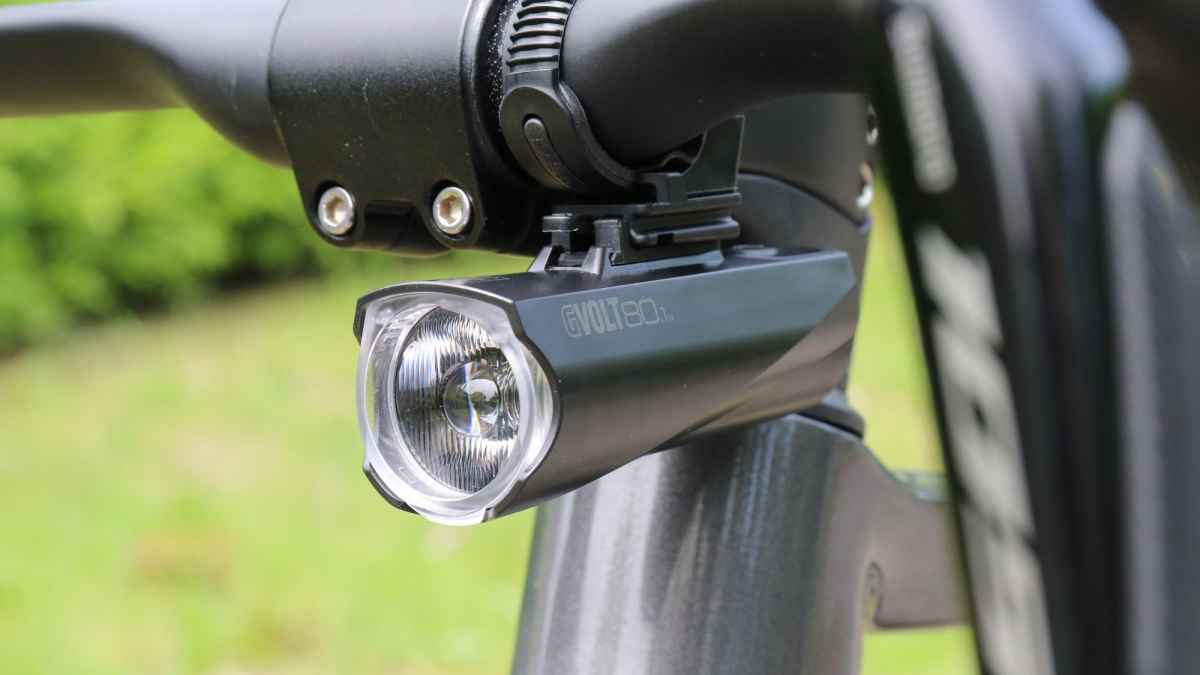
On many modern road bikes, the cockpit is not suitable for battery-powered lights with standard mounts. These only fit properly on handlebars with a round cross-section, leaving hardly any space for accessories. Flat top-tubes and computer mounts with an extension arm call for a light that can be positioned beneath the cockpit. This is precisely why Cateye is launching the GVolt 80.1 with a GoPro adapter.
Fitting the lower arms to the Front Mount is straightforward and proved very secure in testing. With a sub-score of 1.0, Cateye achieved the top mark in the mounting category. The light sits close to the handlebars, remains out of the rider’s field of vision and does not get in the way when changing grips or operating a cycle computer. This is a significant advantage for riders with modern aero handlebars.
Bright light with poor close-up vision
At long range, the light distributes its beam evenly and provides sufficient brightness. The course of the road, uneven surfaces and obstacles can be clearly seen in the dark. The light distribution is therefore particularly well suited to training rides on unlit country roads or brisk commutes.
Directly in front of the front wheel, however, the illumination is slightly weaker. Small obstacles such as twigs or pebbles on slower, winding routes are therefore more difficult to spot; more light would be desirable here. On straight stretches, however, the lighting is well balanced: the beam focuses on the area where visibility is crucial at higher speeds.
Accurate battery indicator, slow charging time
Three lighting modes offer a choice between maximum brightness and longer battery life. At the highest setting, the GVolt 80.1 lasts for three hours and five minutes in the TOUR test. After that, a usable reserve is available thanks to automatic power reduction. For longer night-time rides, however, you should still plan your charging carefully.
The four-stage blue LED battery level indicator is a notable feature. It provides precise information on the remaining capacity. However, when fitted, it is obscured. The charging time of four hours and ten minutes is longer than the average for the test group. Anyone wishing to use the light again shortly after an evening ride will need to bear this drawback in mind.
Solid workmanship and a strong overall result
Weighing in at 107 grams including the mount, the GVolt 80.1 remains light enough for a clutter-free road bike cockpit. TOUR rates the build quality at 2.0 and the handling at 1.9. In particular, the combination of a compact design, a reliable front-mount solution and excellent visibility makes for a good all-round package.
With a TOUR score of 2.1, the Cateye ranks at the top end of the field of seven models tested. It really comes into its own on aero road bikes, where the cockpit requires a lower-handlebar mount.
| Price | 79 euros, including a standard mount and a GoPro adapter |
| Country of manufacture | Japan |
| Battery capacity | 3,400 mAh |
| Weight including holder | 107 grams |
| Lighting modes | 3 |
| Battery level indicator | 4-LED bar, blue |
| Lighting/charging time | 3:05 / 4:10 hours:minutes |
| Illuminated profile | 2.6 |
| Burn time | 2.5 |
| Handling | 1.9 |
| Processing | 2.0 |
| Bracket | 1.0 |
| BIKE rating | 2.1 |

Matthias Borchers
Editor
