


Fear is a poor guide when mountain biking. Anyone who tenses up or reacts incorrectly risks serious falls. How the mind can lead to riding errors – and what helps.
Conclusion: breaking through the deadlock
Fear whilst mountain biking is a natural protective instinct, but it often leads to falls due to defensive reactions such as braking, tensing up or pulling back. By systematically practising your riding technique, keeping your eyes fixed well ahead and actively executing your movements, you can overcome the mental block. In this way, paralysing fear is transformed back into controlled respect and lasting enjoyment on the trail.
Why fear takes over
Mountain biking is a sport that demands dynamism, balance and quick decision-making. Whether it’s boulder fields, steep descents, slippery gravel or long jumps – the terrain requires the body to constantly adapt. But what happens when doubt suddenly creeps in and respect turns to fear? The answer lies deeply rooted in our evolution: the human brain reacts to perceived dangers with ancient survival mechanisms. The amygdala, the brain’s fear centre, rapidly releases stress hormones such as adrenaline and cortisol. The body switches to the classic reflex in a flash: fight, flight or freeze (Fight, Flight or Freeze).

On a mountain bike, however, these biological emergency responses are extremely counterproductive. When the flight-or-freeze response kicks in, your field of vision narrows to the dreaded ‘tunnel vision’. Instead of scanning the line well ahead, mountain bikers fix their gaze on precisely the obstacle they fear – the large rock, the deep rut or the precipice. The principle ‘Where you look is where you go’ then strikes mercilessly: you end up riding exactly where you don’t actually want to go.
Furthermore, anxiety leads to severe muscle tension. Fine motor skills and the necessary suppleness are lost. The body becomes rigid, and the joints in the arms and knees lock up. Instead of actively absorbing shocks as a ‘human suspension’, the cyclist transfers the energy of the impacts to the bike without any damping.
To make matters worse, fear leads to irrational avoidance and defensive reactions. When the brain’s intuitive reaction is: ‘Slow down, pull back and brake!’, on a mountain bike this is often the exact opposite of what would be physically correct. On the trail, speed means stability – much like a spinning top, which only stays upright if it has enough momentum. Anyone who loses momentum out of fear disrupts the bike’s natural momentum and often sets themselves up for failure.
Typical mistakes caused by anxiety on the trail
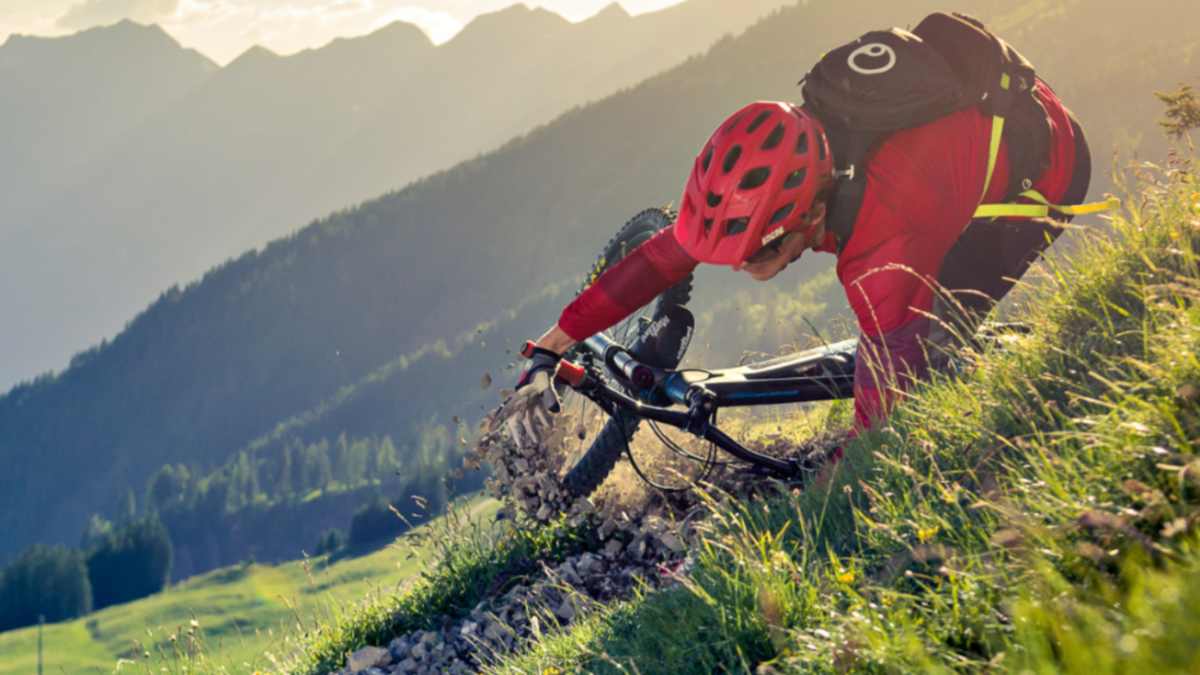
The steep descent: your bum well clear of the rear wheel
- The fear pattern: When the slope drops off steeply, the brain pulls the emergency brake: ‘Get away from the precipice!’ The rider shifts their bottom as far back as possible over the rear wheel to avoid sliding forwards over it.
- The physical consequence: Due to the extremely rear-heavy position, the front wheel is completely off the ground. It loses all grip, can no longer be steered and skids away at the slightest bump. Furthermore, the arms lack freedom of movement as they are fully extended.
- Handy tip: Maintain the basic position! Lower your centre of gravity without pushing your bottom too far back. Keep your chest low over the handlebars, your elbows bent and pointing outwards, and your knees and hips bent as far as possible. This maintains pressure on the front wheel and allows you to steer the bike with precision.
The drop: Too slow approaching the edge
- The fear pattern: A step or ledge appears. The fear of the drop makes the rider hesitate. He brakes before the ledge and rolls towards the drop in slow motion.
- The physical consequence: Due to the lack of momentum and activity, the front wheel tips over immediately as soon as it leaves the edge. Whilst the rear wheel is still on the ground, the front drops sharply. The cyclist is thrown over the handlebars.
- Handy tip: Build up momentum! Fully release the brakes before reaching the edge. Just before the edge, use an active push from your legs and hips to lighten the front wheel and push it forwards beneath your body. This keeps the bike level.
The Gravel Bend: The Sudden Braking Manoeuvre
- The fear pattern: On a gentle bend, you get the feeling that you’re going too fast. The panic reflex kicks in and your finger instinctively reaches for the brake levers.
- The physical consequence: Centrifugal forces and braking forces add up. The tyres lose their static friction. In extreme cases, the front wheel locks up, and a fall is then inevitable.
- Handy tip: Brake before the bend! Once in the bend, ease off the brakes. Keep your eyes fixed well ahead on the exit of the bend, press down on the outer pedal to build up pressure on the tyres. Keep your body upright and lean the bike into the bend.
The rocky trail descent: getting stuck in the rock garden
- The fear pattern: Stones, roots and steps look menacing. The front wheel is subjected to strong jolts from the ground. This sense of unease causes the rider to tense their muscles, grip the handlebars tightly and hold their breath.
- The physical consequence: The motorcyclist becomes a passenger. Shocks from the road surface are transmitted directly into the body, and the bike wobbles uncontrollably. Because tension blocks the rider’s reflexes and ability to track the road, it is impossible to make a quick steering correction.
- Handy tip: Exhale deliberately and keep your joints ‘loose’. Hold the handlebars loosely, whilst your legs and arms actively act as shock absorbers. Give the bike beneath you room to work. Look ahead to find the ideal line.
The Leap: ‘Dead Sailor’
- The fear pattern: The take-off jump is imminent, but just before he takes off, the rider loses his nerve. He freezes and lets himself drift passively over the kicker instead of actively jumping off it.
- The physical consequence: The impact of the take-off edge catapults the rear wheel upwards, whilst the front remains rigid. In mid-air, the rider freezes completely (the so-called ‘Dead Sailor’) and is unable to correct their flight path. The landing becomes a matter of chance.
- Handy tip: Jump actively! Treat the jump as a single movement: build up compression before the take-off and actively push off the edge to drive upwards. Only those who initiate the movement will maintain control in the air.
Overcoming Fear: Mental and Practical Strategies
To break free from the spiral of fear on a mountain bike, you need a combination of targeted riding technique training and mental techniques.
Tried-and-tested methods: What the experts recommend
- Developing riding technique systematically: Fear often arises from being overwhelmed. Those who practise and master the basics can rely on automatic movements in challenging driving situations.
- Visualisation (mental training): Before tackling difficult key sections, first walk the section to assess it. Visualise in detail how you would ride the ideal line smoothly, cleanly and safely. Your brain stores this positive image and can recall it more easily whilst on the bike.
- Practising eye movement: Make a conscious effort to focus your gaze far ahead. The bike goes where you look. Quickly scan for obstacles in the distance, then concentrate your gaze on the line ahead.
- Expanding your comfort zone step by step: Work your way up to steeper slopes, bigger drops or jumps, one step at a time. Only build up your height and speed once you’ve got the easier version down to a tee.
- Breathing and self-talk: Before key moments, use deep abdominal breathing to calm your autonomic nervous system. Positive self-talk (“I can do this”) replaces doubt with focus.
Josh Welz
Editor-in-Chief