


In this article, we use so-called affiliate links. With every purchase through these links, we receive a commission from the merchant. All relevant referral links are marked with . Learn more.
When bikepacking, on a micro-adventure or on a simple overnighter, you only want to take the essentials with you. But what is really necessary - and what do you end up lugging around for nothing? If you're cycling through Germany in summer and happen to find perfect places to spend the night every day, you're carrying a heavy tent for nothing. It's important to weigh things up here: Do you really need a third T-shirt or another pair of socks on a three-day tour?
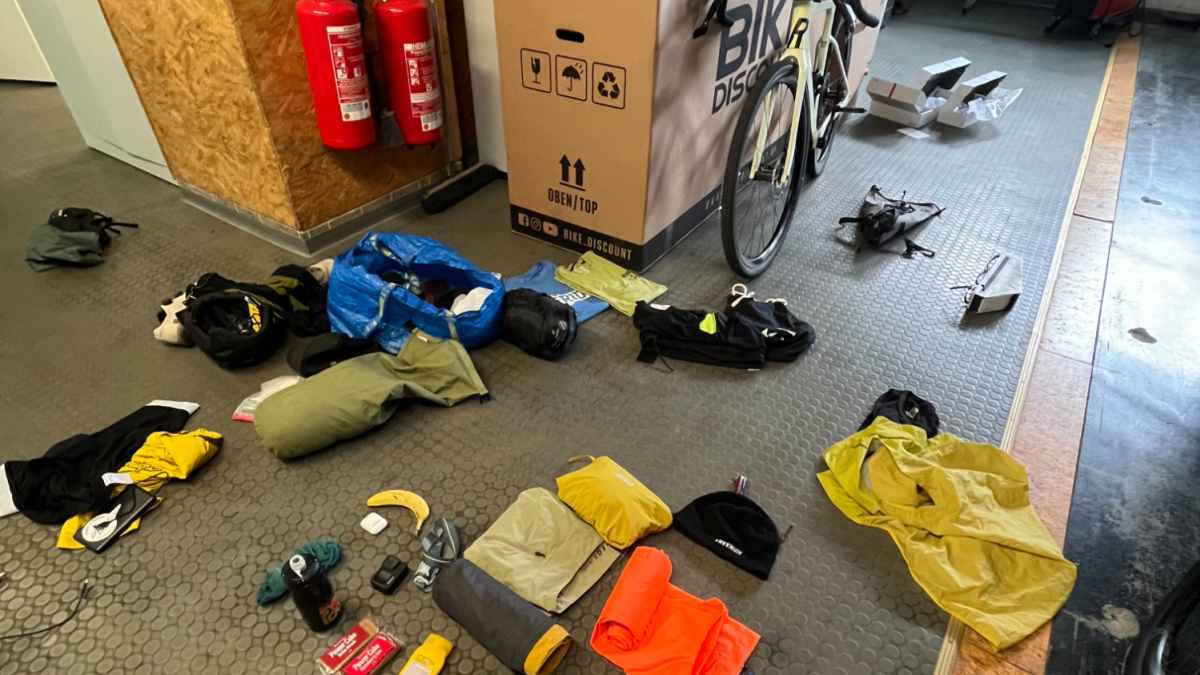
As is so often the case, experience comes with time. But not everyone has to jump in at the deep end. That's why we've put together a list of the most important things that you really need to take with you on tour for anyone who is planning a bikepacking project this season.
This is a must!
1 Sleeping centre: Deuter Astro 300 +2C/36 260 Euro
Lightweight, compact and warm enough for fresh summer days - that's what a sleeping bag for bikepacking needs to be. The Astro 300 made of down has all three properties and weighs just 800 grams. If you want to save money, you can opt for the Deuter Exosphere +4°. The synthetic fibre sleeping bag proved its worth on the Black Forest tour, keeps you warm and light, but is a little sweatier >> available here.
Necessity: 10/10
2 Hothead: woolly hat from 10 euros
When it gets chilly in the evening or at night, a hat works wonders. It doesn't matter which Cap it is - ideally it should be easy to stow away. Alternatively, a Buff.

Necessity: 4/10
3 Headlamp: Petzl Tikka Core 60 Euro
The Tikka is Petzl's original headlamp and is an easy-to-use headlamp with the most important features: A) It is compact and can be quickly stowed away in a jacket pocket. B) The Core version has a rechargeable battery that can be charged via micro USB. C) It offers various light modes and emits 350 lumens in the brightest mode - which is even enough for trail riding in an emergency. Top: It has a red light function to remain more inconspicuous at night >> available here.
Necessity: 8/10
4 After-work outfit: Merino shirt 90-115 euros
Sweaty shirt off, merino shirt on. It keeps you warm and ensures a pleasant climate - also ideal as a sleep shirt on fresh nights. A nice side effect: merino doesn't odour so quickly. We recommend a model with a material mix as it is more comfortable to wear, lighter and dries faster. The merino content should be around 50-70 per cent, for example in the Smartwool Classic All-Season Merino Base Layer L/S Boxed. Price: 90 euros >> available here. If you like it warmer, go for the model in the photo: Smartwool Thermal made from 100% merino. Price: 115 euros.
Necessity: 6/10
5 Crumple zone: Therm-a-Rest Neoair 250 Euro
Just like the sleeping bag, the sleeping pad is all about the balancing act between pack size, comfort and price. Spoiler: The price is quite reasonable - the NeoAir is super light, but unfortunately also super expensive: 250 euros! The mat in the photo has already been used for at least 70 nights and is around ten years old. The successor mat is said to be five times quieter than its predecessor. For the new NeoAir XLite series, Therm-a-Rest used an acoustic laboratory room, among other things, to test noise. In addition, the mat has become one centimetre thicker - with almost the same weight >> available here.
Necessity: 8/10
6 Sabre tool: Victorinox Ranger 65 Euro
Cutting, pulling, slicing: The tool is great for overnighters, uncorking red wine, cutting cheese and bread or removing splinters. It has a solution for most requirements - and is available in a number of variants. Tip: A cord on the knife helps you to find it more quickly in your rucksack or when travelling >> available here.
Necessity: 6/10
7 Emergency plan: Ortovox Bivy Pro 120 Euro
A bivouac sack is actually intended for emergency scenarios. In other words, you wrap yourself in it when the cold wants to suck the life out of you. The Bivy Pro is windproof and a silver coating on the inside reflects body heat in an emergency. It also makes sense without an emergency: simply place it under your sleeping bag for additional insulation and protection against moisture. Not an absolute must-have, but definitely practical >> available here.
Necessity: 2/10
8 Warmth dispenser: Ortovox Swisswool Piz Duan 300 Euro
The more items of clothing, the less space in the pockets. That's why a warmer model is better - the combination of a merino long-sleeved shirt and jacket is sufficient. Take the Piz Duan from Ortovox, for example: it is filled with pure new wool from Swiss sheep, feels pleasant on the skin and is also very light. Of course, it's also cheaper >> available here.
Necessity: 8/10
9 Digital compass: Coros Dura 289 euros
Unfortunately, nothing works without a sat nav on the handlebars. The route is loaded here - and then you're ready to go. The Dura from Coros impresses with a battery life of 120 hours. Even better: mini solar panels provide additional power. On summer tours, the battery remained constantly above 90 per cent in practice. The Dura is operated via a small dial on the side, it also fits on Garmin mounts. It is priced below comparable devices from well-known competitors. Weight: less than 100 grams. Did we still get lost from time to time? Yes, we did.
Necessity: 8/10
10 Water protection Scott Explorair Light Dryo, 170 euros
Without rain gear, it quickly gets tough - and cold. If you don't want to prepare for long rides in the rain, you should limit yourself to a rain jacket (not trousers) - ideally one that is easy to stow away and has a hood. For example, the 2.5-layer Exolorair Light Dyro from Scott. Waterproofness: up to 15,000 mm.
Necessity: 7/10
11 Luxury question: MSR Hubba Hubba 580 Euro
Everyone has to decide for themselves whether to pitch a tent or not. The advantages and disadvantages are well known: No tent means less weight and more storage space - even on the handlebars. Advantages of a tent: You are protected from showers, safe from mosquitoes and have your privacy. Our conclusion on the Hubba Hubba: The set-up is self-explanatory and it is stable even in gusty winds. At 1,085 grams, it is light, but not ultra-light in its category. There are also much cheaper alternatives in terms of price. Positive: It can be easily lashed to the handlebars.
Necessity: 2/10 (depending on weather conditions)
12 Arschrakete Cyclite Saddle Bag 180 Euro
All this stuff has to go somewhere - you can hardly do without an arse rocket. It is waterproof, has enough storage space and is easy to handle >> available here.
Necessity: 10/10
This must also be...
Example of a three- to six-day bikepacking tour.
- 2 T-shirts (cotton rules!) One for cycling, a change shirt for the 2nd or 3rd day.
- 2 pairs of socks - one for cycling, one alternate pair
- Long pants, lightweight and made of cotton. Great for the evening and hardly takes up any space.
- Pants - not too many!
- Sun cream (Depending on skin type - protection factor 30 usually fits)
- Charging cable for smartphone and bike computer, plus a power bank
- Pump & spare hose
- Drinking bottles
- Bolt
- Hygiene items - the bare essentials
- A third of a roll of toilet paper
- Sunglasses (not too dark - cat. 2)
- (And of course whatever is on the man (or woman). Bib shorts, shorts, shirt, helmet...)


Laurin Lehner
Editor