


I can’t help but smile a little. A cucumber on a bike? The cycle sign with its eye-catching yellow-green logo not only shows me the right way, but is probably also trying to tell me that the Spreewald and the Spreewald gherkin are inextricably linked here. I’d like to take a closer look at that. By bike. The panniers are securely fastened to my bike. I’m looking forward to a circular tour through the Spreewald with its particularly unspoilt natural landscape. And cucumbers in all their forms are among my favourite foods.
The gateway to the Spreewald
Cottbus is a charming place. I notice this straight away during my short exploratory cycle ride through the town. They’ve clearly done a good job here of blending historical heritage with modernity. Nevertheless, I get the feeling that in some corners, time has stood still a little. Take, for example, the large, rough cobblestones and concrete slabs, which give my bike quite a jolt. As well as the old town with its medieval city walls, it’s above all the peaceful parks that draw me in almost magically. Scenic gems such as Branitz Park – designed by Prince Pückler – with its water pyramid, or the Spreeauenpark with its rose garden and Tertiary forest. Cottbus, the gateway to the Spreewald, is for me the starting and finishing point of my cycle tour along the Gurken Cycle Route. From here, I’ll follow the distinctive ‘Gurken’ cycle signs right through the heart of the Spreewald.

In the footsteps of the Spreewald Guste
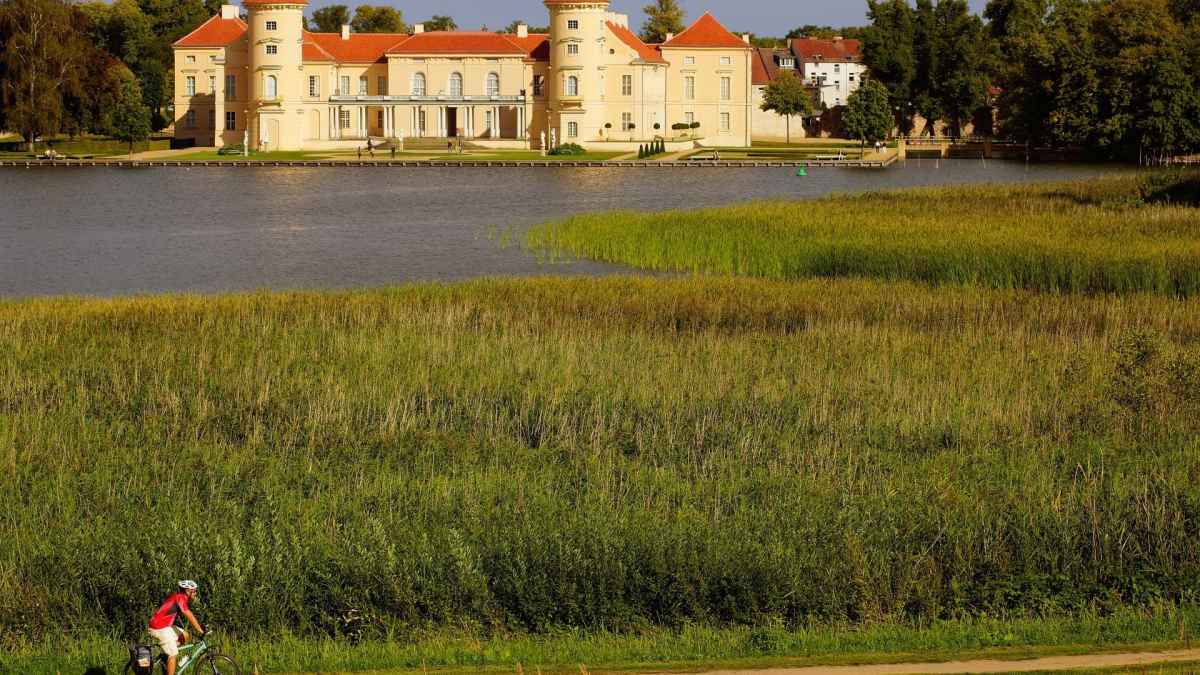
“Are you cycling the Gurkenradweg too?” I’m a little surprised when an elderly lady on her e-bike strikes up a conversation with me just outside Cottbus. She’s obviously noticed the cycling map I’m poring over. She introduces herself as Renate and immediately starts raving about the Spreewald. She’s cycled the entire route over the last few days and is finishing her final stage today in the heart of Cottbus’s old town. Renate can’t stop talking about the many natural treasures, and she really makes me look forward to my ride. Renate is clearly right. Even the first section towards Peitz offers a taste of the Spreewald’s unique, multifaceted landscape. I cycle through dense, shady deciduous forests dotted with meandering little streams and wetlands. It’s peaceful, and the gentle, flat cycle is good for my soul. On the western shore of Cottbus’s Ostsee, I read on a wooden sign that, following 30 years of coal mining, Germany’s largest man-made lake is currently being created here. Just beyond the lake, the landscape opens up, revealing another natural gem: the Peitz Ponds, a vast contiguous wetland comprising 33 different ponds. Among other species, the legendary Peitz mirror carp lives here. At the Peitz Ironworks and Fishing Museum, I also learnt that over 500 tonnes of carp are caught from the ponds every year. I’m impressed by the gentle way the cycle path winds its way through the landscape of the sensitive Spree floodplains. The floodplain area is undergoing continuous restoration, with the aim of returning to the river’s original structures and their diverse habitats. From Peitz via Maiberg – home to an aurochs reserve – to Burg, where the famous short-distance trains of the “Spreewald-Guste” used to run until 1970, the cycle path has been designed so that the narrow strip of tarmac blends almost imperceptibly into the landscape. Sometimes slightly raised on embankments, sometimes following the course of little streams. And then, in Burg, I finally get to taste the thing the cycle path is named after: the original Spreewald gherkin – straight from the wooden barrel. When the lady at an unassuming little gherkin stall learns that I’m from Tyrol, she makes the other tourists wait and treats me to a wide variety of small gherkin varieties. Simply delicious! A farmer, whom I ask for directions to the centre of Burg, smiles a little. No wonder, as Burg is no ordinary town, but Germany’s largest scattered settlement. As the River Spree splits here into around 300 small watercourses, many islands have formed. The farmsteads, half-timbered buildings and log cabins are spaciously scattered across a sort of park. In the authentic little Spreewald village of Straupitz, I marvel at the ‘Schinkelkirche’, an architectural masterpiece with its two huge, gleaming white church towers. And shortly afterwards, I’m equally amazed by the dinner lovingly prepared just for me. The lovely elderly lady at the guesthouse where I’m staying has prepared matjes herring with potatoes for me, accompanied by a generous portion of dill gherkins. She proudly tells me that Spreewald gherkins have a unique flavour, are particularly crisp, and are all harvested exclusively by hand.
From the old mill to the bee house
Whilst I’m enjoying my breakfast, my ultra-modern bike is leaning against the old, venerable Dutch windmill in Straupitz. Built in 1640, this triple-shaft windmill is, following a complete renovation, once again fully operational. It’s early in the morning, so everything is still quiet. And things will remain peaceful for me as I carry on. The Gurken Cycle Route offers a particularly pleasant landscape all the way to Neuendorf am See, with plenty of tranquillity and unspoilt nature. On my way through the small, quiet villages of Neue Zauche and Alte Zauche, I have a companion: the wind! It means well by me and gives me a gentle push from behind. This allows me to enjoy the beautiful countryside with its grain fields and a network of small, branching canals without having to exert myself. The rustling of leaves, the whistling of the wind and birdsong – apart from that, everything is silent. I don’t stop in the lively little town of Lübben with its late-Renaissance castle, as I’ll be passing through here again on the last day of my trip and today I simply want to slow down in the heart of the UNESCO Biosphere Reserve. In Schlepzig, which lies in the heart of the Unterspreewald, I come across a few local e-bike riders. They all rave about ‘their’ reserve – a unique cultural landscape characterised by a harmonious interplay of waterways, forests, meadows, animals and people. I follow the friendly e-bikers through a region dominated by agriculture. One of the cyclists tells me that there’s still plenty of traditional vegetable farming here between Schlepzig and Neuendorf am See. Whilst the others cycle on, I cool off in Lake Leuthener and once again enjoy the solitude and the silence. At today’s destination in Neuendorf am See, I’m greeted by a lovingly tended, colourful garden with a carp pond, lots of carved wooden figures, flowerbeds and an old bee house. This former home to the bees has been carefully restored and will be my home for the night.
Altitude and a touch of luxury
Passing the locks and weirs at Unterspreewald on my way to Lake Köthen, my legs have very little work to do on the flat, finely gravelly path. But then comes the only challenging section of the entire Gurken Cycle Route. Between Köthen and Krausnick, there’s a ‘mountain stage’ up to the Wehlaberg. However, this runs through such a fairytale-like, enchanted-looking forest that the effort is more than worth it. From the observation tower on the Wehlaberg, down to the Heideseen lakes, I really let my bike fly. Now it’s time to relax again. In a wide loop, the cycle path first heads west to Rietzneuendorf and then back east to Lubolz. It’s flat, almost entirely tarmacked, and yet I come across almost exclusively cyclists with electric-assist bikes. Once again, the landscape is characterised by small canals, cucumber fields and wheat crops. But the bright yellow heads of countless sunflowers also line my route. I notice a man discussing something with a few cyclists at a rest area next to the cycle path. I stop and realise he is one of the many staff members at the biosphere reserve. In the Spreewald, the aim is to enable people to experience nature up close, whilst at the same time ensuring that a few important rules are followed. In the lively little town of Lübben, with its late-Renaissance castle, I push my bike through the castle grounds. Although many tourists are travelling through the park on wooden barges along the waterways, I find peace here under the shady trees. At ‘Gurkenpaule’, a local institution in Lübben, I get a glimpse of how the gherkins, in their various flavours, are stored in special wooden barrels. In the evening, I’m treated to a touch of luxury. My hotel for tonight, the upmarket Strandhaus with spa, situated right in the park, has just one room left. And ‘unfortunately’, it’s a suite on the top floor – complete with its own sauna. What a way to round off the day!
Farm shops and cucumber fields up close
To the south-east of Lübben lies one of the best-known places in the Spreewald: the picturesque village of Lübbenau, with its historic houses and farmsteads, its large harbour offering boat trips, and its old town, which is well worth a visit, is regarded by many as the gateway to this unique waterway landscape. In the region around Göritz and Vetaschau, there are frequent stretches of cucumber fields running right alongside the cycle path. I would have loved to have seen one of the famous ‘cucumber flyers’ – enormous, wing-like harvesting machines on which the harvest workers, lying down, pick the future gherkins from their plants by hand. However, as the harvest begins in July, the machines are still undergoing maintenance. Instead, I chat to a farmer in his field, who tells me all sorts of things about the gherkins. Just outside the town of Burg, which I’d already passed through on the first day of my trip, I spot a large wooden sign bearing the distinctive logo of the Spreewald umbrella brand, with the word ‘farm shop’ written beneath it. Only businesses that have close ties to the region and offer regional products in accordance with strict quality standards are permitted to use the logo. I’d like to have a look, and a short while later the friendly shop assistant proudly shows me round her shop. Vegetables, fruit, linseed oil, horseradish, as well as various handcrafted products, are lovingly displayed here. And, of course, there are several large wooden barrels of Spreewald gherkins. The shop assistant won’t let me leave without trying their homemade Spreewald Grützwurst. The cycle path takes me back via the small villages of Werben and Briesen to my starting point, Cottbus. I don’t know why, but it’s only now that I notice the bilingual place-name signs. Although the Spreewald is close to Poland, the language spoken here is a Sorbian-Wendish dialect, spoken by the Sorbian minority living in the Spreewald.
Market wrap-up
On the final few kilometres into Cottbus, I savour the peace and quiet once more. But the closer I get to the city centre, the noisier and more hectic it becomes. It feels strange after the tranquillity of the last few days. It’s only once I’m right in the Old Town that the traffic dies down again. The weekly market is taking place today in the Altmarkt, surrounded by historic buildings. The atmosphere is cheerful, it’s colourful, various scents fill the air and the wide range of regional produce is a real feast for the eyes. I opt for a chilled, non-alcoholic wheat beer, a meatball and – to go with my cycle ride – a small portion of honey-pickled gherkins. A little way away from the market, I sit down on a park bench with my snack and reflect on the four days spent on the Gurkenradweg. The trip here to the Spreewald has been well worth it!
The Cucumber Cycle Route: The route and its highlights
At this point, you will find external content that complements the article. You can display and hide it with a click.
Start/finish: Cottbus; total distance: 260 km; times given are based on a leisurely pace, excluding breaks
Stage 1: Cottbus – Straupitz, 54 km, flat, 80% tarmac, 20% unpaved, 4 hours
Places of interest:
- Cottbus Baltic Sea (Merzdorf)
- Ironworks and Fisheries Museum (Peitz),
- Scattered settlement (castle),
- Dutch windmill (Straupitz)
Stage 2: Straupitz – Neuendorf am See, 68 km, flat, 70% tarmac, 30% unpaved, 5 hours
Places of interest:
- Castle Island (Lübben),
- Farmers’ Museum (Schlepzig),
- Lake Groß Leuthen, Lake Neuendorf
Stage 3: Neuendorf am See – Lübben, 58 km, 150 hm uphill, 50% tarmac, 50% unpaved, 4.5 h
Places of interest:
- Bergspreewald, Wehlaberg observation tower (Krausnick)
- Kanowmühle (Golßen)
Stage 4: Lübben – Cottbus, 63 km, flat, 60% tarmac, 40% unpaved, 5 hours
Places of interest:
- Spreewald Museum and Gurkenmeile (Lübbenau),
- Cucumber Fields/Cucumber Flyers (Göritz),
- The town of Cottbus (Old Town) with Fürst-Pückler Park
Information and travel tips for the Gurken Cycle Route
Getting here
Start/Finish: Cottbus
Car/Bus: A15, Cottbus junction, traffic information: www.adac.de/verkehr/verkehrsinformationen/de
Bus information and bookings: www.flixbus.at/fernbus/cottbus
Rail: A key transport hub for Brandenburg; timetables and bookings for journeys from all directions: www.bahn.de
Important: On long-distance trains, you must book a space for your bicycle in advance (ICE trains have very limited capacity). For more information: www.bahn.de/service/individuelle-reise/fahrrad
Accommodation
ADFC-certified ‘Bett + Bike’ establishments along the original route (cycle parking, tools, facilities for drying clothes and kit, information on the cycle network)
Further information: www.bettundbike.de/ and www.adfc.de/artikel/adfc-bett-bike
Tips for authors (all accommodation is very cyclist-friendly):
Cottbus: Guests at the Best Western Parkhotel Branitz can use the Branitz Sauna & Spa free of charge, www.bestwestern.de/hotels/Cottbus
Straupitz: Spreewaldpension Winzer – a very friendly family-run guesthouse; the owner does the cooking herself, www.spreewald-pension-winzer.de
Neuendorf: Pension Haus am See – a very romantic establishment; stay in the ‘Bienenhäuschen’, www.spreewaldhaus-zum-see.de
Lübben: Luxurious beach house in the Spreewald, an oasis right in the park, very friendly owners, www.strandhaus-spreewald.de
Food and drink
There are only sufficient options in all the larger towns, so a bit of forward planning is required. Focus on regional cuisine
Editor’s tip: Be sure to visit a local farm shop or farmers’ market, try Spreewald asparagus and Spreewald gherkins in a variety of flavours
General information
- Spreewald: www.spreewald.de
- Nature conservation: www.spreewald.de/der-spreewald/naturschutz
- Information and bookings for the Gurken Cycle Route: https://www.spreewald.de/aktivitaeten-karte/radfahren/gurkenradweg
- Map of the region: www.spreewald-biosphaerenreservat.de/karte
- Package deal: www.mecklenburger-radtour.de/gurkenradweg
Cycling guidebooks and maps
- Bikeline Compact Gurken Cycle Route, 9.90 euros
- Kompass freytag & berndt, Spreewald Cucumber Cycle Route, cycling map, 13.90 euros
Cycling infrastructure
As the route is almost entirely flat and runs for around 75 per cent along tarmac cycle paths and quiet back roads, it is particularly suitable for families (including e-bike riders). There are no particularly challenging sections. The entire Gurken Cycle Route is very well signposted throughout (direction arrows with the additional ‘cycling cucumber’ symbol, in green and yellow), mostly with kilometre markers indicating the distance to the next towns. An additional navigation app is not necessary. Cycle shops, e-bike charging points and repair shops are only available in larger towns. Author’s tip: Take a small first-aid kit with you!
Conclusion by travel writer Thomas Widerin
The Gurken Cycle Route really captivated me with its unique blend of nature, culture and culinary delights. Along the 260 kilometres through the Spreewald, I discovered quiet paths, a vast network of canals, unspoilt villages and friendly people. The route is mostly flat, well signposted and suitable even for less experienced cyclists. For me, this trip was one thing above all else: a refreshing break from everyday life.