


A handshake, six months earlier. “Let’s do it.” That was all it took. Three women – Maria, a Swede living in Innsbruck; Caroline from Vorarlberg; and me, Karen from Garmisch – and a plan: a gravel bike-packing trip through Finnish Lapland. Seven days. Somewhere amongst forests, lakes and moors, as far away from civilisation as possible. Ruka-Kuusamo lies just a few kilometres from the Russian border. The region offers around 900 kilometres of gravel routes, which is one of the reasons it’s nicknamed the ‘Home of Gravel’. Dense coniferous forest, crystal-clear lakes, rivers – and tracks that seem to stretch endlessly through the landscape. The first sound after setting off: the soft hum of the tyres on fine gravel. The tracks aren’t uniform gravel roads. At times, you ride straight ahead for kilometres through open countryside, then the path suddenly turns into the forest. The surface is constantly changing: firm gravel, soft moss, roots, lichen – sometimes it almost feels like a mountain bike trail. Then the forest opens up again, revealing a vast horizon ahead of us. And there’s always a lake somewhere. Finland has 168,000 of them. Riding past them is not an option. Our local guide, Visa – one of the organisers of the annual Fellscape event – accompanies us for a day and shows us what makes this region so special for gravel cyclists: the variety of surfaces, the constant alternation between fast, open stretches and technical forest tracks. A combination that simply cannot be replicated.
Campfires and Wild Food
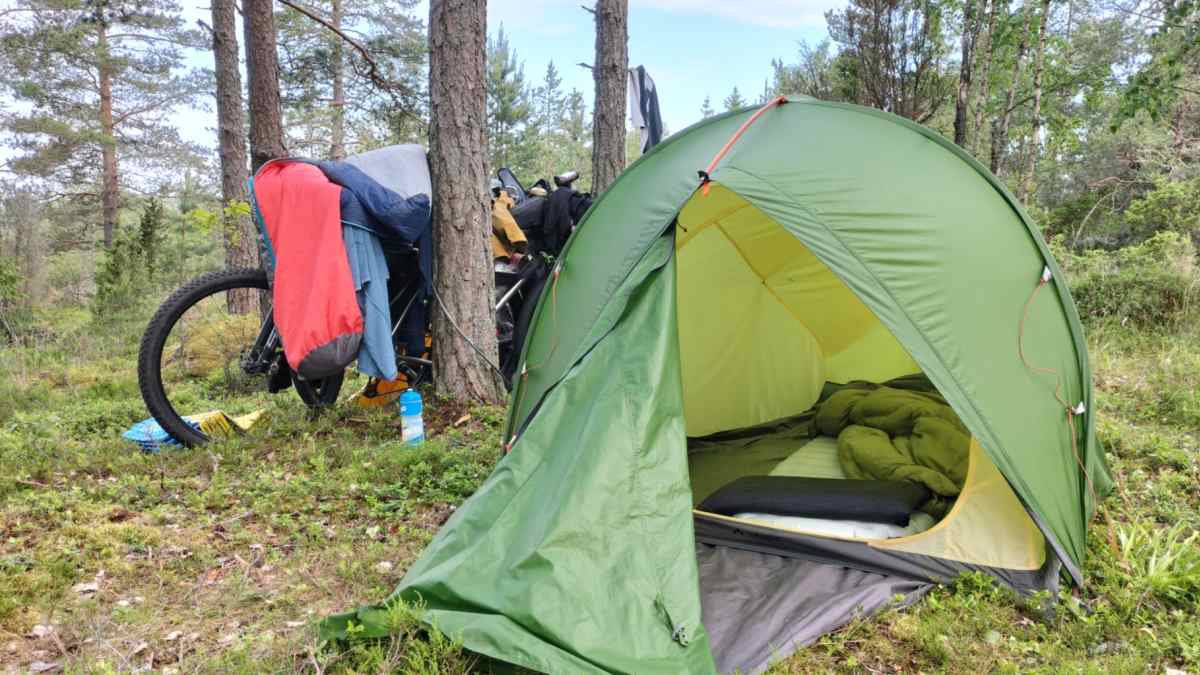
In the evening, the wilderness takes on a different character. Along the routes there are wilderness camps – often right by a lake, with a fire pit and a sauna. Not five stars, but five logs. You have to heat the sauna yourself. We quickly become experts at this. Our rucksacks are mainly filled with regional specialities: ruisleipä, Finnish rye bread, best enjoyed with butter, smoked cheese, ham and gherkin. For breakfast, we have kaurapuuro, a porridge made with oats and fruit. And in the evening? That’s when we put makkara on the grill. We cook the Finnish sausages in the traditional way, directly on a wooden skewer over the embers. Along the way, little forest cafés tempt us to stop for filter coffee and fresh cinnamon buns. Wild food is free: blueberries grow literally everywhere along the roadside. After Ruka-Kuusamo, the route continued towards Posio. Over 500 kilometres of gravel tracks criss-cross the region, along with highlights such as Riisitunturi National Park and the Korouoma Canyon. Here, the surface becomes finer, the straights longer, the pace faster. Then there are turn-offs into the forest again: soft ground, roots, bog paths. Finnish solitude has a quality all of its own. It is not empty, but full of life. Full of forest, water, birds and wind. Sometimes we cycle for half a day without encountering a single person. The landscape constantly shifts between dense coniferous forests, vast moors and mirror-smooth lakes. The most spectacular interlude: in a moorland area, yellow specks suddenly glisten amongst the blueberry bushes. Lakkas – cloudberries. Rare in Finland, a real delicacy. We pause for ten minutes and enjoy the delicious fruit. Shortly afterwards: a lake we have to cross. A rowing boat by ours, another on the opposite bank. Three women, three bikes and a discussion of the situation that takes a little longer than planned. The solution is a bit fiddly, but we make it across the lake with our bikes, keeping our feet dry.

Gravel riding in the bike park
A landscape of wooded hills, moors and lakes stretches out around Finland’s southernmost fell. Syöte National Park is characterised by vast expanses of wilderness and a viewpoint at an altitude of around 430 metres. A bike park has been developed on this mountain over the last few years. The modern chairlift serves skiers in winter and mountain bikers in summer. The trails here are more technical and varied than anything we’ve encountered before: twisty, challenging, with fast sections and unexpected changes of direction. The perfect finale after a week in the wilderness. But first: one last lake. The water is cold. Very cold. But after seven days on a gravel bike, it’s just right. Our final evening in the wilderness takes us to Matti. He used to be a professional snowboarder until several injuries brought his career to an end. Today, he rents out his teepee high up on a hill – though not to just anyone. Only to special people. Like us. But there’s one condition: we have to take part in a Nature Silent Walk. Silence. In nature. For three women who have, by now, learnt to spend hours discussing blueberries and boat logistics, this is a real challenge. Of course, we go along with it anyway. And we learn a lot. About nature. About the plant world. About the surroundings. And about the famous chaga mushroom. It grows mainly on birch trees and plays a special role in traditional Nordic natural history. Matti tells us about its significance and makes us a tea from it. Then night falls. We sleep in a teepee. On reindeer skins. By the fire. Up on the hill. Far away from everything. Eventually, I fall asleep. The next morning, Matti asks me: ‘How did you sleep? Did you dream?’ ‘Yes. And quite vividly, too.’ Perhaps it was the chaga tea. Perhaps the reindeer skin. Perhaps the teepee. Perhaps this special place high above Syöte. Matti says that many people up here have particularly vivid dreams. I believe him straight away.
Bikepacking in Finnish Lapland: The Route
At this point, you will find external content that complements the article. You can display and hide it with a click.
Day 1 Ruka – Lake Juumajärvi / Pohjantähti Wilderness Camp, 97 km, 660 metres of elevation gain
Day 2 Lake Juumajärvi – Palosaari Reindeer Farm, 106 km, 830 hm
Day 3 Palosaari Reindeer Farm – Himmerki Holiday Resort, 71 km, 390 hm
Day 4 Himmerki Holiday Resort – Guest House Lehtiniemi, 83 km, 520 hm
Day 5 Lehtiniemi Guest House – Kelliniemi lean-to, 121 km, 600 hm
Day 6 Kelliniemi – Teerivaara / Hetken Matka Kota, 100 km, 770 metres of elevation gain
Day 7 Teerivaara – Iso-Syöte / Hilltop Hotel, 80 km, 870 hm
What you need to know: Tips & information
Finland is also known as the ‘Land of a Thousand Lakes’ – in fact, there are around 168,000 of them. The traditional mökki, lakeside cottages, are popular summer retreats. Peace and quiet, nature, swimming, fishing and the sauna are all part of the typical Finnish way of life. Finnish Lapland covers around a third of the country and impresses with its endless forests, clear lakes, bogs and vast fell landscapes. Thanks to the midnight sun, it hardly gets dark for weeks on end in summer.
Our bikepacking route takes us through Ruka-Kuusamo, Posio and Syöte in north-western Finland. These three regions demonstrate why Finland is increasingly becoming an insider’s tip for gravel cyclists: new route networks are emerging, bikepacking is growing in popularity and a burgeoning scene is giving rise to gravel events.
Season
The best time for a gravel bike-packing tour in northern Finland is between mid-June and the end of September. From mid-June onwards, the midnight sun ensures particularly long days, whilst the landscape transforms into a colourful autumn panorama by September. In July, we mostly had sunny weather with temperatures of 20–26 degrees Celsius and surprisingly few mosquitoes. That said, the weather can change quickly – even in summer, cool temperatures and rainy days are possible. It is therefore important to be well prepared for a variety of weather conditions.
Getting here
There are several ways to get there: from Munich to Helsinki, then on to Rovaniemi or Kuusamo by plane. From Rovaniemi, a shuttle bus takes you on to Ruka, the starting point of our route. Alternatively, you can take the night train north from Helsinki, followed by a bus journey to Ruka. ruka.fi
For planning
- bikeland.fi General information, suggested routes and GPX tracks
- excursionmap.fi Fire pits, accommodation and huts in Finland
- gravel.ruka.fi Ruka-Kuusamo Region Gravel Network
- korpigravel.fi Guide to the Ruka-Kuusamo Region
- rukasafaris.fi Bike hire, accommodation, shuttle, transfer, guide
Accommodation
- RUKA – KUUSAMO Isokenkäisten Klubi, Wilderness Lodge & Wild Food Kitchen, Rukariutta Apartments
- POSIO Kelliniemi Campsite or Shelter at Himmerki Holiday Resort
- SYÖTE Hilltop Hotel Hetken Matka (Tipi)
Highlights
Korpihilla Finnish delicacies made from berries and herbs. If booked in advance, the owner, Ritva, will also cook for you at her idyllic home in Riisitunturi National Park
Livojärvi Café A summer café on the Finnish Riviera serving the best pancakes
Palosaari Reindeer and Fishing Farm
Fellscape Gravel events and cycle races
Nature Silent Meditation Walk with Matti in Teerivaara near Syöte
Husky Farm Syöte Outdoor Services
Rafting on the Kitkajoki River
Kayaking or SUP at Lake Kitkajärvi in Posio
A visit to Pentik world-renowned ceramic artist
Conclusion on the bike-packing tour of Finnish Lapland
Finnish Lapland isn’t a destination for those looking to rack up the kilometres in a hurry, but rather for anyone who sees gravel bikepacking as a genuine experience of nature. Between Ruka-Kuusamo, Posio and Syöte, endless gravel tracks, technical forest sections, secluded moors and crystal-clear lakes await. These seven days have shown that anyone willing to embrace changing terrain, long stages and sudden changes in the weather will be rewarded with an exceptionally varied tour. And after a night in a teepee, a dip in the cold lake and a ride under the midnight sun, one thing is clear: this wilderness will stay with you forever. Karen Eller, travel writer