Author: Ben Krischke
"All you need is bike", reads the sign on a bike hire shop in Kransjka Gora. All I need is sleep, I think, as my gaze wanders from the sign to the stream of water from the drinking fountain that fills my bottle. A night of horror with only four hours of sleep lies behind me. Not because of the campsite, which was fine. In "Camp Špik", as the name suggests, there are even surprisingly good pizzas. But because of the tent neighbours, who talked late into the night and then gave a snoring concert. And all this the night before my first big climb up the Vršič Pass.
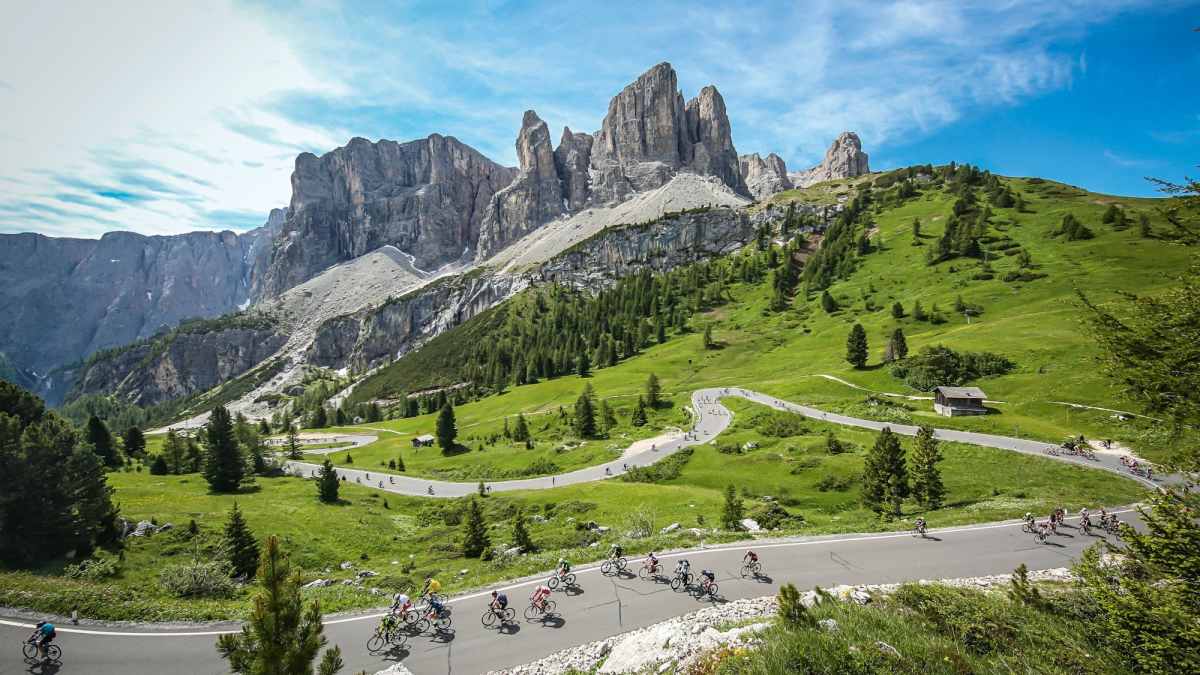
This is my first time in Slovenia. It's also my first time camping as an adult man. As a result, I have more luggage with me than usual on multi-day tours: Bag on the handlebars, bag on the top tube, bag on the down tube, "arse rocket" and rucksack. I'm not exactly what you'd call a "lightweight". The fact that a lot of luggage equals a lot of weight, which I have to carry in addition to my own body weight, is something I feel mercilessly on the way up to the Vršič Pass. The climb begins at Kransjka Gora, just behind Lake Jasna, at the entrance to the Triglav National Park. 24 hairpin bends with gradients of up to 14 degrees lead upwards for a good ten kilometres and over 800 metres in altitude, including bends lined with cobblestones. This climb is a real monster that should only be tackled on a racing bike and without luggage. Not just me, but also a young woman who overtakes me on her red racing bike and calls out to me: "Wow, you're doing great! With all that stuff!"

The window in the mountain
My water, including that in my hydration bladder, is almost gone when, after bend 19, my gaze falls on a large rock formation that is cut out at one point. A bright ray of sunlight shines through the cut-out. It's as if the good Lord is watching my suffering through the keyhole. "Predjne Okno" is the name of this window on the north face of Prisank in the Julian Alps. It is around 80 metres high and 40 metres wide, the result of a collapse caused by weathering. I had planned an hour and a half for the climb, but in the end it takes over three hours with breaks and pushing passages. The reward at 1611 metres is the good feeling of having once again climbed somewhere using pure muscle power, half a litre of cold cola from the pass kiosk to reanimate me with sugar and caffeine - and the postcard motif of grazing sheep against the most beautiful mountain backdrop.
A new girlfriend
After a 30-minute break, the downhill serpentines make my disc brakes glow. Because that's also part of the truth: The more weight, the longer the braking distance. Better not to mess with physics, I think, while the brakes already sound like they're being maltreated in a torture chamber. But the anticipation of my next meeting is greater than my concern about how much longer this can go on. At the end of the descent, a new friend is waiting to accompany me on the rest of my tour. Sometimes clearly visible, sometimes hidden. Sometimes wild, sometimes calm, as befits a true diva - but always shining in a radiant turquoise colour that I have never seen on any other river.
We are talking about the Soča, which flows a good 140 kilometres from north-west Slovenia to the Gulf of Trieste in Italy. The source of the Soča lies near one of the last hairpin bends on my descent from the Vršič Pass. It can be reached on foot in 15 minutes from a hut with the name "Koča pri izviru Soče" - which simply means "hut at the source of the Soča" and is difficult for German speakers to pronounce. A good footing is essential, however, as the path becomes very steep at the end. This climb is not really worthwhile. In other words, it's better to stay further down at the hut - and enjoy homemade lemonade and Slovenian home cooking (lots of sausage!) right by the Soča.
No longer an insider tip
At around 20,300 square kilometres, Slovenia is only about half the size of Switzerland. Almost 2.1 million people live here between the Julian Alps and the Adriatic Sea, although the Slovenian coastline is less than 50 kilometres long. Culturally, the country is strongly influenced by its neighbours Austria, Italy, Hungary and Croatia - which means that near the Italian border, where I am travelling, an accidental "Grazie" quickly escapes my lips. Over six million guests are said to visit Slovenia every year. This is not yet mass tourism, but it is no longer an insider tip either. If you want to book a hotel spontaneously, you need a lot of luck, while the campsites are very well filled. Sometimes so full that spontaneous campers come across signs saying "full". However, there is usually still a place for bikepackers.
This is also the case at "Kamp Klin", where I pitch my one-man tent later in the day. Directly on the Soča, around 20 kilometres from its source, where the gentle trickle has already grown into a sizeable mountain stream. I strike up a conversation with Ute and Joachim at Kamp Klin. The couple are in their early 60s, come from near Schweinfurt and have spontaneously invited me for dinner. We chat for a long time about travelling, Joachim's years as a policeman and FC Bayern Munich. And when I retire to my little one-man tent later that evening, I have a better understanding of the appeal that camping has for some people. Some experiences just don't happen if you only ever stay in a hotel. For example, paprika rice with strangers under the starry Slovenian sky.
A real strain
Those who follow the Soča experience an impressive transformation. At least when it's not hiding behind trees, which unfortunately happens more often. While the GPS device guides me alternately along more or less pleasant gravel and forest paths, well-developed cycle paths and main roads, the Soča becomes wider and wider. Where it is wild, kayakers plunge into the current. Where it flows gently, people go for a swim. Only one thing remains the same: its turquoise colour and how the Soča glows even more when the sun shines on it. What sounds like a romantic leisurely cycle is a real effort. Even if one section is downhill for longer, the next nasty climb is sure to follow. The headwind and blazing sun drain my energy, while I often have to deal with speeding drivers on the main road. Meanwhile, Komoot also takes me on sections that are not cycle paths. At one point, I have to climb up a stony forest path that is so steep that I can only lift my gravel bike. Note to self: plan a road bike route for the next tour of Slovenia.
Welcome to the sea
When I set off in the morning after the last night - which I spend in the Hotel Sabotin in Solkan - to tackle the remaining kilometres, I can feel the tour so far in my whole body. It's not just my legs that are tired from all the climbs. My motivation is also lacking. After all, I only have 100 metres of climbing ahead of me on the last stage, spread over 50 kilometres. Just keep pedalling, I think - and push on to the finish with stoic composure. At Nova Gorica, I do the same as the Soča and cross the border into Italy. From now on, the river is officially called the Isonzo - and no more "Grazie" is out of place.
I follow the Agrocormenese Canal for a long time, which runs parallel to the Soča, jump into the river again at Farra d'Isonzo and take my last look at the Soča from above on a bridge near San Canzian d'Isonzo. It is the very last bridge that crosses the Soča. A real river idyll if the traffic wasn't constantly whizzing past me. It's exactly 19 kilometres to Villaggio Punta Sdobba, the end point of my journey. Pedalling as hard as my body will take me, toiling once more under the sun. Once I arrive in the small fishing village, I can take one last look at the Soča before it becomes one with the sea. I accompany her on her last few metres, alone with her. The diva and me. Only one of the fishermen's huts is playing loud music. Someone is celebrating. All I need is sleep.
At this point, you will find external content that complements the article. You can display and hide it with a click.
The tour: facts & figures
Arrival day: Villach to Kransjka Gora 50 km | 500 hm | approx. 3.5 hrs.
There are hardly any steep climbs. However, the constant ascent is somewhat gruelling. But you are rewarded with the first great views.
Day 1: Kransjka Gora to Soča (municipality) 45 km | 1010 m | approx. 6 hours.
The biggest challenge lies in the ascent to the Vršič Pass. The route is mainly on tarmac roads, but is very demanding due to the steep climbs.
Day 2: Soča to Solkan 90 km | 700 m | approx. 6 hrs.
Tip to save some time: After Tolmin in a southerly direction, do not take the eastern route via - caution: risk of confusion! - Modrej, but rather take the western route via Modrejce (main road).
Day 3: Solkan to Villaggio Punta Sdobba 50 km | 100 m | approx. 3 hrs.
The last stage leads over largely flat terrain. However, even this can be bumpy at times.
General information and travel tips
Journey (from Munich)
Railway: By train via Salzburg and Bad Gastein to Villach, from there trains run to Arnoldstein or, less frequently, to Tarviso Boscoverde. Kransjka Gora can only be reached by bus.
Car: Depending on the route, it takes between four and five hours by car to Kransjka Gora via the A10 motorway.
Overnight stay
There is a wide range of hotels and campsites along the route. For journeys in July or August, be sure to book in good time.
Kransjka Gora: The large campsite "Camp Špik" near Kransjka Gora is a good address for spontaneous holidaymakers. There is also a hotel complex on the site. camp-spik.com/en
Soča: The "Kamp Klin" campsite is located directly on the Soča and offers a restaurant and snack vending machines. The campsite also has a small guesthouse. sloveniaholidays.com/kamp-klin-lepena-soca.html
Nova Gorica: The "Sabotin" hotel in Solkan is a good hotel with its own restaurant. One night costs around 100 euros in high season. hotelsabotin.com/en
Villaggio Punta Sdobba: The next largest town is Monfalcone, around 18 kilometres away. If you want to stay overnight at the end of the tour, book into the "Hotel Caneo". www.caneo.it
Food and drink
Hearty meat and sausage dishes, especially stews, are typical of Slovenian cuisine. Fish dishes dominate on the coast. Pasta dishes such as "Štruklji" roulades and the hearty bean soup "Jota" are popular. Slovenia is also a wine country.
Cycling infrastructure
When planning your route, it is best to plan a road bike tour. Otherwise, the route is well signposted and the cycle paths, if there are any, are often very well developed. There are bike shops and workshops along the route, for example in Kransjka Gora, Kobarid and Tolmin.
Travelling time
Slovenia is worth travelling to all year round. Depending on the weather, cyclists can hope for cycling weather from May to the end of September.
More information and inspiration at www.slovenia.info/de