


Mountain biking: A high-risk sport – the most common injuries – and how to protect yourself
Josh Welz
· 04.08.2026

Our conclusions on the right protective equipment
The most common mountain bike injuries do not affect the knee, but rather the upper body, shoulder, hand and wrist. Protective gear should therefore be suited to the discipline: lightweight for touring, minimalist for marathon races, more comprehensive on technical trails and offering maximum protection in the bike park. Riding technique, realistic line choice, self-assessment, managing fatigue and a securely fitted helmet remain crucial.
A mountain bike crash doesn’t always look spectacular. On a forest track, a slippery gravel bend is enough; on a trail, a pedal snag will do. In marathon races, exhaustion and waning concentration are added factors. In bike parks, high speeds, jumps and challenging obstacles also come into play. The risk of injury is therefore not the same everywhere. Injury patterns also differ significantly. Protective kit must therefore be adapted accordingly.
The most common cause of accidents ...
The key finding from accident research is that it is usually the combination of speed, angle of impact and terrain that determines the severity of falls and, consequently, the severity of injuries.
An analysis of US A&E data recorded a total of 2,543 mountain bike injuries over a nine-year period. Situations in which the rider was thrown over the handlebars or had been completely thrown from the bike were particularly prone to causing injuries. In these cases, the fracture rate was 39.6 per cent, the rate of torso injuries was 26.8 per cent and the concussion rate was 6.2 per cent.

Common causes when out and about
The most common causes of falls can be divided into several groups:
- Driving errors: Excessive speed, choosing the wrong line, braking too late or maintaining too rigid a posture.
- Errors in weight transfer: The front wheel loses traction, even though it needs grip at that very moment, or your centre of gravity shifts too far forwards on steep sections.
- Front wheel lock-up: Particularly on loose ground, applying the front brake too forcefully can cause the vehicle to roll over.
- Rear or front wheel skidding: Wet roots, mud, leaves and loose gravel can cause a sudden loss of grip.
- Loss of pedal feel: If a foot slips off the pedal, the rider may lose their balance or collide with the pedal with their shin.
- Exhaustion: In marathons and on long rides, reaction times, strength and precision tend to decline.
- Misjudgement of one’s own abilities: This factor is particularly important in the bike park when choosing jumps or trails that are beyond one’s current ability.
- Technical faults: A flat tyre, a snapped chain, broken parts or incorrectly adjusted brakes are less common than riding errors, but can have particularly serious consequences.
The upper body and arms are affected more frequently than the knee
A systematic review of a total of 17 studies involving more than 220,000 injured mountain bikers revealed that bruises, grazes and minor lacerations were the most common types of injury. In ten of the 17 mountain biking studies, the upper body or upper limbs were the body regions most frequently injured.
Knee pads, however, are the most commonly used form of body protection when cycling. A contradiction? Not quite: knee injuries do occur when cycling, particularly in the event of sideways falls, pedal strikes, twists and collisions. Compared to the hand, wrist, forearm, shoulder and collarbone, however, the knee is often overestimated in the event of a sudden fall. But: unlike a back protector, knee pads can also be stowed away in your rucksack when out on a cycle tour.
Why wrists and hands are often affected
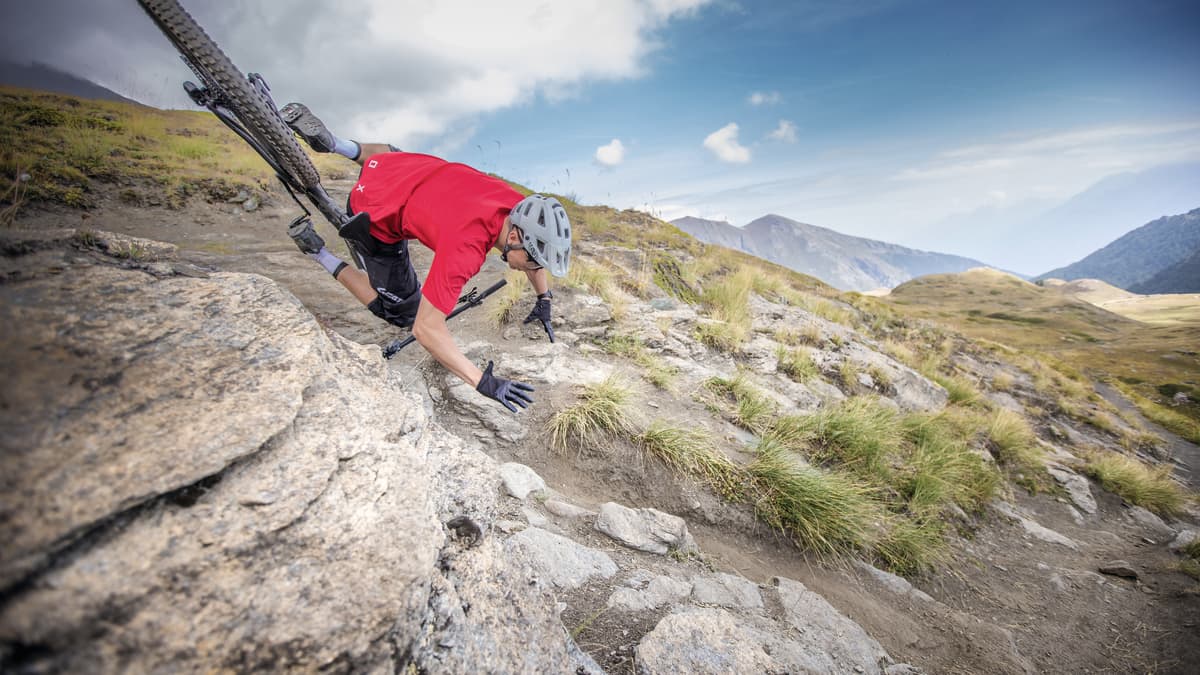
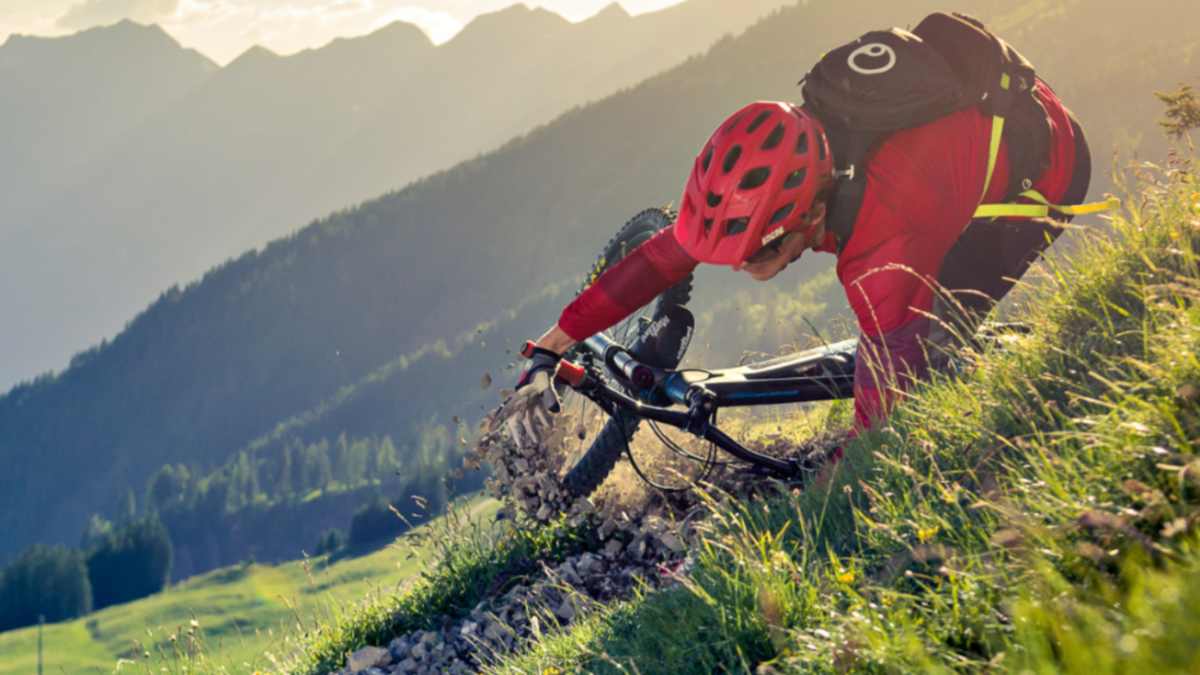
The typical reflex when falling forwards is to put your hands out on the ground. Although this so-called ‘fall on an outstretched hand’ – FOOSH for short – may protect your face and head, it transfers the impact energy directly to your hands, wrists, forearms, elbows and shoulders.
A prospective study conducted in the Whistler and Squamish region recorded 765 visits to the accident and emergency department, involving a total of 1,079 individual injuries. 511 of these injuries involved the upper limb. Among the 217 hand and wrist injuries, fractures were the most common diagnosis. In the hand, metacarpal fractures were particularly common. At the wrist, scaphoid fractures and fractures of the radius were particularly prevalent. 70 per cent of the falls investigated were forward falls.
This explains why gloves alone offer only limited protection. They reduce grazes, improve grip and protect against branches. However, they do not help against the high forces of an impact – fractures of the scaphoid or radius are a common consequence.
Can wrist guards help?
Wrist guards with a stabilising splint can limit wrist hyperextension and distribute the impact forces. Evidence from other sports suggests they offer protection against wrist injuries. A case-control study on inline skating found that people without wrist guards had a significantly higher risk of wrist injuries. The situation might be similar in mountain biking. However, such protectors must not restrict the grip on the handlebars – which is the sole reason why they are not commonly used in cycling.
Knee pads: a good idea, but not always compulsory
It’s particularly useful on technical trails. A minor fall to the side, where your knee hits a rock, may not necessarily cause a serious joint injury, but it can result in a painful bruise or an open wound. What’s more, a good protector also provides some protection for the upper shin area.
Knee pads are particularly effective at protecting you when:
- direct blows to the kneecap
- Abrasions and lacerations
- Contact with the pedal
However, the data makes it clear that knee injuries are not the most common acute injury in mountain biking. But they’re easy to carry with you on a ride – you can simply take them out of your rucksack if needed. For trail riders, knee pads are particularly useful because they prevent many typical minor injuries and protect the sensitive kneecap in the event of a sideways fall.
For long rides, we recommend lightweight, close-fitting models. They are usually thinner and offer less protection – but they’re definitely better than no protection at all!
Other important things to bear in mind when travelling are:
- adequate ventilation
- secure fit without slipping
- as little restriction as possible when pedalling
- tested impact performance
- a thin, soft fabric designed for extended wear
Knee pads aren’t strictly necessary on a forest trail ride. However, if you expect to encounter varied terrain, challenging descents or unfamiliar paths, you can carry lightweight pads in your rucksack to save space.
The most common injuries in the bike park
In bike parks, the injury profile shifts significantly towards more serious injuries. A study from Whistler Bike Park analysed 898 cases requiring medical treatment. 42.5 per cent of patients had at least one fracture. 75.4 per cent of the fractures involved the upper limb. A traumatic head injury was documented in 11.2 per cent of cases.
A new study conducted at two Austrian bike parks examined the 2023 and 2024 seasons. A similar picture emerged there too: fractures and injuries to the shoulder and collarbone were among the most common findings.
Typical features of the bike park include:
- Clavicle fractures
- Shoulder injuries
- Injuries to the hand and wrist
- Forearm fractures
- Bruises and grazes
- Concussions
- Injuries to the chest and spine
- less common, but potentially very serious, injuries to the head, neck and torso
Which protective equipment is suitable for which sport
Rides on forest tracks
For leisurely rides, a well-fitting helmet, cycling gloves and practical clothing are the essentials. Knee and elbow pads are not strictly necessary. In changeable conditions, it may be a good idea to carry lightweight knee pads in your rucksack.
Trail riding and technical rides
On challenging trails, knee pads are standard kit for many riders. Depending on the terrain, lightweight elbow pads, gloves with reinforced palms and goggles are advisable. Those who frequently ride steep, rocky or fast descents will benefit from a slim-fitting back protector or a lightweight protective vest.
Marathon and cross-country races
Marathon cyclists usually choose not to wear protective gear because weight, heat and freedom of movement are crucial. A lightweight helmet and gloves are advisable. During long races, overheating can itself become a safety risk. Furthermore, protective gear that constantly slips out of place or hinders pedalling is often not worn consistently. Those who prioritise the overall experience during long marathons or stage races may well set off with a small rucksack. For stages known to be technically challenging, it’s definitely worth packing a couple of thin knee pads.
Bike park and downhill
For days out at the bike park, knee and elbow pads, gloves and a full-face helmet are particularly useful. A lightweight back protector vest, which only protects the upper thoracic vertebrae or part of the spine, is better than no protection at all. However, it should not be confused with comprehensive back protection. For high-speed runs, rough downhills and big jumps, a protective vest with back and chest coverage is absolutely essential. If you want to be on the safe side, choose a protective vest with additional shoulder protection. Many park riders also use a neck brace – a special piece of protection for the cervical vertebrae that can save lives in the event of a serious crash.
Modern materials: soft when driving, hard on impact
The development of modern protective gear has a clear aim: protective performance should no longer automatically be associated with thick, heavy and poorly ventilated equipment.
Viscoelastic foams
Viscoelastic materials are flexible in their normal state. Upon a sudden impact, they harden and distribute the energy over a larger area. This makes it possible to produce thin protective pads that are less restrictive when cycling.
EVA and EPP foams
EVA foam is lightweight, elastic and comfortable. It is frequently used for padding and flexible protectors. EPP foam is also very lightweight and can partially return to its original shape after being deformed. However, this does not automatically mean that both materials are equally good. The key factors are density, construction, thickness, covering and the overall design of the end product.
Honeycomb and lattice structures
Honeycomb or lattice structures reduce weight, ensure good ventilation and sweat evaporation, and are still able to absorb and dissipate impact forces effectively. These materials are often found in simple, lightweight protective vests.
Multi-layered protectors
Many modern protectors combine a soft, skin-hugging layer with an energy-absorbing core and an abrasion-resistant outer layer. This enhances comfort, as the protector moulds itself to the body without having to sacrifice a hard outer shell.
Fully armoured, full speed ahead?
Better not. Good protection gives you peace of mind. But neither foam nor a honeycomb structure can make a fall safe – they can only help to minimise the consequences. Protectors primarily reduce the impact of certain types of collision. They do not provide reliable protection against every fracture or twisting injury.
When making a purchase, you should therefore not just focus on buzzwords such as ‘smart foam’ or ‘high-tech material’. Last but not least, it is important to ensure the right size, a secure fit that is not too restrictive, and adequate protection for at-risk and vulnerable parts of the body. For mountain bike protectors, the standards in the EN 1621 series apply, depending on the area to be protected. These standards also apply to motorcycling – make sure you check this when buying!
Helmets: brief, but consistent
The helmet remains the most important piece of protective kit. Cross-country helmets are lightweight and well-ventilated. Touring helmets usually provide slightly more coverage at the back of the head and around the temples. Enduro helmets extend further down the sides and offer greater protection whilst still providing good ventilation. Full-face helmets also protect the face and jaw and are suitable for downhill, bike parks and fast enduro trails. A compromise option is a combined open-face helmet with a removable or adjustable chin guard. For tough bike park trails, such a helmet does not automatically replace a full-face downhill helmet.

Josh Welz
Editor-in-Chief