


A mountain bike marathon is more than just a long race - it's a game of clever power distribution, mental strength and precise care. Those who focus solely on fitness will often be proved wrong. The right strategy is crucial. Hours of cranking, burning legs and at some point the all-important question in your head: Why am I actually doing this to myself? A mountain bike marathon is not a sprint, but a battle on several levels - against the course, your own body and, above all, your inner bastard. If you want to survive here, you need more than strong legs: with the right tactics in terms of speed, psyche and supplies, the fight for survival becomes a controlled race. We show you what really matters in order to not only get there, but to get the best out of yourself.
Speed: The most common mistake happens at the start
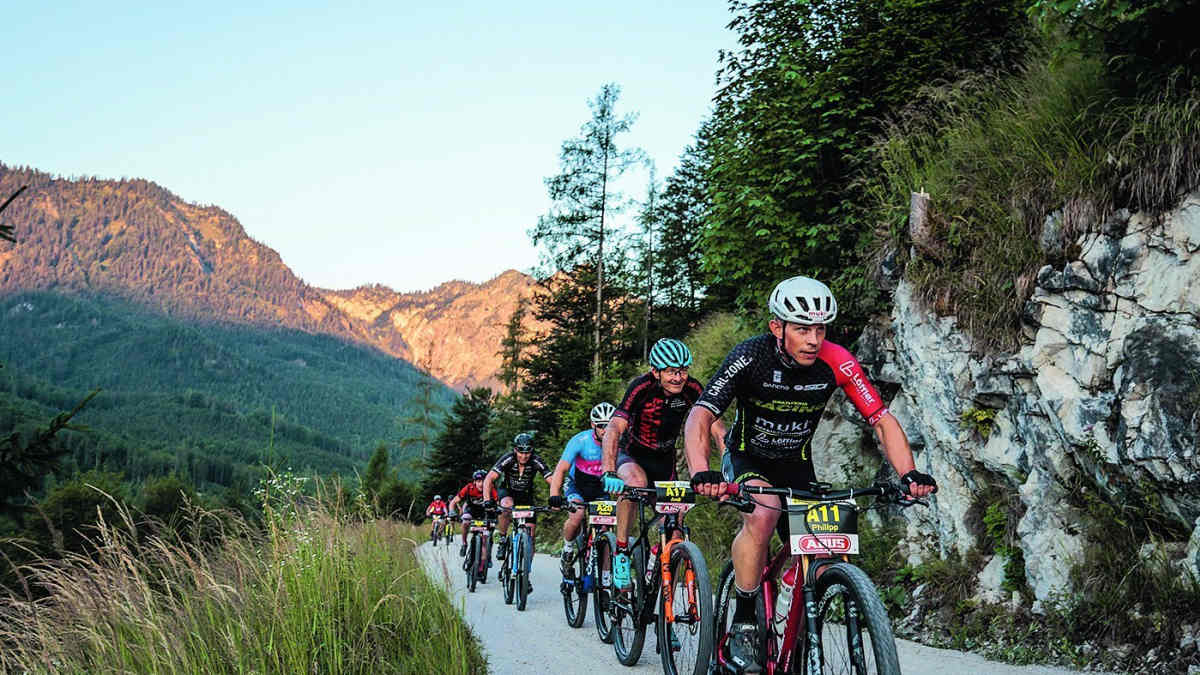
The first few kilometres of a marathon are seductive: adrenaline, fresh legs and a fast field ensure that many riders start well above their limit. This is exactly what pays off later. The most important rule is therefore: start in a controlled manner. Orientate yourself to your planned performance range and not to the pace of the others. If you overdo it at the start, you will almost always pay the price in the last third - often in the form of a massive drop in performance. A steady pace is almost always faster than a race with large fluctuations. Especially on long climbs, it is worth staying consistently in your own zone - even if others are passing you. It makes sense to divide the race into sections:

- Start phase: Drive deliberately defensively
- Centre section: Find a rhythm and remain constant
- Final: Use reserves if there is still something left in the tank
Psyche: The head is always travelling
A marathon is rarely decided by physical strength alone. Sooner or later there comes a point when the head has to take over. Phases of doubt or exhaustion are typical: "Why am I actually doing this?" or "I can't do it anymore." This is where the wheat is separated from the chaff. Also important: accept setbacks. One bad section does not mean that the whole race is lost. After a low, there is often a high again. Simple mental strategies are helpful:
- Think in stages: Instead of focusing on the entire distance, concentrate on the next climb or refreshment point.
- Positive self-talk: Sounds banal, but it works. Those who build themselves up internally remain more efficient.
- Develop routines: Steady pedalling, controlled breathing - this provides stability when the going gets tough.
Supply: Eat before you get hungry
The best fitness is useless if the body is not adequately fuelled. One of the biggest mistakes in a marathon is eating and drinking too late. A mix of quickly available carbohydrates (gels, drinks) and some solid food (bars) has proven to be effective. It is important to test what you can tolerate during training. Drinking is also often underestimated. Even a moderate loss of fluids can significantly reduce performance. Especially in the heat, it is better to plan a little more and drink small amounts regularly. Electrolytes also help to prevent cramps and stabilise performance. The rule of thumb is: drink early and regularly. You should start to replenish your energy levels as early as the first hour of the race. After that, keep topping up - ideally every 20 to 30 minutes.
The interaction decides
A mountain bike marathon requires more than just fitness. If you choose your pace wisely, remain mentally stable and have your supplies under control, you significantly increase your chances of finishing the race successfully - and even having fun in the process. After all, that's what it's all about in the end: optimising your performance and mastering the challenge. Pace, psyche and supply do not work in isolation - they influence each other. If you start too quickly, you use up more energy and come under mental pressure more quickly. If you are poorly fuelled, you not only lose physically, but also mentally. The best marathon runners are therefore not only characterised by strong legs, but also by a good feeling for their body and the situation.
Conclusion
Marathon bikers need mental stability and resilience for the really long things. I like cycling long distances. For motivation, it helps me to look forward to a full day on the bike. Good provisioning is not an optional extra, but a must. Speed kills: Many riders burn out in the first hour after the start. It's better to ride steadily and with brains. - Jan Timmermann, BIKE editor

Jan Timmermann
Editor